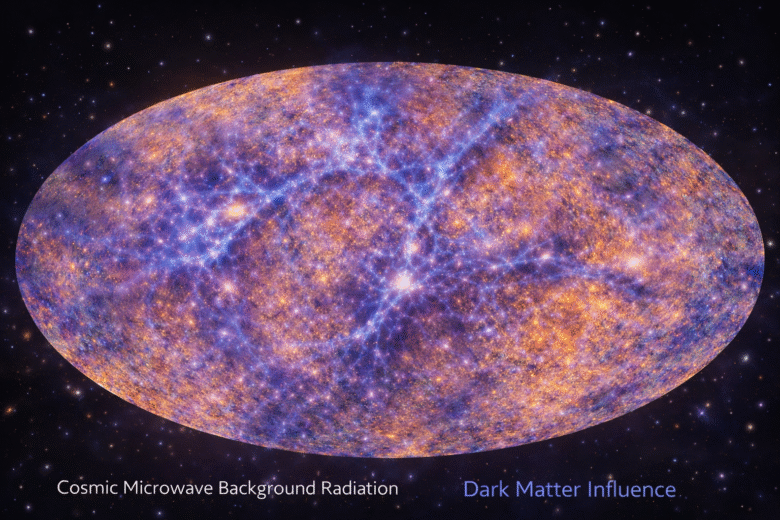
Fun fact: More than 80 percent of the matter in the universe is invisible and has never been observed by our eyes or by telescopes as we know them.
That’s the bewildering heart of The Mystery of Dark Matter That Still Defies Science. When astronomers talk about the “cosmic dark side,” they aren’t being dramatic—they are being literal. The vast majority of the universe isn’t made of stars, planets, or galaxies made of atoms like you and I. Instead, it is made of something ghostly and unseen that we call dark matter. And even after decades of study, its true nature still eludes us.
Think about that for a moment: everything you know about the universe, from the glowing core of the Sun to distant galaxies dancing at the edge of space—those things are only the tip of the cosmic iceberg. The rest is dark, hidden, and stubbornly unknown.
When ‘Nothing’ Shapes Everything
If this feels like a philosophical riddle as much as a scientific puzzle, you’re not alone. Dark matter doesn’t emit light or heat, doesn’t reflect it, and doesn’t interact with ordinary matter in any detectable way except through gravity. That’s why astronomers call it “dark”—not because it’s spooky, but because it simply refuses to be seen.
Astronomer Vera Rubin first shocked the scientific world in the 1970s by showing that stars at the edges of galaxies orbit far too quickly given only the visible matter present. Something invisible had to be exerting extra gravitational pull. Her work provided the first robust evidence that more than just the familiar atoms exist in space.
Today, dark matter is thought to make up about 85 percent of all the matter in the universe. Ordinary matter—the stuff of atoms—is just a tiny minority, a cosmic afterthought.
The Invisible Web Holding Galaxies Together
It might sound counterintuitive, but in many ways, the universe is “held together” by what we cannot see. Dark matter acts like a kind of invisible scaffolding. Galaxies, clusters, and even the vast cosmic web—an enormous network of filaments and voids stretching across billions of light-years—are shaped by its gravitational influence. Without dark matter’s pull, galaxies would simply fly apart.
Astronomers have mapped dark matter in part by watching how it warps space itself. When light from distant galaxies passes through regions rich in dark matter, it bends—a phenomenon known as gravitational lensing. These distortions are one of the few ways we can indirectly “see” dark matter’s presence.
One of the most famous examples is the so-called “Bullet Cluster,” where colliding galaxy clusters have separated normal matter (visible in X-rays) from the bulk of the matter inferred by gravitational lensing—providing some of the best direct evidence for dark matter.
The Universe You Can’t Touch
If you imagine the universe as an iceberg, what we see—the stars, planets, gases, and dust—is just the shimmering tip. Below the surface lies a vast, unseen mass we have yet to touch, measure, or understand in a direct way. Even our most powerful particle colliders, like CERN’s Large Hadron Collider, have so far failed to produce definitive evidence of dark matter particles.
Leading theories suggest dark matter might be composed of novel particle types—like weakly interacting massive particles (WIMPs) or axions—but these are speculative and unconfirmed.
Some scientists even wonder if we need to rethink our understanding of gravity itself. Could the laws as we know them break down at cosmic scales? While such ideas are still on the fringe, the fact that they are seriously discussed shows just how little we truly know.

Why This Mystery Matters
You might be wondering why all this matters. After all, if dark matter doesn’t interact with light or touch, why care? Because it is the invisible force shaping the universe’s evolution. If we fail to understand dark matter, our models of how galaxies formed, why they cluster the way they do, and even how the universe will evolve over trillions of years are all fundamentally incomplete.
In other words, dark matter is not just an esoteric puzzle for physicists in labs. It is central to every cosmic story we tell—from the Big Bang that birthed time and space to the distant future when stars fade away.
Searching For Clues in the Darkness
The search for dark matter has spurred technological and scientific leaps. Scientists have built ultra-sensitive detectors deep underground, hoping to catch a whisper of dark matter interacting with normal matter. Others sift through sky surveys, hunting for subtle gravitational signatures. Even space missions like the European Space Agency’s Euclid telescope are designed to map billions of galaxies in fine detail, helping trace the dark matter backbone of the cosmos.
Some recent studies have suggested intriguing hints—like possible interactions between dark matter and “ghost particles” called neutrinos—but these remain tentative and controversial. If confirmed, such signals might finally crack open our understanding of what this invisible stuff really is.
But the challenge remains: we gravitate toward understanding the universe, yet most of its substance resides in something that betrays neither light nor heat nor sound.
The Humbling Scale of the Unknown
If you look up at the night sky and feel small, remember this: you’re not just tiny in space—you’re tiny in substance. Everything that you can see, touch, and measure makes up less than one-fifth of all matter in the universe. The rest is dark, silent, and still shrouded in mystery.
And while some might find that uncomfortable, it’s also one of the most thrilling frontiers of science. It’s an invitation to imagine, to question, and to wonder just how much more there is to learn.
Conclusion: The Darkness Still Calls
The Mystery of Dark Matter That Still Defies Science isn’t just a headline—it’s a profound reminder of how little we grasp about the foundations of reality. The universe is not the bright, starry vista we romanticise in art and poetry. It is also the deep, invisible architecture that underlies every cosmic structure.
If there’s one takeaway here, it’s this: the universe still humbles us. And perhaps that’s a good thing. Because as long as there are mysteries like dark matter, we are never truly alone in our search for answers.
Author’s Note
I often find myself staring at images of the night sky, feeling as if the stars are whispering secrets just beyond my reach. The more I learn about dark matter, the more I am struck not by what we know—but by how much remains unknowable. Writing this felt like standing on the edge of a cosmic cliff, peering into vast unknowns and reminding myself why curiosity matters. Not to fill every gap with answers, but to keep the questions alive.
G.C., Ecosociosphere contributor.