
Fun fact: A single particle of light can store more information than dozens of classical computers—if you let it exist in more than two states.
Light in 37 Dimensions: When Physics Breaks Our Intuition sounds like the opening line of speculative fiction, but it is very much a real scientific result. Recently, physicists demonstrated that light can be prepared in a quantum state that behaves as if it exists in thirty-seven dimensions at once. Not spatial dimensions you can walk through, but informational ones—layers of possibility that quietly stretch the limits of how we think reality works.
This is not about hidden universes or science-fiction portals. It is about how the universe encodes information, and how badly our everyday intuition fails once we leave the comfortable world of switches, wires, and simple yes-or-no answers. The experiment does not change the laws of physics—but it does expose how narrow our understanding still is.
What Does “37 Dimensions” Actually Mean?
Let’s clear the confusion first. When scientists say light exists in thirty-seven dimensions, they are not claiming the universe suddenly grew extra directions. These dimensions are not physical space. They are dimensions of quantum information—ways a system can exist, overlap, and be measured.
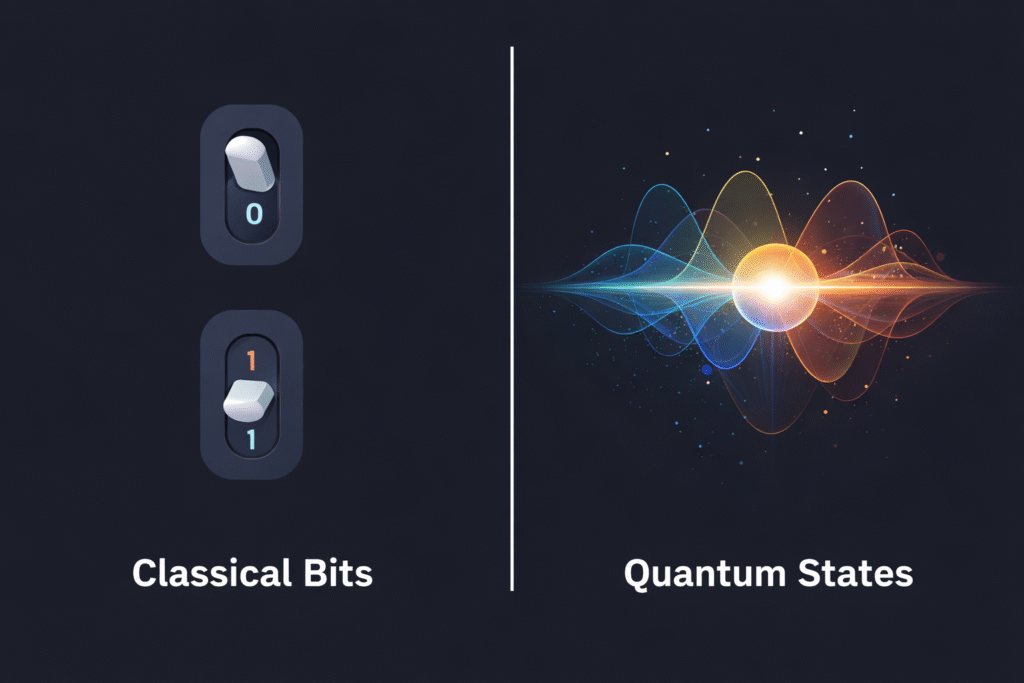
Most people are familiar with the idea of a bit: it is either zero or one. In quantum mechanics, the equivalent unit is called a quantum bit (qubit), which can exist as zero, one, or a mixture of both at the same time. But physicists are no longer satisfied with just two states. They now work with quantum systems that can occupy many states simultaneously. These are sometimes called quantum digits (quantum digit), and they can hold far more information than ordinary quantum bits.
Thirty-seven dimensions simply means the photon was prepared so it could occupy thirty-seven distinct quantum states at once. That number is not mystical—but it is remarkable.
Why This Is Hard for the Brain to Accept
Human intuition evolved for throwing stones and counting goats, not for understanding probability clouds and overlapping realities. We instinctively want objects to be somewhere, doing one thing at a time. Quantum mechanics refuses to obey that demand.
A photon in a high-dimensional quantum state is not confused. We are. The mathematics describing it is precise and testable. The discomfort comes from our mental habits, not from the physics itself.
This experiment forces us to accept an uncomfortable truth: reality does not need to make sense to human intuition to be real.
How Scientists Pulled This Off
The researchers used carefully arranged optical components to manipulate the properties of light—its phase, its path, and its interference patterns. By controlling these parameters, they created a photon whose possible outcomes span thirty-seven independent states.
To confirm this was not an illusion, they tested the system against classical explanations. The results violated what classical physics allows, meaning the photon’s behaviour could only be explained through quantum mechanics. In short, this was not clever accounting—it was a genuine expansion of quantum dimensionality.
Why This Matters Beyond the Lab
At first glance, this sounds like physics for physicists. But high-dimensional quantum states are not just intellectual curiosities. They have real consequences.
In quantum communication, higher dimensions mean more information can be sent using fewer particles. In quantum security, it becomes harder for eavesdroppers to extract information without being detected. In quantum computing, systems with more dimensions could perform certain tasks more efficiently than traditional quantum computers.
This is not an incremental improvement. It is a change in strategy—using richness instead of repetition.
The Danger of the Headline
Here is where a little scepticism is healthy. Headlines love the phrase “new dimensions” because it sounds revolutionary. But exaggeration does a disservice to the science. These are not hidden realms. They are mathematical freedoms that quantum systems naturally possess.
The real breakthrough is not that scientists found something exotic hiding in the universe. It is what they learned how to use what was already there.
What This Says About Science Itself
There is something quietly humbling about this discovery. Quantum mechanics is nearly a century old, yet we are still finding new ways to explore it. This is not a sign of failure—it is a sign of depth.
Every time we think we have understood reality, it opens another layer. Not because it wants to confuse us, but because understanding is not a destination. It is a process.
Why This Should Matter to the Public
You do not need to care about equations to care about this story. It speaks to something larger: the limits of certainty. In a world obsessed with control, prediction, and simple answers, quantum physics keeps reminding us that complexity is not a flaw. It is a feature.
Light in thirty-seven dimensions tells us that nature is more generous than our categories—and less interested in our comfort than we would like.
Conclusion
Light in 37 Dimensions is not about rewriting reality. It is about expanding our humility. The universe does not operate in neat boxes, and neither should our thinking. As science pushes further into high-dimensional quantum worlds, we will face harder questions—not just about technology, but about how much ambiguity we are willing to tolerate.
Perhaps the real challenge is not building better machines. It is learning to live with a reality that refuses to be simple.
Author’s Note
I was drawn to this story because it resists simplification. Writing about light in thirty-seven dimensions felt like an invitation—to stay curious, to remain unfinished, and to accept that clarity is sometimes earned by sitting with confusion rather than escaping it.
G.C., Ecosociosphere contributor.