Fun fact: If you counted every living cell in your body tonight, a surprising number of them wouldn’t actually be you.
That sentence alone unsettles people. It should.
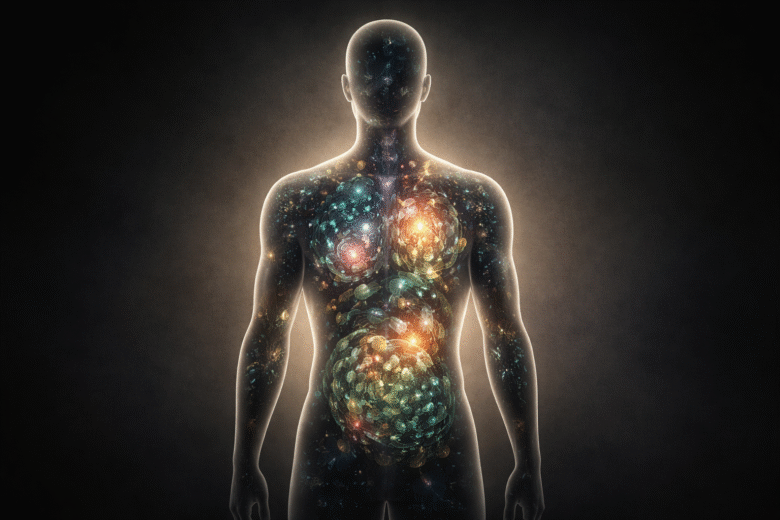
The idea that your body has more microbial cells than human cells has floated around for years, often repeated like a biological shock line. Modern science is a little more careful now—but the core truth remains just as uncomfortable and fascinating. You are not a single organism. You are an ecosystem.
Inside you, on you, and especially in your gut, live billions of microbial cells—bacteria, fungi, and other microscopic life forms that quietly shape how you digest food, fight infections, and even feel emotions. They do their work without asking for permission, without announcing themselves, and mostly without your awareness.
This is not science fiction. This is your everyday biology.
And once you truly absorb that, it becomes hard to see the human body the same way again.
The Counting Problem: Are We Outnumbered or Not?
For a long time, textbooks confidently claimed that microbes outnumber human cells by ten to one. That dramatic figure made for good headlines—and terrible accuracy.
More recent research corrected the math. The updated estimate suggests something closer to a near tie: roughly the same number of microbial cells as human cells in an average adult body. Sometimes, microbes are slightly fewer. Sometimes they are slightly more. It varies by body size, diet, health, and even how recently you used the toilet.
But here’s the uncomfortable part.
Even when the numbers are equal, microbial cells still dominate in influence. They may be smaller, but their collective genetic power dwarfs ours. The human genome carries about twenty thousand genes. The microbes living inside you carry millions.
In genetic terms, you are vastly outnumbered.
Your Gut: The Most Crowded City You’ll Never See
If microbes had passports, most of them would stamp “colon.”
The human gut—especially the large intestine—is one of the most densely populated microbial habitats on Earth. Trillions of bacteria live there, forming what scientists call the gut microbiome: a complex community that functions like an internal organ we forgot to include in anatomy diagrams.
These microbes help break down food you cannot digest on your own. They produce vitamins. They train your immune system to recognize friends from foes. They even help regulate inflammation, which plays a role in everything from arthritis to heart disease.
When this microbial community is healthy, you rarely notice it. When it is disturbed—by antibiotics, stress, poor diet, or illness—you feel it immediately. Bloating, fatigue, infections, mood changes. The silence breaks.
Your body reminds you who really keeps the peace inside.
Mood, Mind, and the Microbial Whisper
One of the most unsettling discoveries of recent years is how deeply microbes influence the brain.
Gut bacteria communicate with the nervous system through chemical signals, immune pathways, and the vagus nerve—a direct biological hotline between the gut and the brain. This connection is often called the gut-brain axis.
Certain microbes help produce neurotransmitters like serotonin and dopamine, chemicals linked to mood, motivation, and emotional balance. Others influence how your body responds to stress.
This doesn’t mean bacteria control your thoughts. But it does mean your emotional landscape is partly shaped by organisms that don’t share your name, your memories, or your ambitions.
You are not thinking alone.

Immunity: Trained by Strangers
Your immune system does not arrive fully formed. It learns.
From birth, exposure to microbes trains immune cells to distinguish between harmless and dangerous invaders. This early education matters. Too little exposure, and the immune system may overreact, leading to allergies and autoimmune conditions. Too much disruption, and it may fail to protect you.
This is why modern life presents a paradox. We are cleaner than ever, yet immune-related disorders are rising. We kill bacteria aggressively, often without discrimination, and then wonder why balance disappears.
The body does not want sterility. It wants cooperation.
Antibiotics: The Necessary Violence
Antibiotics are among the greatest achievements of modern medicine. They save lives daily. But they are also blunt instruments.
When you take antibiotics, you don’t just kill the harmful bacteria. You damage the helpful ones too. Sometimes the microbial community recovers. Sometimes it doesn’t—especially after repeated use.
This is not an argument against antibiotics. It is an argument for respect. Every pill alters an internal ecosystem that took years to establish.
The microbes remember even when you forget.
Diet: Feeding More Than Just Yourself
Every meal is a negotiation.
What you eat feeds you—and it feeds your microbes. Fibre-rich foods nourish beneficial bacteria. Ultra-processed foods often favour less helpful strains. Artificial sweeteners, once marketed as harmless, have been shown to alter microbial balance in ways we are still trying to understand.
When people say “listen to your gut,” they may be closer to biology than metaphor.
Cravings, digestion, energy levels—these are not just personal quirks. They are signals from a community that depends on your choices for survival.
Identity in an Age of Microbes
We like to imagine ourselves as independent, self-contained individuals. Biology quietly disagrees.
Your body is not a sealed unit. It is a living network of human and microbial cells working in constant negotiation. Health is not domination. It is balance.
Once you see yourself this way, certain ideas shift. Cleanliness becomes contextual, not absolute. Health becomes ecological, not just personal. Medicine becomes less about elimination and more about restoration.
You are not less human because you share your body.
You are more alive because you do.
Conclusion: Learning to Live With the Invisible
The real revelation is not whether microbial cells outnumber human cells. It is that life has never been solitary.
Your body has always been shared. Your health has always been collective. Your survival has always depended on cooperation with organisms you cannot see.
Perhaps the most humbling lesson modern biology offers is this: control is an illusion. Relationship is reality.
If we want healthier bodies—and a healthier planet—we might start by paying attention to the smallest citizens we’ve spent decades trying to erase.
Author’s Note
I wrote this because it changes how you stand in your own skin. It reminds me that knowledge isn’t just about answers—it’s about humility. And sometimes, the smallest lives are the ones that teach us the most about coexistence.
G.C., Ecosociosphere contributor.