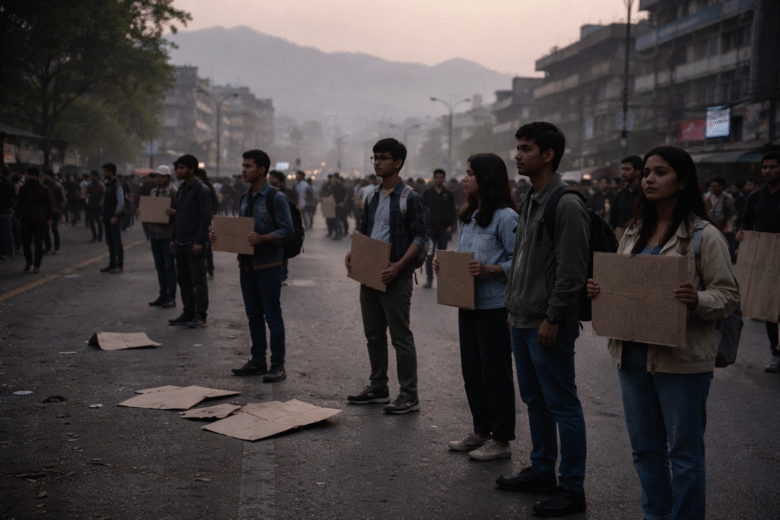
Fun fact: More than half of Asia’s population is under the age of 30, yet across the continent, this largest generation in history is also the most economically squeezed.
Scroll through social media on any given week, and you will see it: angry placards, defiant chants, blurred images of police lines, and hashtags rising and falling with algorithmic speed. Youth Protests and Economic Frustration in Asia: Beyond Viral Hashtags is not just a headline—it is a lived condition. From Kathmandu to Colombo, from Dhaka to Jakarta, young people are no longer merely “disappointed.” They are exhausted, cornered, and increasingly unwilling to stay quiet.
What looks like sudden unrest is, in truth, long-fermented frustration. Viral clips may introduce us to these protests, but they rarely explain why so many young people feel they have nothing left to lose.
The Economics of Disappointment
For decades, Asian governments sold a simple promise to their youth: study hard, stay patient, and stability will follow. That promise is now fraying.
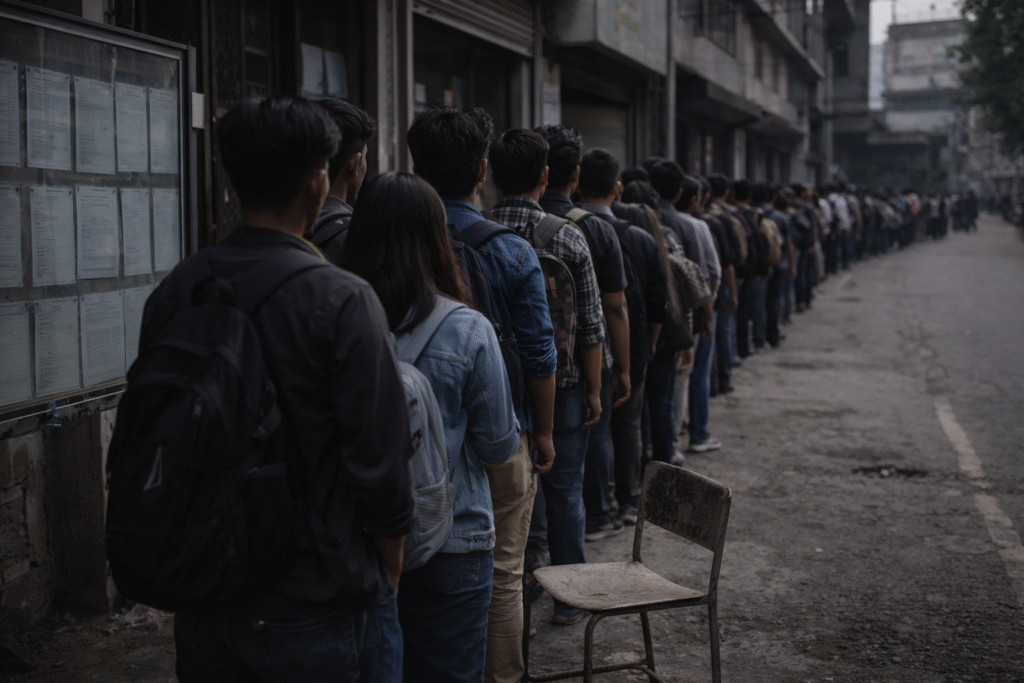
Graduates are walking into job markets that have nowhere to place them. Informal work has replaced secure employment. Housing costs rise faster than wages. Public exams feel rigged, political systems feel closed, and corruption feels permanent rather than episodic.
In Nepal, recent youth-led demonstrations did not erupt over a single policy decision. They grew out of a broader sense that economic mobility had stalled. Young people spoke openly about underemployment, shrinking opportunities, and the quiet humiliation of relying on family well into adulthood. What angered them was not poverty alone, but the sense that effort no longer mattered.
Across South Asia and Southeast Asia, this pattern repeats. Degrees no longer guarantee dignity. Skills do not guarantee security. Even migration—the traditional escape route—has become riskier, costlier, and more exploitative.
Economic frustration, once absorbed privately, is now being expressed collectively.
When Politics Stops Listening
Economic pressure alone does not always lead to protest. What pushes frustration into the streets is political deafness.
Many Asian democracies and semi-democracies allow voting but restrict participation. Young people can cast ballots, but they rarely shape agendas. Policy discussions feel distant, elitist, and insulated from daily struggle.
In several recent protests, youth voices were dismissed as “misguided,” “immature,” or “foreign-influenced.” This dismissal matters. When institutions refuse to acknowledge pain, anger hardens into resistance.
Political restrictions do not always arrive as open repression. Sometimes they appear as endless delays, closed doors, opaque recruitment systems, and silence in response to petitions. Over time, this quiet exclusion becomes combustible.
Young protesters are not demanding perfection. They are demanding recognition—that their futures are not negotiable footnotes.
Beyond the Hashtag Illusion
Social media has changed how protests are seen, but not why they exist.
Hashtags compress complex realities into digestible slogans. They travel fast, but they also flatten meaning. A trending tag may suggest spontaneity, even chaos, when in fact many youth movements are deeply thought through.
In Nepal and elsewhere, young organizers used digital platforms not for spectacle, but for coordination. They shared legal advice, safety information, and economic data. The phone was not the cause of the protest—it was a tool of survival.
Yet there is a danger here. When movements are consumed primarily as online content, their depth is lost. Viewers scroll past pain without sitting with it. Policymakers dismiss unrest as “online noise,” underestimating the seriousness of what is unfolding.
The real story lives offline—in conversations at tea stalls, in overcrowded hostels, in households where education loans outweigh hope.
A Generation with Nothing to Unlearn
One striking feature of today’s youth protests is moral clarity. Many young people do not romanticize the past. They are not nostalgic for older systems. They have grown up watching corruption scandals, broken reforms, and recycled leadership.
This generation has nothing to unlearn—only systems to confront.
They question why economic growth figures look impressive while personal lives remain precarious. They ask why public services deteriorate even as political rhetoric improves. They notice when laws protect power more than people.
This clarity makes them harder to placate. Token gestures, symbolic consultations, and vague assurances no longer work. Young protesters are asking uncomfortable questions—and waiting for real answers.
Why This Moment Matters
History shows that youth unrest is not a temporary disturbance; it is an early warning.
When economic frustration meets political exclusion, societies face a choice. They can reform—or they can repress. Neither path is easy, but only one is sustainable.
Ignoring youth protests does not restore order. It delays reckoning. Every baton charge, every internet shutdown, every dismissive press statement widens the emotional gap between generations and institutions.
Asia stands at a demographic crossroads. Its youth population can be a source of renewal—or of prolonged instability. The difference lies not in controlling dissent, but in listening to it.
Conclusion: Listening Before It’s Too Late
Youth Protests and Economic Frustration in Asia: Beyond Viral Hashtags is ultimately about dignity. Young people are not marching for attention; they are marching because silence has failed them.
These protests are not signs of chaos. They are signs of unmet responsibility.
If governments continue to treat youth anger as a public relations problem, the streets will grow louder. If they treat it as a policy challenge rooted in real economic strain and political exclusion, there is still room for repair.
The question is not whether the youth will keep speaking. They will. The question is whether anyone in power is still willing to listen—before frustration turns into something far harder to contain.
Author’s Note
This piece grew from a simple unease: what happens when patience is endlessly asked for, but the future keeps receding? Youth protests are rarely sudden. They are the sound of hope wearing thin. Writing becomes a way to pause, to look closer, and to ask whether silence is being mistaken for acceptance.
G.C., Ecosociosphere contributor.