Fun fact: Scientists have found that most people form their strongest musical memories between the ages of 12 and 22.
If you play a song from your teenage years, something strange happens. Your brain doesn’t just hear music—it opens a door. Suddenly, you are back in a classroom corridor, a bus ride home, a first crush, or a night when the world felt confusing and limitless at the same time.
That is why the question “Why Music from Your Teen Years Feels So Powerful” is not really about music alone. It is about identity. It is about memory. And perhaps most importantly, it is about the moment in life when we first begin to discover who we are.
Ask anyone in their thirties, forties, or sixties what music they love the most. Many will mention songs from their teenage years. Not because those songs were objectively better, but because those songs were present when life was being written for the first time.
Music becomes powerful in adolescence because it arrives at the exact moment when the brain, the heart, and the world are all changing at once.
The Brain’s “Memory Stamp” Years
Neuroscientists often talk about something called the “reminiscence bump.” It refers to the period in life when memories become unusually vivid and emotionally strong. For most people, this period falls between early adolescence and early adulthood.
During these years, the brain is extremely sensitive to emotional experiences. Hormones are fluctuating, identity is forming, and every experience feels magnified. When music enters this emotional storm, it becomes a marker of time.
A song is never just a song again.
It becomes a timestamp.
One track might remind you of a school farewell. Another might carry the memory of studying late for exams. Another might forever belong to the first time you felt heartbreak.
Your brain links music with emotion using the limbic system, the part of the brain responsible for feelings and memory. Once this link is created, the song acts like a key. Years later, hearing the same tune unlocks the entire emotional moment again.
This is why people often say music “takes them back.”It literally does.
Teenage Music Is Also Identity Music
Teenage years are the first time we actively choose our own music. As children, we mostly listen to what our parents play—old Bollywood songs, devotional music, or whatever happens to be on the radio in the car.
But during adolescence, something shifts. Music becomes personal. You start discovering artists on your own. You argue with friends about which songs are better. You play the same track repeatedly because it somehow captures how you feel.
Music becomes a form of identity. In many ways, the songs you love at sixteen become emotional signatures. They represent who you were becoming. That is why people defend their teenage music so fiercely. It is not just taste being defended. It is the younger version of themselves.
Music Was Once a Shared Experience
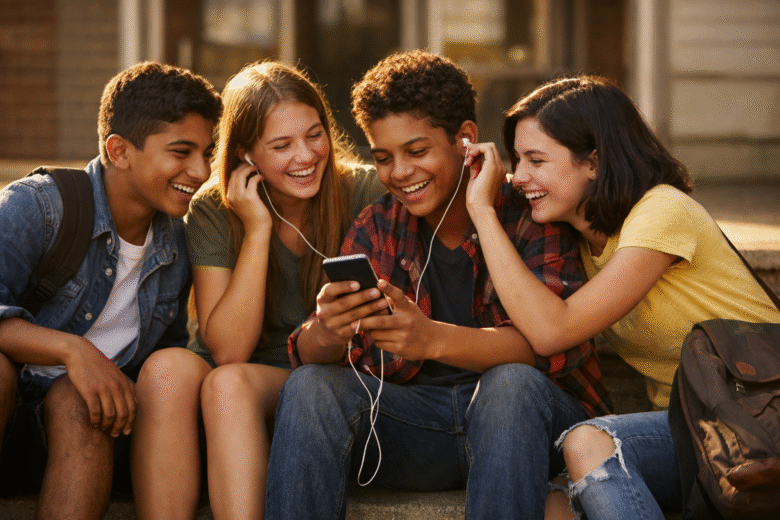
There is another reason teenage music feels powerful. In earlier decades, music was something people experienced together. Friends shared earphones on buses. Students burned songs onto compact discs (CDs). Radio countdowns were events everyone waited for.
Even today, music still travels through friendships, classrooms, and social circles. A song becomes powerful not just because of the melody but because of the people who were there when you heard it.
The track you listened to during a school trip is never just a track again. It becomes the soundtrack of that friendship. In a way, teenage music becomes a social memory archive.

The Emotion of First Times
Teenage years are filled with “first times.”
First independence.
First rebellion.
First love.
First heartbreak.
The brain treats first experiences differently from routine ones. Psychologists say first experiences are encoded with greater emotional weight. Now imagine music playing in the background of those moments.
A love song heard during a first relationship becomes inseparable from that memory. A sad song heard after a breakup becomes a companion to grief. Even years later, hearing the same song can trigger emotions that feel surprisingly fresh.
It is not nostalgia alone. It is an emotional memory reactivating.
The Illusion That Music Used to Be Better
Ask someone why they prefer older songs, and you will often hear the same argument.
“Music used to be better.”
But this statement is usually misleading.
What people really mean is this:
“Music felt better when I was younger.”
The emotional intensity of adolescence makes songs feel larger than life. Lyrics feel personal. Melodies feel profound. Later in adulthood, life becomes routine. Responsibilities multiply. The emotional rollercoaster of adolescence fades.
Music does not necessarily become worse. But our emotional intensity changes. So, the songs that once shaped our teenage years remain unmatched.
The Streaming Era and the Memory Problem
There is an interesting twist in the modern world.
Today’s teenagers have access to more music than any generation before them. Streaming platforms such as Spotify, a digital music streaming service that provides on-demand access to millions of songs, and Apple Music, a music streaming platform operated by Apple Incorporated (a global technology company known for consumer electronics and digital services), allow listeners to jump instantly between songs.
But this abundance may also weaken emotional attachment. When music is endless and disposable, songs sometimes lose the power they once had. Earlier generations listened to the same cassette tape for months. That repetition created deep emotional links.
Today, songs can disappear into the algorithm within days. It raises an interesting question:
Will the teenage music of today still feel as powerful twenty years from now?
Perhaps. But the way young people form musical memories is clearly evolving.

Music as Emotional Time Travel
Despite changes in technology, one thing remains unchanged. Music is still one of the most powerful triggers of memory.
Researchers have observed that even people suffering from memory loss conditions, such as Alzheimer’s disease, a progressive neurological disorder that affects memory and cognitive ability, can sometimes recall songs from their youth when other memories have faded.
Music survives in the brain longer than many other forms of memory. Which means those teenage songs you once played endlessly may outlive countless other experiences.
They are not just songs. They are emotional time capsules.
Conclusion
So why does music from your teenage years feel so powerful? Because those years are when life first feels intense, confusing, hopeful, and dramatic all at once. Music arrives exactly at that moment and attaches itself to the emotions of becoming.
Those songs become markers of identity, memory, friendship, and discovery. They remind us of who we were before adulthood simplified our lives into schedules and responsibilities. And maybe that is why, years later, when an old song starts playing unexpectedly, we pause for a moment.
Not because the song is extraordinary. But because it reminds us of a time when everything felt extraordinary.
Author’s Note
I often notice that when students discuss music, they talk about songs as if they were chapters of their lives. One track means friendship. Another means heartbreak. Another means a moment they cannot fully explain. That observation stayed with me.
Writing about music is not really about entertainment. It is about memory—how the smallest sound can bring back entire years. Perhaps that is why music still matters in a world full of distractions. It reminds us that our lives are not just events. They are stories with soundtracks.
G.C., Ecosociosphere contributor.