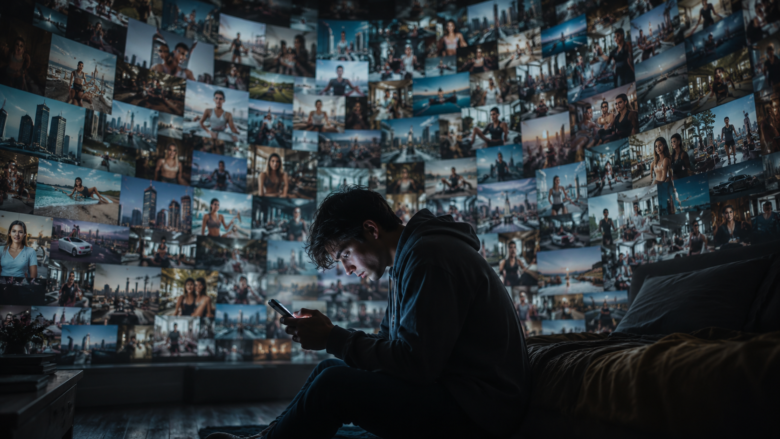
A person can open their phone feeling perfectly fine and put it down twenty minutes later with a vague sense that something is missing.
Perhaps they are not successful enough.
Not attractive enough. Not productive enough. Not interesting enough.
The feeling is often difficult to describe because nothing specific happened. Nobody insulted them. Nobody told them they were failing. In many cases, the content they consumed was intended to be positive, motivational, or inspiring.
Yet something shifted.
It is tempting to blame the internet for creating these insecurities. After all, the feeling seems closely tied to modern technology.
But insecurity itself is not new.
Human beings have always worried about status, appearance, belonging, and acceptance. Long before smartphones existed, people compared themselves to their neighbours, friends, coworkers, and community members. The desire to fit in and the fear of falling behind are older than civilization itself.
What changed was not the existence of insecurity.
What changed was the environment in which it operates.
For most of human history, comparison had natural limits.
A person knew a few dozen people well and perhaps a few hundred people casually. Their understanding of success, beauty, achievement, and status emerged from the world immediately around them.
Today, those limits barely exist.
A teenager in a small town can compare themselves to celebrities in Los Angeles, entrepreneurs in Singapore, athletes in Europe, and influencers they will never meet. All of these lives appear on the same screen, often within the span of a few minutes.

The brain does something strange with this information. It does not always treat these people as separate individuals living separate lives. Instead, it quietly combines them.
The perfect body from one account merges with the perfect career from another. The exciting travel experiences of a third person blend with the relationship of a fourth and the confidence of a fifth.
Eventually, an impossible standard begins to form.
Not because anyone created it intentionally. Because the mind is constantly assembling pieces of what it sees.
The result is a comparison that nobody can actually win.
A person is no longer comparing themselves to another human being. They are comparing themselves to a collection of highlights gathered from thousands of different lives.
Most people recognize this intellectually.
Yet understanding something and feeling it are not always the same thing.
A photograph can still provoke envy even when we know it represents a carefully selected moment.
A success story can still trigger self-doubt even when we understand that countless failures remain invisible.
The emotional part of the brain rarely waits for the rational part to finish its analysis.
Over time, technology became remarkably good at learning which content captures attention.
Not because machines understand insecurity. Because they understand behaviour.
They notice what people pause to look at. What they return to. What they share, save, replay, and engage with.
And human beings tend to pay close attention to things that feel personally relevant.
Especially when those things touch on uncertainty.
Someone wondering whether they are attractive may linger on beauty content. When the future feels uncertain, it is easy to spend hours searching for answers. Someone feeling lonely may spend hours reading about relationships.
The attention is genuine. The concern is genuine. The problem is that these concerns often lead to more content that intensifies the same feelings.
The cycle can be surprisingly subtle.
A person begins by looking for guidance. Then they discover more things they should improve. Then they discover people who appear to have already solved those problems. Then they encounter new standards they had never considered before.
What started as inspiration gradually becomes comparison. And comparison has no natural stopping point.
This may explain why modern self-improvement sometimes feels strangely exhausting.
Improvement was once largely connected to a specific goal. Learning a skill, becoming healthier, gaining knowledge, or developing discipline.
Today, it can feel as though every aspect of life is open for evaluation.
The internet offers endless opportunities to become better, but it also creates endless opportunities to feel unfinished.
There is always another habit to adopt, another mistake to avoid, another area of life that appears to need optimization.
For many people, the destination becomes increasingly difficult to identify.
They spend so much time pursuing a better version of themselves that they rarely stop to appreciate the person they have already become.
None of this means that technology is inherently harmful.
The internet can educate, connect, entertain, and expose people to ideas they might never have encountered otherwise. It has created communities, opportunities, and sources of knowledge that previous generations could scarcely imagine.
The problem is not that insecurity exists online. The problem is that insecurity has become remarkably valuable.
Attention has value. Engagement has value.
In the attention economy, every extra moment of engagement matters. And few things capture human attention more reliably than uncertainty about ourselves.
In a sense, the Internet did not invent insecurity. It discovered it. Then it learned how to measure it, amplify it, and keep it engaged.
That may be one of the defining psychological challenges of modern life.
Not avoiding comparison altogether. Human beings have probably never been capable of that.
The challenge is recognizing when our insecurities are emerging from genuine personal concerns and when they are being quietly shaped by an environment designed to hold our attention.
The difference may seem small, but it matters more than we often realize.
And understanding the difference may be one of the most important forms of digital literacy we can develop.
Author’s Note
The internet is often blamed for creating many of the anxieties people experience today. Yet insecurity is not a modern invention. What has changed is the scale at which comparison now operates and the systems that increasingly benefit from it. Understanding this shift may help us approach our online lives with a little more awareness and a little less self-judgment.
G.C., Ecosociosphere contributor.
References & Further Reading
- American Psychological Association (APA) – Research on social comparison, self-esteem, and digital behavior.
- Pew Research Center – Studies on social media usage and its social impacts.
- Center for Humane Technology
- The Social Dilemma Resources
- World Health Organization (WHO) Mental Health Resources – Information on psychological well-being in modern society.