

There is probably a photograph of you as a baby somewhere in your family’s collection. Perhaps you are sitting on someone’s lap, staring at the camera with an expression nobody can explain anymore. Your parents might remember when it was taken, what you were doing that day, or how difficult it was to make you …
How does the brain turn signals into the world we experience? Explore EcoSocioSphere’s neuroscience articles on perception, memory, sleep, emotion and the senses. From the unfamiliar sound of a recorded voice to the ways our surroundings influence attention, these stories explain the nervous system through everyday experiences and the research behind them.
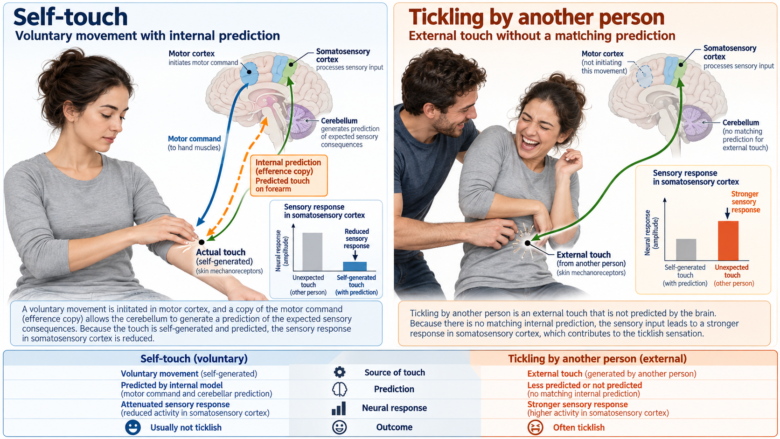
Try running your fingers lightly along the side of your neck or across the sole of your foot. You will certainly feel the touch, and it might even be a little uncomfortable, but it is unlikely to make you burst into laughter. Now picture someone else lightly touching that very same spot. Suddenly, you might …

You pick up a towel from the clothesline and press it against your cheek. It looks dry, but something about it tells you otherwise. The fabric feels slightly cool against your skin, and when you squeeze it between your fingers, you can tell it hasn’t dried completely. You might even ask someone else to check …

There is something slightly unsettling about the way you are reading these words. You probably feel as though your eyes are looking directly at a screen, your brain is observing the letters, and somewhere inside your head the meaning is being understood. But your brain has never seen this screen. It has never seen a …

There is something strangely difficult about looking away from the sea. A person may arrive at a beach intending to stay for only a few minutes, yet soon find themselves standing at the edge of the water, watching one wave rise, fold and disappear after another. Nothing particularly surprising is happening. The waves do not …

There is a reason we look at someone’s eyes when we are trying to understand what they really feel. A smile can be polite. A voice can be controlled. Words can be carefully selected, rehearsed, or even deliberately misleading. But the eyes seem to operate slightly closer to whatever is happening underneath. Fear can widen …

Walk beside another person for long enough and something curious often begins to happen. You may start with slightly different strides, one person walking faster and the other taking shorter steps, yet after a while those differences seem to soften. Your footsteps begin arriving at roughly the same rhythm. Sometimes the same legs move forward …
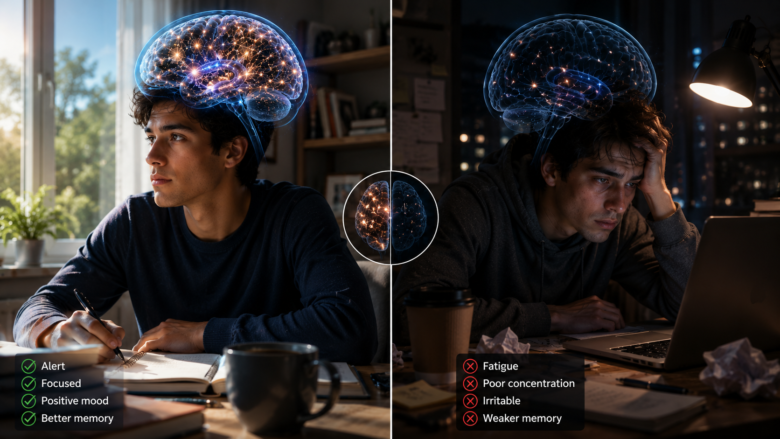
There is something strangely passive about sleep. For roughly a third of our lives, we lie still, largely unaware of the world around us, unable to work, eat, travel, protect ourselves, or do any of the things that seem useful for survival. From an evolutionary perspective, this should make sleep expensive. An unconscious animal is …

Every night, we enter a world that does not exist. People we have not seen for years suddenly appear. Familiar places acquire rooms they never had. We run from dangers that vanish the moment we wake, hold conversations that never happened, and accept impossible events without questioning them. For several hours, the brain that spends …

Why Humans Blush: The Strange Biology of Being Seen Blushing is one of the few things the human body does that seems almost designed to betray us. A compliment catches us off guard, someone mentions an embarrassing mistake, or attention suddenly turns in our direction, and before we can decide how to respond, our face …