
For most of the twentieth century, the space race was about pride.
The United States and the Soviet Union competed to reach the Moon, orbit the Earth, and prove technological superiority. Rockets carried astronauts, flags, and dreams of exploration. But the twenty-first century version of the space race looks very different.
This time, the prize is not prestige. It is resources.
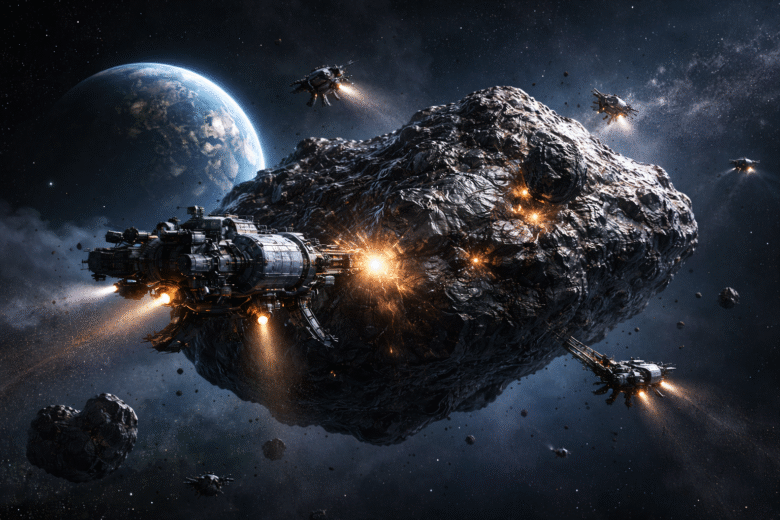
Behind the romantic language of exploration lies a rapidly emerging reality: space may soon become the next frontier for mining. And the numbers involved are almost absurd.
Asteroids Worth Trillions
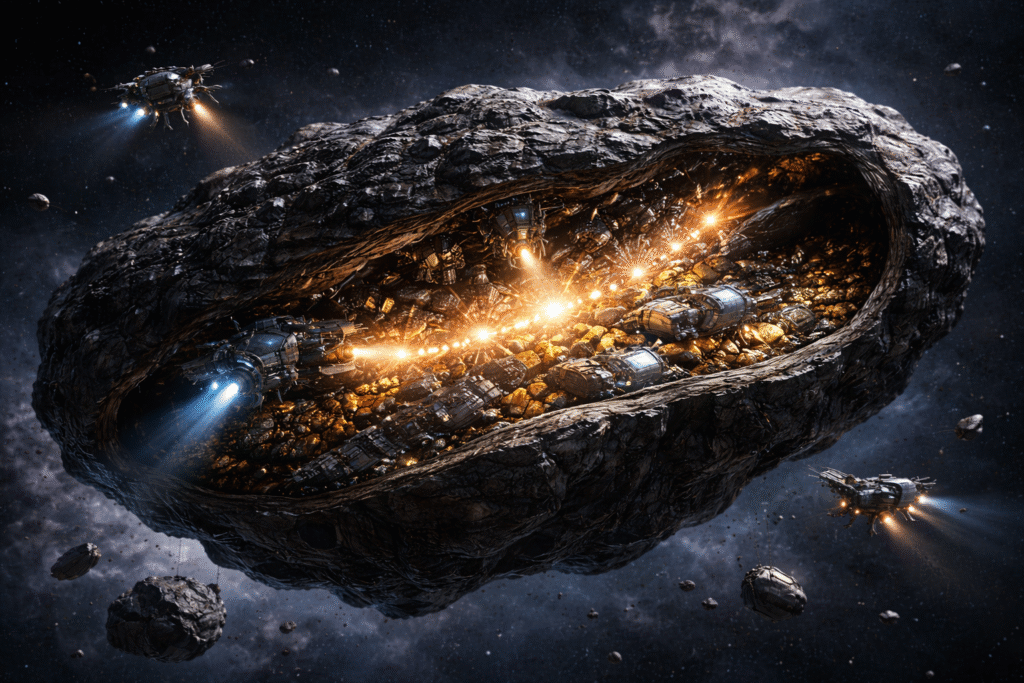
Asteroids are not just drifting rocks. Many are rich in valuable metals — platinum, nickel, cobalt, and even rare elements that power modern technologies. Some estimates indicate that a single metal-rich asteroid may hold more platinum than humanity has mined on Earth in its entire history.
One famous example often cited by scientists is asteroid 16 Psyche, which may contain enormous quantities of iron and nickel. While exact values are speculative, researchers believe the materials inside such asteroids could theoretically be worth trillions of dollars.
Of course, extracting them is another challenge entirely. But the possibility is enough to attract serious attention.
The Players Entering the Race
Governments are no longer the only actors interested in space. Private companies and startups are now exploring ways to harvest resources beyond Earth.
Companies like Planetary Resources and Deep Space Industries once promoted ambitious plans for asteroid mining. Although both companies were eventually acquired or dissolved, their ideas helped launch a serious conversation about space resources.
Today, space agencies and private firms alike are studying how mining operations might one day work. The United States, China, and several European space agencies have all funded research into asteroid exploration and resource extraction technologies.
Even if large-scale mining is still decades away, the groundwork is already being laid.
Why Space Mining Matters
At first glance, mining asteroids might sound like a futuristic luxury. But it could solve several real problems. Many modern technologies rely on rare metals that are difficult or environmentally destructive to extract on Earth. Mining operations on our planet often leave enormous ecological scars.
Asteroids, by contrast, exist in environments where mining would not destroy forests, rivers, or ecosystems. Some scientists also believe space resources could support long-term space missions. Water extracted from asteroids could be converted into rocket fuel — hydrogen and oxygen — allowing spacecraft to refuel in space rather than carrying everything from Earth.
In that sense, asteroid mining could make deep-space exploration more practical. Ironically, mining might be the key to exploration.
The Legal Wild West of Space
But there is a fundamental question that no one has fully answered. Who owns an asteroid?
International space law was written long before asteroid mining became realistic. The Outer Space Treaty of 1967 states that no country can claim ownership of celestial bodies like the Moon or asteroids.
However, the treaty is less clear about whether companies can extract resources from them. Some countries have already passed laws allowing private companies to own materials mined in space. The United States, Luxembourg, and the United Arab Emirates have created legal frameworks to encourage space resource development.
Critics argue that this could create a cosmic gold rush, where powerful nations and corporations claim valuable resources before international rules are established. In other words, the legal system is racing to catch up with the technology.
A New Kind of Frontier
Historically, frontiers have always attracted competition. Gold rushes, oil booms, and land claims shaped the modern world. Each new resource discovery brought both opportunity and conflict.
Space may follow a similar pattern. Except this time, the frontier is millions of kilometres away. The challenge is not just technological — it is political, economic, and ethical. Do we treat space as a shared environment for humanity, or as the next territory to divide?
The Quiet Shift in Human Motivation
Perhaps the most striking aspect of this new space race is what it reveals about us. Early space exploration was driven by curiosity and ambition. Humans wanted to see what was out there.
Today, curiosity is still part of the story. But economics is increasingly in the driver’s seat. The same species that once raced to plant a flag on the Moon may soon race to extract metals from an asteroid. Exploration has not disappeared. It has simply acquired a price tag.
Conclusion: The Future of Space May Be Industrial
The image of space exploration is often romantic — astronauts floating in silence, distant planets glowing against black skies.
But the future of space may look more industrial than inspirational. Robotic miners could one day operate on asteroids. Spacecraft might transport metals back to Earth or process them in orbit.
Factories, not just explorers, could populate the solar system. Whether that future becomes reality remains uncertain. But one thing is clear. The next giant leap for mankind may not be about discovering new worlds.
It may be about extracting resources from them.
Author’s Note
Space has always inspired wonder. It also exposes something fundamental about human nature. Wherever we go — oceans, continents, or now the solar system — curiosity eventually meets economics. Writing this made me realize that the future of exploration may be shaped as much by markets as by dreams.
G.C., Ecosociosphere contributor.