If you step outside on a clear night and look up, the sky still feels ancient. Stars shimmer quietly. Constellations drift slowly across the darkness. The universe appears calm, almost untouched.
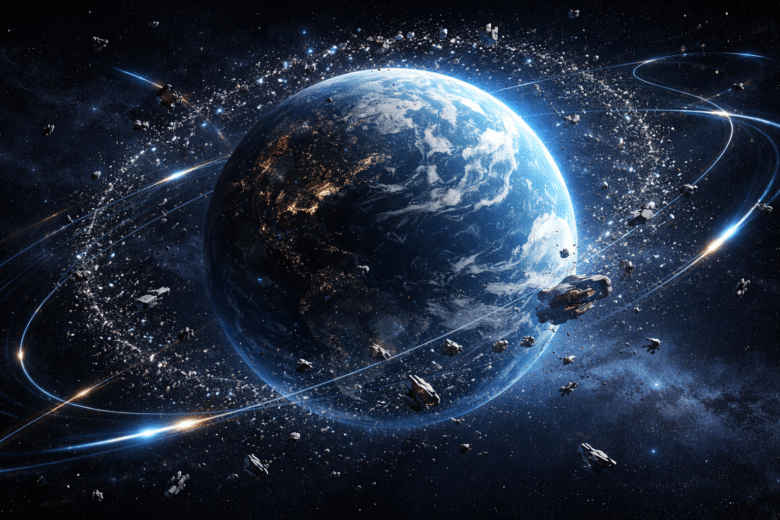
But appearances can be misleading. Above our heads, orbiting the Earth at thousands of kilometres per hour, is an invisible cloud of technology — satellites, broken spacecraft, fragments of metal, and pieces of debris too small to see but large enough to cause destruction.
Space, once vast and empty, is slowly becoming crowded. And most people have no idea.
The Invisible Traffic Jam Above Earth
Since the launch of Sputnik in 1957, humanity has placed thousands of satellites into orbit. These satellites power the modern world. They enable GPS navigation, weather forecasting, television broadcasts, financial transactions, and global internet connections.
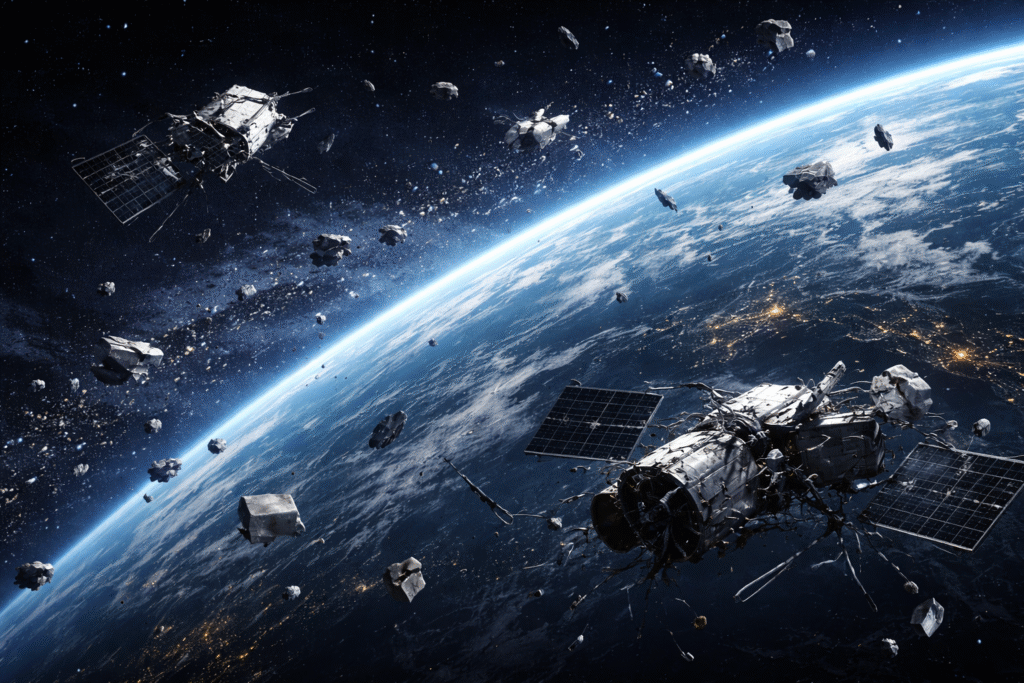
In many ways, they are the hidden infrastructure of modern civilization. But satellites don’t last forever. Over time, they break, collide, or simply stop functioning. When that happens, they become space debris — objects still traveling around Earth at speeds of nearly 28,000 kilometres per hour.
Even a small fragment can be dangerous. At those speeds, a piece of metal the size of a coin can damage or destroy an operational spacecraft.
A Growing Problem
Today, space agencies estimate that Earth’s orbit contains:
- More than 10,000 active satellites
• Over 30,000 pieces of debris larger than 10 centimetres
• Hundreds of thousands of smaller fragments
Most of this debris circles the planet in low Earth orbit, the same region where many satellites operate. The situation is getting worse.
Private companies are launching massive satellite constellations to provide global internet coverage. SpaceX’s Starlink network alone plans to deploy tens of thousands of satellites. Each launch brings new benefits — but also new risks.
The Domino Effect in Space
Scientists worry about a phenomenon called the Kessler Syndrome. First proposed in 1978 by NASA scientist Donald Kessler, the theory suggests that collisions between satellites could create cascading debris.
One crash produces fragments. Those fragments hit other satellites, creating more debris. Eventually, the chain reaction could make certain orbital regions unusable. Imagine a traffic accident that triggers a permanent highway blockage — except the highway circles the entire planet.
While we are not there yet, experts warn that the risk is increasing.
Why It Matters on Earth
Space debris might seem like a distant technical issue. But modern life depends heavily on satellites. Navigation systems guide aircraft and ships. Weather satellites track storms. Communication satellites connect continents.
If key satellites were damaged or destroyed, the consequences could ripple across the global economy. Even financial markets rely on satellite-based timing systems. In other words, the infrastructure of modern civilization extends far beyond Earth’s surface. And that infrastructure is vulnerable.
Can We Clean Up Orbit?
Recognizing the growing danger, scientists and engineers are exploring ways to remove space debris.
Some proposed solutions include:
- Robotic spacecraft designed to capture and remove dead satellites
• Nets or harpoons that could collect large pieces of debris
• Drag devices that slow satellites so they burn up safely in Earth’s atmosphere
These technologies are promising — but they are still in early stages. Cleaning up orbit is extremely difficult because debris moves at incredible speeds and is spread across vast distances. Preventing new debris may be easier than removing existing junk.
A Shared Responsibility
Space is unique. Unlike land or oceans, it does not belong to any single nation. It is governed by international treaties that treat it as a shared environment for humanity.
But shared spaces often face the same problem: everyone benefits from them, yet no one fully controls them. Without cooperation, orbital space could gradually become polluted — not with plastic or chemicals, but with fragments of technology.
The irony is striking. We left Earth’s atmosphere to explore the cosmos. And we may end up bringing our pollution with us.
Conclusion: The Fragile Frontier
Space still feels infinite when we look up at the stars. But the region immediately surrounding Earth is surprisingly fragile. A few hundred kilometres above the surface lies a thin shell of orbital space where most satellites operate.
That narrow zone is becoming increasingly crowded. Humanity has entered an era where our technology extends far beyond the planet — and so do our environmental responsibilities. The question is no longer whether we can launch satellites.
The real question is whether we can manage the space around Earth responsibly. Because if orbit becomes too dangerous, the sky above us may not just be crowded. It may become unusable.
Author’s Note
Space often symbolizes humanity’s greatest ambitions. But it also reveals our habits. Wherever we expand — forests, oceans, or orbit — we tend to leave traces behind. Writing this made me realize that sustainability may soon apply not only to Earth, but to the space around it.
G.C., Ecosociosphere contributor.