
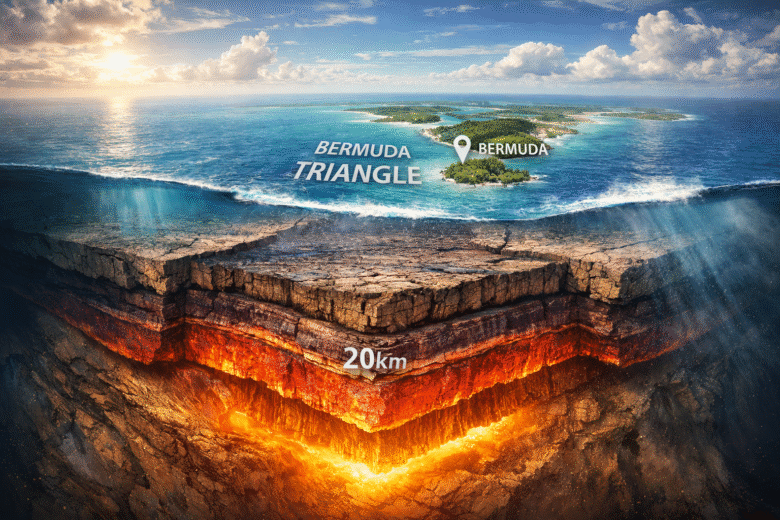
Fun fact: The Bermuda Triangle is not just a patch of mysterious sea—it sits above rock layers so strange that even Earth scientists are rethinking how islands stay afloat.
For decades, the Bermuda Triangle has lived in popular imagination as a place where ships vanish, compasses misbehave, and logic seems to sink. But now, science has uncovered something far more unsettling—and far more interesting—than any legend. Beneath the ocean floor near Bermuda lies a massive, 20-kilometre-thick rock layer, hidden quietly between Earth’s crust and its deeper interior. This blog explores Beneath the Bermuda Triangle—and why this discovery matters far beyond myths.
This is not a story about ghosts or portals. It is a story about how Earth remembers its past—and how we often forget to listen.
A Strange Layer Where None Should Exist
To understand why scientists are surprised, we need to understand what they expected to find.
Normally, the structure beneath the ocean follows a simple pattern: a thin crust on top, then the mantle below. Islands formed by ancient volcanoes usually cool down, grow heavier, and slowly sink back into the ocean over millions of years. That is geology’s quiet rule.
Bermuda breaks that rule.
Despite being volcanically inactive for tens of millions of years, Bermuda still sits unusually high above the surrounding seafloor. Until recently, no one could explain why. Seismic waves—generated by earthquakes on the other side of the planet—have now revealed the answer: an extra layer of solid rock, thick enough to rival mountain ranges, wedged beneath the crust.
This layer is lighter than the rocks around it. It acts like a hidden support beam, holding Bermuda up from below. Earth, it seems, reinforced this island long ago—and never removed the scaffolding.
Earth’s Long Memory
What makes this discovery remarkable is not just its size, but its age.
The rock layer likely formed over 30 million years ago, during a period when molten material was forced upward but never quite reached the surface. Instead of erupting, it cooled underground, spreading sideways and hardening into a thick platform. Geologists call this process underplating, but the term hardly captures its consequence.
This buried layer is a fossil of Earth’s internal activity—a snapshot of a moment when the planet rearranged itself.
And it raises an uncomfortable question: How many other places are we misreading simply because we cannot see beneath them?
Why This Changes How We Understand Islands
The textbook explanation for ocean islands is neat and comforting. Volcano forms. Volcano cools. Island sinks.
But Bermuda refuses to follow the script.
If one island can stay buoyant for millions of years without active volcanism, then Earth’s interior may be doing far more quiet work than we assumed. Islands may not simply fade away after their dramatic birth. Some may be quietly supported from below, preserved by geological decisions made in deep time.
This matters because our models of Earth shape how we predict everything from seismic risk to ocean floor stability. When reality diverges from theory, theory must bend.

The Bermuda Triangle: Mystery Reframed
It is tempting to pull this discovery back into old myths. The phrase Bermuda Triangle almost demands drama. But this is where science becomes most powerful—when it refuses easy wonder and replaces it with deeper awe.
There is no evidence that this rock layer causes ships to disappear or planes to fall from the sky. Navigation errors, weather patterns, and human mistakes explain those stories well enough.
What this discovery does instead is more profound: it reminds us that Earth does not need myths to be mysterious.
A hidden rock layer, thicker than the height of Mount Everest stacked twice, quietly shaping the ocean floor for millions of years—this is not supernatural. It is simply nature operating on a timescale we struggle to grasp.
Listening to the Planet
Perhaps the most fascinating part of this story is how scientists discovered the layer. They did not drill. They did not dig. They listened.
Seismic waves from distant earthquakes passed through the Earth and changed speed as they moved through different materials. By tracking these changes, researchers built a picture of what lies far below, layer by layer.
It is humbling. The planet speaks constantly—through vibrations, heat, pressure—and only recently have we learned how to interpret its language.
In an age obsessed with speed and surface, this discovery came from patience and depth.
Why This Story Matters Now
At first glance, a rock layer beneath the Atlantic might feel irrelevant to everyday life in India or anywhere else. But it is not.
We live in a time when we are rapidly reshaping Earth’s surface—mining, drilling, dredging, damming—often without fully understanding what lies beneath. Discoveries like this remind us that the ground below our feet has a history, and that history influences stability, resilience, and risk.
When we ignore deep systems—ecological or geological—we are often surprised by their consequences later.
Earth is not fragile, but our assumptions about it often are.
Conclusion: Mystery Isn’t Gone—It’s Just Deeper
The Bermuda Triangle has not lost its mystery. It has simply traded spectacle for substance.
A hidden rock layer, formed millions of years ago, still holding an island aloft, still shaping the ocean floor—this is not a mystery meant to scare us. It is a mystery meant to slow us down.
Science did not solve a riddle here. It uncovered a reminder: the planet is older, quieter, and more complex than our stories allow.
If we want to understand Earth’s future—its climate, its hazards, its limits—we must learn to look beneath the surface. Not just of oceans, but of our assumptions.
Author’s Note
I keep returning to stories like this because they resist urgency. No crisis. No villain. Just deep time doing its work. Writing an article like this, I am reminded that the most important truths are often buried—not hidden out of malice, but because they require patience. This story mattered to me because it whispered instead of shouting. And sometimes, that is exactly how learning begins.
G.C., Ecosociosphere contributor.