

Fun fact: There are magnetic materials on Earth where tiny defects behave as if single magnetic poles—something physics textbooks say should not exist—are freely roaming inside a solid.
That strange idea lies at the heart of “Spin Ice: When Magnets Refuse to Behave.” It sounds like a contradiction, almost a prank played by nature. Magnets, after all, are supposed to be simple. North and south. Order and alignment. Stick or repel. And yet, deep inside certain crystals cooled to extreme temperatures, magnetism quietly rebels against these expectations.
Spin ice is not frozen water. It is not cold iron. It is a reminder that nature does not owe us simplicity. Sometimes, it prefers elegance wrapped in confusion.
The familiar rules magnets were supposed to follow
Most of us encounter magnetism in its polite form. A fridge magnet snaps into place. A compass needle points north. Physics classes teach us that magnetic moments—tiny bar magnets inside atoms—line up neatly in materials like iron, creating order.
That idea works beautifully for many materials. But it collapses when geometry gets in the way.
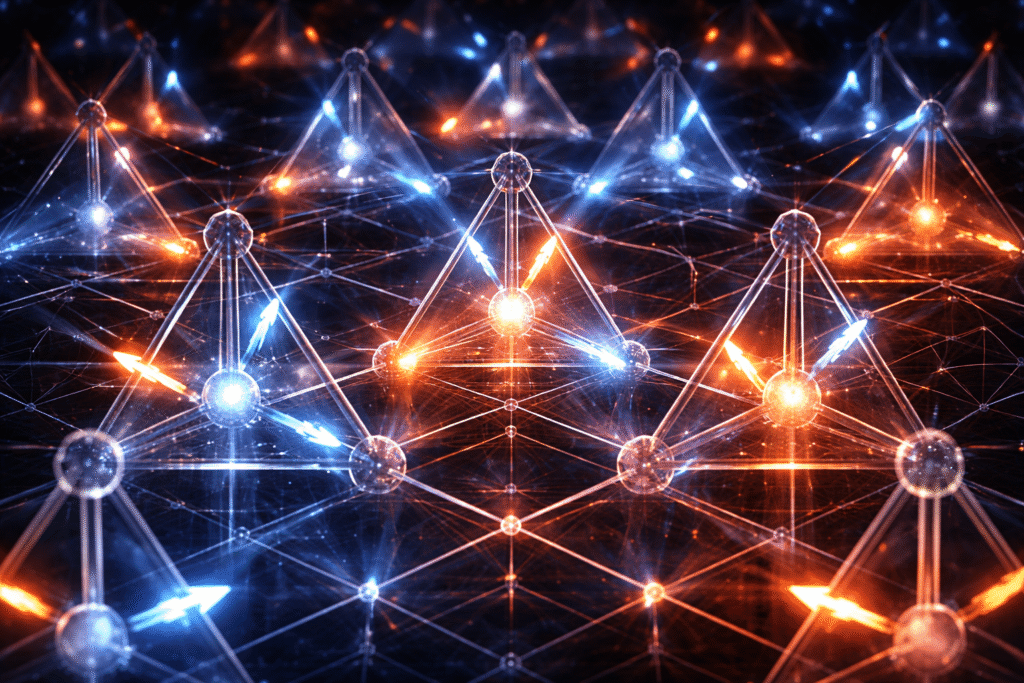
Spin ice materials are built on a lattice of tiny tetrahedra—four-pointed shapes connected corner to corner. Each corner holds a magnetic atom whose “spin” points either inward or outward. The problem is that no arrangement can satisfy all magnetic interactions at once.
This is what physicists call frustration. Not emotional frustration, but geometric frustration—a system trapped between competing demands with no perfect solution.
Why spin ice looks like frozen water
Here is where the name becomes clever rather than poetic.
In ordinary water ice, hydrogen atoms follow a simple rule: around each oxygen atom, two hydrogen atoms sit close and two sit farther away. This “two-near, two-far” rule creates disorder that never fully disappears, even at very low temperatures.
Spin ice follows a strikingly similar rule. On each tetrahedron, two magnetic spins point inward and two point outward. This “two-in, two-out” arrangement mimics the hydrogen pattern in water ice.
The result is unexpected. Even near absolute zero, when materials usually settle into perfect order, spin ice remains disordered. Not chaotic, but frozen into many equally valid arrangements. The material carries residual entropy—a memory of disorder that refuses to vanish.
In a world that equates cold with order, spin ice quietly disagrees.
When disorder becomes a feature, not a flaw
This frozen disorder is not a failure of nature. It is a feature.
Because there are so many ways to satisfy the two-in, two-out rule, spin ice never settles into a single ground state. It exists in a kind of democratic stalemate, where no configuration is privileged over another.
This challenges one of the deepest assumptions in physics: that systems always seek a unique lowest-energy arrangement. Spin ice shows that sometimes, the lowest-energy state is not a single point, but a vast landscape of possibilities.
It is a humbling lesson. Even at temperatures close to absolute zero, nature can remain undecided.
The shocking appearance of magnetic monopoles
Then comes the part that feels almost heretical.
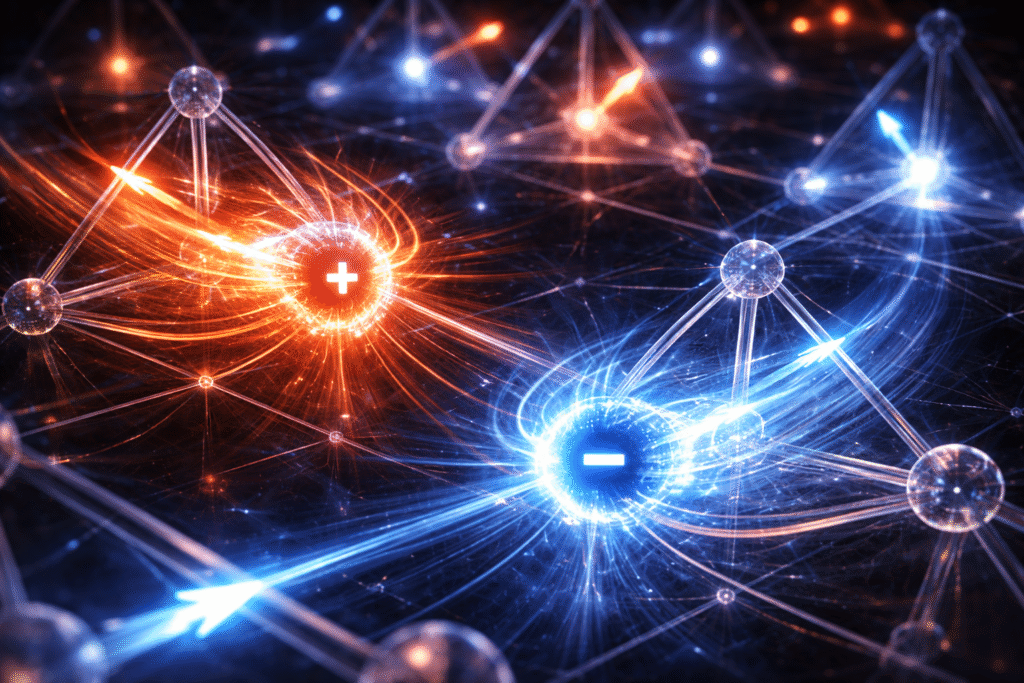
If one magnetic spin in spin ice flips, it breaks the two-in, two-out rule. One tetrahedron ends up with three spins pointing in and one out, while a neighbouring one gets the opposite arrangement.
These defects behave like isolated magnetic charges—north without south, or south without north.
Physicists call them emergent magnetic monopoles.
To be clear, these are not fundamental particles roaming the universe. They are collective effects, quasiparticles created by the behaviour of many spins acting together. But inside the material, they behave uncannily like real magnetic charges. They can move. They interact. They respond to forces.
For decades, magnetic monopoles existed only in equations and speculation. Spin ice gave physicists something close enough to touch.
Why this discovery rattled physics
The idea that something forbidden at a fundamental level can emerge naturally at a collective level is deeply unsettling—and deeply exciting.
Spin ice teaches us that the laws governing small parts do not always dictate the behaviour of the whole. Complex systems can give rise to new “particles” and new rules that make sense only at that scale.
This is not just a curiosity. It reshapes how physicists think about emergence, complexity, and the limits of reductionism—the idea that understanding the smallest parts explains everything else.
Spin ice politely but firmly says: not always.
Artificial spin ice and human curiosity
Nature did not stop at crystals buried in laboratories. Scientists went further and built artificial spin ice—carefully arranged arrays of nanomagnets designed to mimic the same frustrated geometry.
These artificial systems allow researchers to watch spin configurations change in real time, to guide defects, and to test ideas that natural materials make difficult.
Why bother? Because understanding frustration and emergent behaviour could reshape how we design future technologies—from data storage to unconventional computing systems that rely on patterns rather than strict order.
Spin ice, once a niche curiosity, now sits at the crossroads of fundamental physics and applied imagination.
Why spin ice matters to the rest of us
It is tempting to ask: why should anyone outside a physics lab care?
Because spin ice is a metaphor hiding in plain sight.
It shows that disorder is not always a problem to be solved. Sometimes, disorder is a stable solution. It shows that constraints can create richness rather than limitation. And it reminds us that reality is often more inventive than our theories.
In a world that values neat answers and rigid categories, spin ice offers a gentler truth: complexity is not a mistake. It is how nature explores possibility.
Conclusion: learning to live with unresolved answers
Spin ice does not resolve magnetism into something simpler. It complicates it beautifully.
It shows us materials that never quite decide, defects that masquerade as impossible particles, and systems where frustration leads not to collapse, but to creativity.
Perhaps the real lesson of spin ice is not about magnets at all. It is about how we approach knowledge. Not everything needs to settle. Not every system needs to choose one answer. Sometimes, the richness lies in the unresolved.
And maybe that is something worth sitting with—both in physics and beyond.
Author’s Note
This topic stayed with me because it felt like a quiet rebellion against certainty. Writing about spin ice reminded me why I write at all—not to tidy the world, but to sit with its strangeness long enough to appreciate it. Sometimes, awakening begins with admitting that confusion is not the enemy of understanding.
G.C., Ecosociosphere contributor.