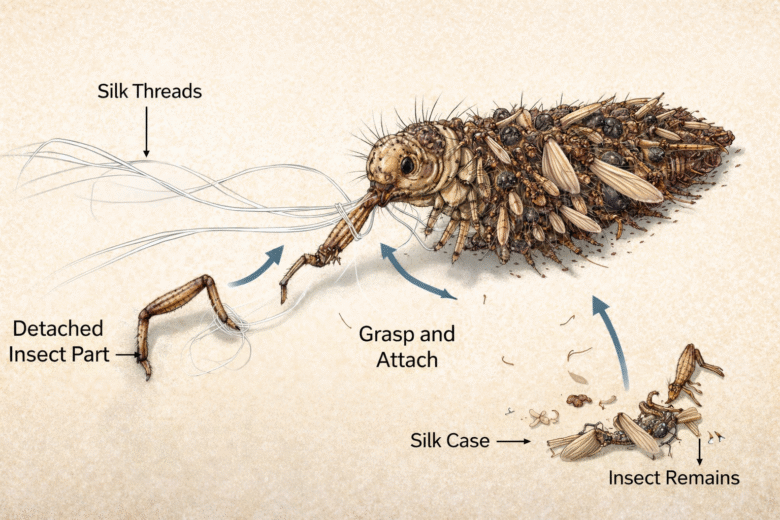
A caterpillar has been discovered that literally decorates itself with the body parts of the insects it eats.
Let that sink in for a moment.
In a world where survival often means blending in, hiding, or running away, this creature takes a far more unsettling approach—it wears its past meals like armour. Scientists have nicknamed it the “bone collector caterpillar,” and while it sounds like something from a horror story, it is very real, quietly living in the forests of Hawaii.
This is not just a bizarre curiosity. It is a reminder that nature does not follow our ideas of beauty or morality. It follows one rule—survive.
A Predator in Disguise
The bone collector caterpillar belongs to a group known as case-bearing moth larvae. These larvae build protective coverings, or “cases,” using silk and materials from their surroundings—like leaves, sand, or bark.
But this one is different. Instead of harmless debris, it collects the remains of other insects—legs, wings, and even heads—and attaches them to its body. The result is something that looks less like a caterpillar and more like a walking pile of death.
Why would it do this? Because it works.
Predators rely heavily on visual cues. Birds, for example, are trained by evolution to recognize shapes that look like prey. But this caterpillar disrupts that pattern. It does not look like food. It looks like leftovers.
And in the wild, leftovers are often ignored.
The Strategy Behind the Horror
At first glance, this behaviour feels almost… excessive. Why go through the effort of collecting and wearing insect remains?
The answer lies in a concept called camouflage and defensive mimicry. Many animals survive by pretending to be something they are not—a leaf, a twig, or even something dangerous. This caterpillar takes mimicry to a new level. It is not just hiding. It is actively telling predators: “I am not worth your time.”
There is also another layer to this strategy. By using the remains of insects, the caterpillar may carry the scent of decay or predation. Some predators avoid such smells instinctively, associating them with disease or danger. So, what looks like a gruesome costume is actually a carefully evolved survival tool. Nature, once again, proves that effectiveness matters more than elegance.
Why Hawaii? A Laboratory of Evolution
This strange caterpillar was found in Hawaii, a place often described as a natural laboratory of evolution.
Because the islands are isolated, species evolve in unique ways. Without the usual predators or competitors found on continents, organisms experiment—slowly, over generations—with new survival strategies.
Some grow larger. Some become flightless. And some, like this caterpillar, become… creative. Hawaii is home to thousands of species that exist nowhere else on Earth. Many of them are still being discovered. Which raises an uncomfortable question: how many more strange, almost unbelievable life forms are out there, quietly surviving in ways we have not yet imagined?

Nature Is Not Gentle—It Is Practical
We often like to think of nature as peaceful—green forests, chirping birds, flowing rivers. But that is only one side of the story. The other side is this. A caterpillar that eats insects and wears their remains. It does not do this out of cruelty. It does not feel pride in its disguise. It simply follows the logic of survival.
And that logic can be ruthless.
The truth is, nature does not care about what looks disturbing to us. It rewards what works. If wearing the remains of your prey keeps you alive long enough to reproduce, then that strategy stays.
Over time, it becomes instinct. Over time, it becomes normal.
What This Teaches Us About Life
There is something strangely humbling about this caterpillar. It forces us to confront a simple truth: survival is often messy, uncomfortable, and far from ideal.
We like clean narratives—heroes, villains, good, bad. But nature operates in shades of grey. Sometimes survival looks like beauty. Sometimes it looks like something we would rather not see.
And yet, both are equally valid. In a way, this tiny creature is a quiet reminder that adaptation—not perfection—is what keeps life going.
Conclusion: The Strange Logic of Survival
The caterpillar that wears the bones of its victims is not just a biological curiosity—it is a statement. A statement that survival does not follow human rules. A statement that evolution is not concerned with aesthetics.
And perhaps most importantly, a statement that the natural world is far stranger than we are comfortable admitting. The next time you walk through a forest or look at a small insect, remember this: what you see is only a fraction of what exists. And sometimes, hidden in plain sight, are stories that challenge everything you think you know about life.
Author’s Note
There are days when teaching feels like explaining the world in neat, simple boxes. And then there are topics like this that refuse to fit into any box at all. This caterpillar stayed with me—not because it is frightening, but because it is honest. It does not pretend to be anything other than what survival has made it.
G.C., Ecosociosphere contributor.