
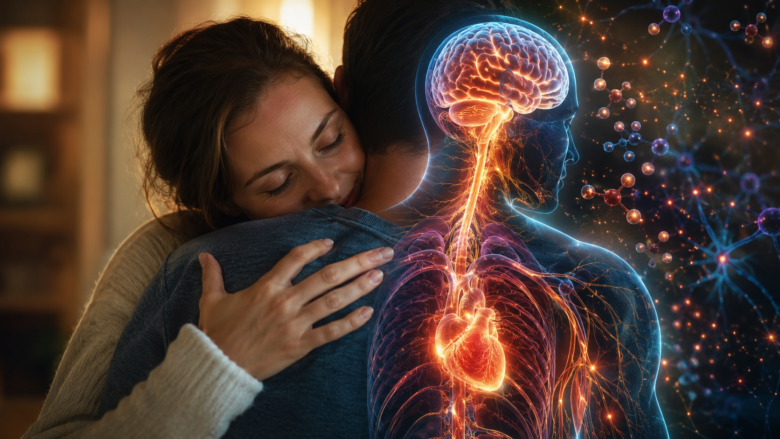
Think about the moment you reunite with a close friend after many years apart. Before either of you says a word, there is often a handshake, a hug, or a reassuring pat on the shoulder. In difficult moments, someone may simply hold another person’s hand without offering any advice. Parents instinctively cradle their newborns. Couples walk hand in hand. Friends celebrate with embraces. Across cultures, physical touch appears again and again as one of the oldest forms of communication.
It may seem like a simple social habit, but biology tells a much deeper story.
Long before humans developed language, touch served as one of the body’s earliest communication systems.
It helped infants bond with caregivers, strengthened cooperation within groups, and provided reassurance during times of danger. Even today, our nervous system continues to respond to touch in ways that are surprisingly powerful, influencing our hormones, emotions, stress levels, and even physical health.
The skin, after all, is much more than a protective covering. It is the largest organ in the human body and contains millions of specialized sensory receptors that constantly monitor the world around us. Some receptors detect pressure, others respond to temperature or pain, while a special group of nerve fibres is particularly sensitive to slow, gentle stroking. These fibers are believed to play an important role in social touch, sending signals to regions of the brain involved in emotion rather than simply identifying where the skin has been touched.
In other words, your brain does not just recognize that someone touched your arm. It also begins interpreting what that touch means.
That distinction is important because not all touch carries the same message. A handshake between colleagues, a hug from a family member, or a comforting hand on the shoulder during grief may activate similar biological pathways, but the emotional context shapes how the brain responds. Touch is far more than simple physical contact. It is information.
One of the best-known biological responses to positive physical touch involves a hormone called oxytocin. Often referred to as the “bonding hormone,” oxytocin is released during affectionate interactions such as hugging, holding hands, cuddling, and skin-to-skin contact between parents and infants. Rather than creating affection from nothing, oxytocin appears to strengthen existing social bonds by increasing feelings of trust, closeness, and emotional security.
This helps explain why physical affection often feels reassuring during stressful situations. When someone you trust hugs you after receiving bad news, the comfort is not only emotional. Your body is actively changing its internal chemistry.

At the same time, positive touch can influence another important biological system: the body’s stress response.
When we experience anxiety or fear, the adrenal glands release stress hormones such as cortisol, preparing the body to deal with perceived threats. Heart rate increases, breathing becomes faster, muscles tense, and attention narrows.
These reactions are extremely useful when facing genuine danger.
The problem is that modern life often keeps this stress response switched on for far longer than our ancestors experienced. Deadlines, financial worries, social pressures, and constant digital notifications can repeatedly activate the same biological systems that once helped humans survive predators.
Supportive physical touch appears to help interrupt this cycle.
Numerous studies have found that affectionate touch from trusted individuals can reduce cortisol levels while encouraging activation of the parasympathetic nervous system—the part of the nervous system responsible for rest, recovery, and relaxation. As breathing slows and muscles relax, the body gradually shifts away from a state of constant alertness.
This may explain why people often describe hugs as calming rather than simply pleasant.
The effects are not limited to stress hormones alone. Physical touch has also been associated with changes in heart rate, blood pressure, and the release of neurotransmitters involved in mood regulation, including dopamine and serotonin. Together, these chemical messengers contribute to feelings of emotional stability, motivation, and overall well-being.
Yet the science tells only part of the story.
Touch is remarkably dependent on trust and consent. The exact same physical action can produce completely different biological and emotional responses depending on who initiates it, whether it is welcomed, and the surrounding circumstances. A comforting embrace from a close friend may reduce stress, while unwanted physical contact can increase anxiety, elevate cortisol, and activate brain regions involved in detecting threats.
Our nervous system is constantly asking a simple question: Is this touch safe? The answer determines much of what follows.
This sensitivity begins astonishingly early in life. Newborn babies depend heavily on physical contact for healthy development. Skin-to-skin care immediately after birth helps regulate body temperature, heart rate, breathing, and sleep patterns. Premature infants receiving gentle therapeutic touch often gain weight more effectively and show improved physiological stability compared with those receiving less physical contact.
These early experiences help shape emotional development as well. Consistent, nurturing touch supports secure attachment between infants and caregivers, providing a biological foundation for emotional regulation that can influence relationships throughout life.
As we grow older, the need for touch does not disappear. Adults continue to rely on physical affection in subtle ways.
A reassuring handshake before an important interview, holding a loved one’s hand during illness, celebrating victories with hugs, or simply sitting close to someone we trust all reinforce social bonds that humans have depended upon for thousands of years.

Interestingly, researchers have also observed what happens when touch becomes scarce.
People experiencing prolonged loneliness or social isolation often report increased stress, poorer sleep, and reduced emotional well-being. While loneliness is influenced by many factors beyond physical contact alone, the absence of safe, supportive touch may contribute to the body’s ongoing sense of social disconnection.
This is one reason why periods of enforced isolation, such as during the COVID-19 pandemic, highlighted how deeply humans depend on physical presence as well as conversation.
Modern life has changed many aspects of human interaction.
Video calls allow families separated by continents to see one another. Instant messaging enables conversations across time zones within seconds. Artificial intelligence can now simulate surprisingly natural dialogue. Yet none of these technologies can fully reproduce the biological experience of human touch.
A screen can transmit information.
It cannot activate the same sensory receptors in the skin, trigger the same hormonal responses, or provide the quiet reassurance that comes from another person’s physical presence.
Perhaps that is why even in an increasingly digital world, we continue to shake hands after agreements, hug people we love, comfort grieving friends with an embrace, and instinctively reach for someone’s hand during moments of uncertainty.
These gestures may seem ordinary because they have always been part of being human.
Behind every handshake, every hug, and every reassuring touch, countless nerve signals travel through the body, hormones subtly shift, stress gradually eases, and the brain receives one of its oldest forms of reassurance—that, even if only for a moment, we are not alone.
Author’s Note
Physical touch is one of humanity’s oldest forms of communication. While modern life increasingly relies on digital interaction, biology reminds us that safe, caring physical contact continues to play a vital role in emotional well-being, stress regulation, and social connection. Understanding the science behind touch helps us appreciate that some of our simplest gestures are also among our most biologically meaningful.
G.C., Ecosociosphere contributor.
References & Further Reading
- Field, T. (2010). Touch for Socioemotional and Physical Well-Being: A Review. Developmental Review, 30(4), 367–383.
- Morrison, I. (2016). Keep Calm and Cuddle On: Social Touch as a Stress Buffer. Adaptive Human Behaviour and Physiology.
- Dunbar, R. I. M. (2010). The Social Role of Touch in Humans and Primates. Neuroscience & Biobehavioural Reviews.
- Uvnäs-Moberg, K. (2003). The Oxytocin Factor. Da Capo Press.