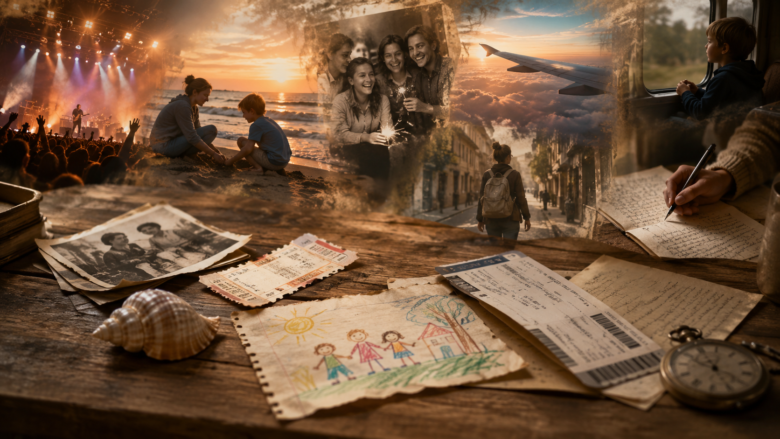
Almost everyone owns something that seems completely ordinary.
A faded movie ticket tucked inside a book.
A seashell collected from a family vacation.
A boarding pass from a memorable journey.
A child’s first drawing.
An old wristwatch that no longer works.
To anyone else, these are simply everyday objects. Yet for the people who own them, they can become among the most treasured possessions they have. Their value comes not from their price. Instead, it comes from the memories and emotions they represent.
This raises an interesting question. Why do human beings become so emotionally attached to ordinary things?
The answer begins with the remarkable way our brains remember the past.
Contrary to popular belief, memory does not work like a video recording. Instead of storing an experience in one place, the brain spreads different pieces of it across multiple networks. When we encounter something connected to that experience, those networks work together to rebuild the memory.
Psychologists call this cue-dependent memory. Certain sights, sounds, smells, and physical objects act as cues that unlock experiences stored deep within the brain.
That is why a simple concert ticket can instantly bring back the excitement of the performance, or a smooth pebble collected during a holiday can remind someone of the laughter, conversations, and emotions shared on that day. The object itself does not contain the memory—it simply helps the brain find it again.
This is why souvenirs often survive long after their practical purpose has disappeared. A boarding pass no longer gets us onto a plane, and a festival wristband no longer grants entry. Their usefulness has ended, but their emotional purpose remains.
Souvenirs also reveal something important about how humans understand themselves.
Unlike many other animals, people build stories about their own lives. We do not simply remember isolated events. We connect them into a narrative that explains who we were, who we are today, and how we arrived here. Psychologists call this narrative identity, and souvenirs quietly become physical chapters in that story.
A graduation certificate represents years of effort. A passport filled with stamps reflects curiosity and adventure. A handwritten recipe passed down through generations preserves not only instructions but also family traditions and relationships. These objects reassure us that important parts of our lives really happened.
Another reason souvenirs become so precious is something psychologists call the Endowment Effect. Research has shown that people naturally value possessions more highly simply because they own them. Once an object becomes part of our lives, giving it up often feels like a greater loss than logic would suggest.

When ownership combines with personal memories, that attachment becomes even stronger.
An inexpensive coffee mug from a first job, an old school badge, or a birthday card from someone special may have little financial value. Yet replacing them would never replace the experiences attached to them. Their importance comes not from the material they are made of, but from the life they have witnessed.
Memory is also closely connected with emotion. Experiences filled with happiness, pride, love, or even grief are remembered more vividly than ordinary moments. When an everyday object becomes linked to those emotions, it gradually transforms into something much greater than its physical form.
Before long, it is no longer simply an object.
It becomes a small piece of personal history.
There is another reason these keepsakes become difficult to part with.
Life never stands still.
Children grow up. Families move. Friendships change. Loved ones pass away. Places that once felt familiar slowly disappear. Souvenirs provide something constant amid all that change.
They connect our present selves with the people we once were and remind us that those moments continue to matter.
This is why people often become especially attached to souvenirs during major life transitions. Graduations, weddings, the birth of a child, moving to a new city, or retiring from a career all mark significant changes in our lives. Keeping a physical reminder helps preserve a sense of continuity as one chapter ends and another begins.
The same idea explains why tourists buy souvenirs almost everywhere they travel.
Most travel keepsakes are not particularly useful. Refrigerator magnets, postcards, keychains, and seashells rarely serve any practical purpose. What they preserve is the experience itself. Long after the details of a journey begin to fade, a small object can instantly bring back the feeling of standing before a famous landmark, exploring unfamiliar streets, or sharing unforgettable moments with family and friends.
Even in the age of smartphones, physical souvenirs continue to matter. We can capture thousands of photographs and videos, yet many people still keep handwritten letters, childhood toys, ticket stubs, or pressed flowers. A photograph records what something looked like. A physical object can also be held, touched, and felt, engaging multiple senses that make memories more vivid.
This is one reason family heirlooms are so meaningful. A grandparent’s watch, an old fountain pen, or a handwritten letter allows memories to be passed from one generation to the next.

These objects become more than possessions—they become connections between people separated by time.
Modern minimalist lifestyles encourage people to own fewer possessions, yet sentimental objects are often the hardest to discard. We are rarely attached to the object itself. We are attached to the story it carries. A cracked coffee mug may represent years of shared conversations, while an old key that no longer opens any door can still unlock a flood of memories.
Interestingly, this habit is far older than modern tourism. Archaeologists have discovered ancient ornaments, shells carried across great distances, carefully crafted beads, and treasured heirlooms buried alongside their owners. Many had little practical value, suggesting that humans have been preserving meaningful objects for thousands of years.
Perhaps the reason is simple.
Memory alone never feels entirely secure.
We know that details fade. Faces become less distinct. Voices grow quieter. Entire periods of life slowly blur together. A small keepsake cannot stop time, but it can help us revisit it. It gives memory something tangible to hold onto when the mind begins to let go.
That may be why an old ticket stub, a seashell, or a child’s drawing can feel priceless despite having almost no monetary value.
Their worth cannot be measured by what they are made of.
It is measured by what they remember for us.
In the end, souvenirs are not really about preserving objects.
They are about preserving pieces of ourselves.
Every meaningful keepsake quietly asks the same question: Who was I when this became important?
Each time we pick one up, we are reminded that although life never stops changing, the experiences that shaped us continue to travel with us—sometimes inside our memories, and sometimes inside the smallest objects we choose to keep.
Author’s Note
Every one of us owns something that would seem insignificant to a stranger but impossible to replace for ourselves. This article explores the fascinating science behind that attachment, revealing how memory, emotion, and identity transform ordinary objects into treasured keepsakes. Understanding why we keep souvenirs offers a deeper appreciation of the remarkable ways our minds preserve the experiences that shape who we are.
G.C., Ecosociosphere contributor.