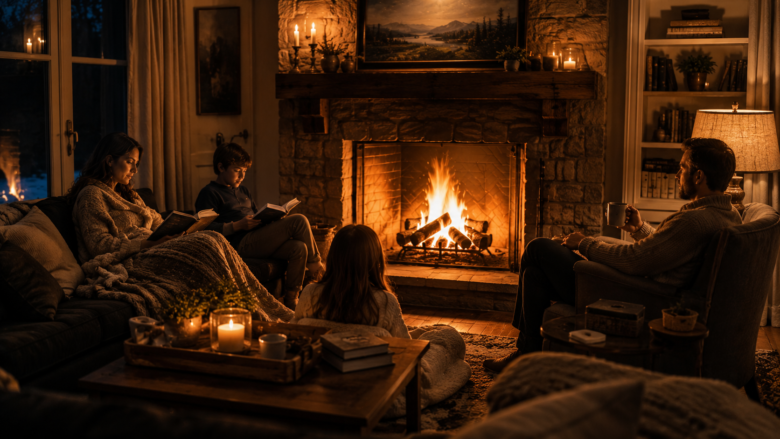
Imagine sitting beside a campfire after sunset.
The conversation becomes quieter. People stop looking at their phones as often. Some simply watch the flames while others enjoy the warmth without saying much. Minutes pass, sometimes even hours, yet almost nobody complains of being bored.
It is a strangely universal experience.
Whether it is a fireplace in a home, a bonfire on a beach, or a small campfire in the mountains, humans have always been fascinated by fire. We can watch its flickering flames with no particular goal, almost as though they are telling a story that needs no words.
Its enduring appeal has far deeper roots than simple beauty.
To understand why fire continues to captivate us, we have to look back to a time long before electricity, cities, or even agriculture. For much of human history, fire was one of our greatest survival tools. It provided warmth during cold nights, light after sunset, protection from many predators, and a reliable way to cook food.
Its glow became the gathering place where people rested, shared food, worked on their tools, and prepared for whatever came next. Fire became the centre of daily life.
Its importance may even have influenced human evolution. Cooking made many foods easier to digest and allowed our ancestors to obtain more energy from the same meal. Some scientists believe this extra energy supported the growth of the large, energy-hungry brains that distinguish humans from other primates. While many factors shaped our evolution, the controlled use of fire was undoubtedly one of the most important.
Yet fire changed more than our diet.
Before humans mastered fire, darkness largely brought activity to an end. Once flames could be maintained, evenings became opportunities rather than obstacles. Families and communities gathered together after sunset, creating time to exchange knowledge, teach children, solve problems, and strengthen social bonds. Around countless campfires, stories were told, traditions were passed down, and cultures slowly took shape.
In many ways, civilization grew in the light of a fire.
Although our lives look very different today, our brains are still the product of that long evolutionary history. Evolution works slowly. Behaviours that were useful for thousands of generations often remain with us, even when the original need has disappeared.
That may explain why watching fire still feels so natural.
The movement of flames is constantly changing, yet never chaotic. Unlike flashing advertisements or rapidly changing social media feeds, a fire captures our attention without overwhelming it. Psychologists describe experiences like this as a form of soft fascination—natural patterns that gently hold our attention while allowing the mind to relax. Similar feelings arise when watching waves roll onto a beach, rain falling outside a window, or leaves moving in the wind.
Fire offers the same quiet rhythm. This may be why people often describe sitting around a fire as calming, even when nothing special is happening.

The flames provide just enough activity to keep the eyes engaged while giving the mind space to reflect.
It is no coincidence that meaningful conversations often unfold beside campfires and fireplaces. The fire becomes a shared point of focus, making silence feel comfortable instead of awkward.
Even in the digital age, we continue to recreate this ancient experience. Families gather around fireplaces during winter. Friends build bonfires while camping or celebrating festivals. Restaurants and hotels install fire pits because they naturally encourage people to stay longer and connect with one another. Some people even play videos of crackling fireplaces on televisions or computers simply to create a peaceful atmosphere.
From a practical perspective, none of this is necessary.
But emotionally, it makes perfect sense.
Our attraction to fire reminds us that modern technology has changed our surroundings far more quickly than it has changed our minds.
We no longer depend on flames for survival, yet they still evoke feelings of warmth, safety, and togetherness that were reinforced over thousands of generations. The associations formed by our ancestors continue to influence how we experience the world today.
Perhaps that is why fire occupies such an important place in human culture. Across civilizations, it has symbolized celebration, remembrance, hope, and renewal. Candles mark birthdays and religious ceremonies. Bonfires accompany festivals. Olympic torches, memorial flames, and ceremonial fires all carry meanings that go beyond their practical use. Fire has become a symbol because it was first a necessity.
Its physical warmth eventually became emotional warmth.
In a world filled with constant notifications, endless entertainment, and shrinking attention spans, fire offers something increasingly rare.
Permission to slow down. It asks nothing from us except to be present. There is no destination, no achievement, and no reward waiting at the end of watching a flame. The experience itself is enough.
The next time you find yourself staring into a campfire or fireplace, remember that you are participating in one of humanity’s oldest traditions. Long before books, cities, and smartphones existed, countless generations ended their days beneath the same dancing light. Around those flames they found food, safety, companionship, and stories that connected one generation to the next.
Perhaps that is why, even today, a simple fire can still make us feel at home.
Author’s Note
The Human Side of Things explores the hidden biology, psychology, and evolution behind everyday human experiences. Our fascination with fire is more than a preference for warmth or beautiful light—it is a reminder that many of our modern behaviours are rooted in adaptations that helped our ancestors survive. Sometimes, the oldest habits continue because they still speak to something deeply human.
G.C., Ecosociosphere contributor.