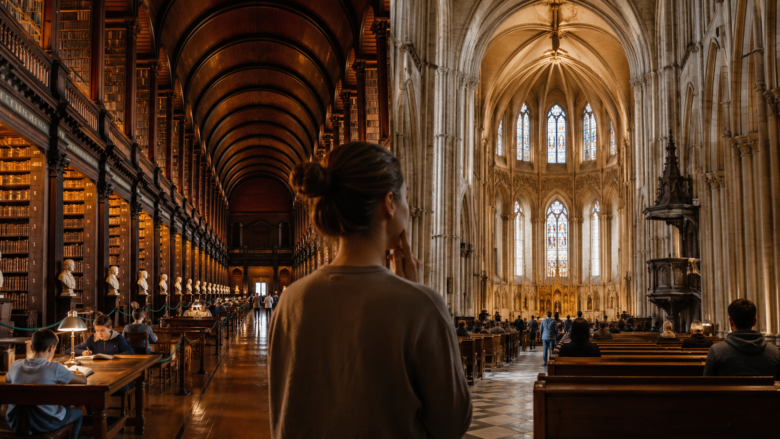
Have you ever noticed how your voice changes the moment you step into a library, a museum, a hospital, or a place of worship?
Nobody may ask you to speak softly. There may not even be a sign reminding visitors to keep quiet. Yet, almost instinctively, your voice drops to a whisper. It happens so naturally that most of us never stop to wonder why.
At first glance, it seems like a simple matter of good manners. We learn from childhood that certain places are meant to be quiet, so we behave accordingly. While that is certainly part of the story, psychologists and neuroscientists have discovered that something much more fascinating is taking place.
Long before we consciously decide how loudly to speak, our brains have already begun interpreting the environment around us and adjusting our behaviour.
Our voice is far more adaptable than we realize. We do not speak to a close friend in the same way we speak during a job interview. We naturally change our tone when talking to a child, an elderly person, or someone who is upset.
Even without thinking about it, our brain constantly modifies our volume, speed, pitch, and emotional tone depending on the situation. Whispering in certain places is simply another example of this remarkable ability.
The process begins almost the moment we enter a new environment. Within seconds, our brain starts gathering visual and auditory clues. The height of the ceiling, the amount of light, the arrangement of furniture, the materials used in the walls, and even the expressions of the people around us all contribute to a rapid assessment.
Without forming a conscious thought, the brain begins asking questions.
Is this a place for learning? Is it sacred? Are people concentrating? Is silence expected here? The answers shape our behaviour before we even open our mouths.
Architecture plays a surprisingly powerful role in this process. Buildings are not just collections of walls and roofs. They silently communicate expectations. Walk into a grand cathedral with its towering ceilings, long aisles, and echoes that seem to stretch endlessly above you, and your voice almost immediately softens.
Enter a modern library lined with shelves of books and rows of readers absorbed in their work, and speaking loudly suddenly feels out of place. Even hospitals, with their calm corridors, medical equipment, and patients resting nearby, encourage visitors to lower their voices without anyone having to explain why.
Part of this response comes from acoustics. Large halls, stone buildings, and empty spaces often produce echoes that make us hear our own voices more clearly. When our words bounce back from the walls, we become more aware of how loud we sound.
Many people instinctively reduce their speaking volume in echoing environments because their own voice suddenly feels amplified.
Interestingly, the opposite happens in noisy surroundings. Scientists call this the Lombard Effect, a phenomenon in which people automatically speak louder when surrounded by background noise.
In crowded restaurants, busy markets, airports, or concerts, we raise our voices without making a conscious decision. Our brain simply adjusts our speech to remain audible. Whispering in quiet places is, in many ways, the reverse of this same automatic adjustment.
Yet architecture and acoustics explain only part of the mystery. Humans are deeply social creatures, and our brains constantly monitor the behaviour of those around us. If everyone nearby is speaking softly, we naturally begin doing the same.
Psychologists refer to this as social mimicry.

We unconsciously copy not only people’s gestures and facial expressions but also their walking speed, posture, and even the volume of their voices.
This tendency has deep evolutionary roots. For most of human history, survival depended on living successfully within small groups. Being too loud at the wrong moment could reveal a hiding place, scare away prey, disturb an important ritual, or attract unwanted attention from predators or rival groups.
Individuals who quickly adapted their behaviour to match those around them were more likely to remain accepted within the group. Although modern libraries and museums are very different from prehistoric forests, the same social instincts continue to guide our behaviour today.
Some places also evoke powerful emotions that naturally encourage quieter speech. Places of worship, memorials, and historical monuments often inspire feelings of awe. Psychologists describe awe as an emotional response to something so vast or meaningful that it momentarily makes us feel smaller within a larger world.
Research has shown that experiences of awe tend to slow our movements, encourage reflection, and reduce the desire to dominate conversations. Speaking softly becomes part of that emotional experience.
Silence itself also carries meaning. In a hospital, quiet expresses concern for patients who may be resting or recovering. In a library, it communicates respect for people trying to concentrate. At a funeral, silence becomes a shared language of grief and remembrance.
Even museums, where priceless objects from distant civilizations are carefully displayed, create an atmosphere that encourages contemplation rather than conversation. In each case, whispering is less about following rules and more about acknowledging the purpose of the space.
Children begin learning these unwritten rules surprisingly early. They watch adults lower their voices in certain places and imitate the behaviour long before anyone formally explains it. Over time, these repeated experiences become deeply embedded habits.
By adulthood, entering a quiet environment often triggers an almost automatic adjustment in speaking volume without any deliberate thought.
Perhaps the most remarkable part of this behaviour is how effortlessly it happens. Modern neuroscience suggests that the brain functions as a prediction machine, constantly anticipating what behaviour will be appropriate before we consciously decide what to do.
As soon as we step into a cathedral, a courtroom, or a library, our brain combines visual cues, previous experiences, cultural expectations, and the behaviour of others into a rapid prediction: this is a place where quiet is expected. By the time we speak, our voice has already changed.
The next time you find yourself whispering in a museum, lowering your voice in a hospital corridor, or speaking softly beneath the high ceiling of an old temple, pause for a moment and notice what has happened.
No one may have instructed you to be quiet. No alarm sounded. No conscious calculation took place. Instead, your brain quietly read the room, interpreted its meaning, and adjusted your voice accordingly.
It is a small reminder that humans are constantly shaped by the spaces they inhabit. Buildings influence more than where we walk. Social norms guide more than how we behave.
Together, they reach into something as personal as our own voice, gently reminding us that even our quietest whispers are not entirely our own, but part of an invisible conversation between the mind, the environment, and the society we share.
Author’s Note
We often think of our voice as something we consciously control. Yet, every day, our surroundings quietly shape how we speak without us even noticing. This article explores the fascinating relationship between architecture, social expectations, and the human brain, revealing how even a simple whisper reflects millions of years of evolution and our deep connection with the environments we inhabit.
G.C., Ecosociosphere contributor.