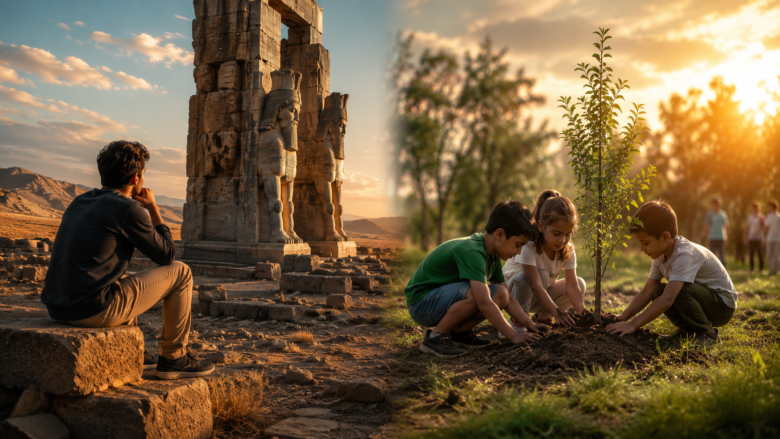
Every human life has one certainty. No matter who we are or where we come from, one day our own story will end.
Yet remarkably, our concern often stretches far beyond that final moment. We wonder what will happen to our families, our possessions, our work, and even our names. We write wills, preserve photographs, plant trees whose shade we may never sit beneath, and devote years to projects whose success we may never witness. Across cultures and throughout history, people have built monuments, written books, created art, founded institutions, and raised children with the hope that some part of themselves will continue after they are gone.
Perhaps what makes humans unique is not simply that we know we will die, but that we care deeply about what remains afterward.
No other animal appears to think this way. Many species protect their offspring or build nests, but there is no evidence that they worry about how future generations will remember them. A wolf does not seek recognition from descendants it will never meet. An elephant may mourn a dead companion, yet it does not carve its life story into stone. Humans, however, constantly imagine a future in which they no longer exist—and then try to shape it.
This ability begins with one of our greatest cognitive strengths: mental time travel. The human brain can revisit the past, experience the present, and imagine countless versions of the future. That remarkable capacity allows us to plan careers, prepare for disasters, and save money for retirement. But it also allows us to picture a world that continues without us.
For many people, that realization is both unsettling and motivating.
Knowing that life is temporary naturally raises uncomfortable questions. Will anyone remember us? Did our lives matter? Will the people we love be safe? These questions cannot be answered by instinct alone, so humans search for meaning in many different ways. Some find comfort in religion, others in family, creativity, science, service, or the hope that their actions will leave the world slightly better than they found it.
Legacy often begins where mortality becomes impossible to ignore.
Many psychologists believe that our awareness of mortality quietly shapes much of what motivates us throughout life. Unlike other everyday concerns, death cannot be solved or escaped. Instead, people learn to manage that awareness by investing in things that seem larger and more enduring than themselves. Contributing to society, passing on traditions, mentoring younger people, or creating lasting works can all provide a sense that one’s existence extends beyond a single lifetime.
This idea helps explain why people become deeply attached to their achievements. A scientist may spend decades pursuing a discovery that future generations will build upon. An artist may hope that their work continues to inspire long after they are gone. Parents often see their children as living extensions of their own values, experiences, and dreams. Even small acts, such as teaching a useful skill or planting a garden, can carry the quiet satisfaction of creating something that will outlast the individual.
Interestingly, our desire for permanence is visible even in everyday habits.
People carefully organize family photo albums, preserve handwritten letters, record videos of important milestones, and increasingly store countless memories online. Digital technology has made this easier than ever before. Social media profiles, cloud storage, blogs, and personal websites now serve as vast archives of modern lives. In some cases, these digital traces continue to exist long after the people who created them have passed away.
For the first time in human history, ordinary individuals—not just kings, scholars, or famous artists—can leave behind detailed records of their lives. Future generations may know more about their great-grandparents than any previous generation ever could, simply because photographs, messages, and videos have become so easy to preserve.

In many ways, humanity has turned memory itself into a form of technology.
This longing for permanence is also reflected in the stories civilizations tell. Ancient rulers built enormous monuments not merely to display power but to ensure they would be remembered. Great libraries were created to preserve knowledge beyond a single lifetime. Writers have always hoped their words would survive them, while explorers ventured into unknown lands knowing history might remember their names even if they never returned.
Although the forms have changed over thousands of years, the underlying desire has remained surprisingly consistent. We want our lives to have meaning that extends beyond the years we personally live.
And perhaps that desire has shaped civilization far more than we usually realize.
That idea reaches beyond famous individuals. Most people will never have monuments built in their honour or history books written about their lives. Yet the desire to leave something behind is no less real. It simply takes quieter forms.
A teacher remembers the students they helped gain confidence. A doctor hopes patients live healthier lives because of their care. A parent passes on traditions that were once taught by grandparents. A neighbour plants a tree knowing someone else will enjoy its shade years from now. These actions rarely attract headlines, but they represent one of humanity’s oldest instincts: improving a future we may never personally witness.
Legacy is not always about being remembered. Sometimes it is about making the future slightly better for people we will never meet.
Evolutionary scientists believe this tendency offered practical advantages long before modern civilization existed. Human survival depended on cooperation across generations. Knowledge about edible plants, hunting techniques, tool-making, farming, medicine, and social customs had to be passed from older individuals to younger ones. Unlike many animals that rely heavily on instinct, humans survive by inheriting knowledge.
As a result, caring about future generations became deeply valuable. A community where elders invested in teaching, protecting, and preparing the young stood a better chance of surviving than one that did not. Over thousands of generations, thinking beyond one’s own lifetime became woven into human culture.
This may explain why we often admire people who sacrifice for causes whose rewards they will never experience themselves. Building universities, protecting forests, funding scientific research, preserving historical sites, or working to reduce climate change all reflect the same remarkable ability to value a future beyond our own lives.
Modern psychology adds another layer to this picture. Researchers describe a stage of adulthood called generativity—the desire to nurture, guide, and contribute to future generations. Rather than focusing only on personal success, many people gradually become more concerned with passing on values, sharing experience, and creating something lasting. It is one reason why mentoring, volunteering, teaching, and community service often become deeply fulfilling later in life.

Perhaps fulfilment is not found only in what we achieve, but in what continues because we were here.
Of course, the pursuit of legacy also has its complicated side. The desire to be remembered can inspire extraordinary creativity, but it can also fuel unhealthy ambition. Throughout history, rulers have sought immortality through conquest, wealth, or grand monuments. In today’s world, some pursue constant online attention, believing visibility itself guarantees significance.
Yet public recognition and lasting influence are not the same thing. Many famous names eventually fade from memory, while countless ordinary people quietly shape generations through kindness, wisdom, and everyday acts that history never records. A compassionate teacher, a devoted parent, or a generous friend may influence hundreds of lives without ever becoming widely known.
This suggests that legacy is less about fame than about impact.
Interestingly, many philosophical traditions reach a similar conclusion. While they differ in their beliefs about what happens after death, they often encourage people to focus less on being remembered and more on living well in the present. If our actions improve the lives of others, then a part of us naturally continues—not as a monument, but through the choices, values, and relationships we helped shape.
In the end, our fascination with what happens after we die may reveal something profoundly hopeful about human nature.
We know our time is limited. We understand that our individual lives are only small chapters in a much longer story. Yet instead of giving in to despair, people build, teach, love, create, discover, and protect. We invest in children we may not see grow old, write books for readers we will never meet, and work toward futures we may never experience ourselves.
Perhaps that is humanity’s quiet answer to mortality.
Death marks the end of a life, but it does not necessarily mark the end of influence. Every idea shared, every act of kindness, every lesson taught, and every life touched has the potential to ripple outward long after its source has disappeared.
In that sense, our greatest legacy may never be our name carved into stone. It may simply be the countless ways in which our existence helped shape the lives of others—and through them, a future that continues long after we are gone.
Author’s Note
Our awareness of mortality is often seen as a source of fear, but it has also inspired some of humanity’s greatest achievements. The desire to leave something meaningful behind has driven discoveries, works of art, communities, and acts of compassion across history. Perhaps the question is not whether we will be remembered, but what kind of difference we choose to make while we are here.
G.C., Ecosociosphere contributor.