

Have you ever looked up at the sky and spotted a rabbit in the clouds?
Or noticed that your morning toast seemed to be smiling back at you? Perhaps you’ve caught yourself seeing a sleepy face in the front of a car, a surprised expression on an electrical socket, or even a pair of eyes staring from the bark of an old tree.
The strange thing is that once you see the face, it becomes almost impossible to unsee it.
You know perfectly well that the cloud is just water vapour and the toast is simply burnt bread. Yet your brain insists that there is something familiar looking back at you.
Why does this happen?
It turns out that your brain is doing exactly what it evolved to do.
The phenomenon is known as pareidolia—our tendency to perceive meaningful patterns, especially faces, in random or ambiguous objects.
While it may seem like a harmless illusion, pareidolia offers a fascinating glimpse into how the human brain makes sense of the world.
Unlike a camera, the brain does not simply record what the eyes see. It constantly interprets, predicts, and fills in missing information. Every second, it receives an overwhelming amount of visual data. If it tried to analyse every colour, edge, and shadow individually, even simple tasks would become impossibly slow.
Instead, the brain looks for patterns.
It asks a simple question: Have I seen something like this before?
Most of the time, that strategy works remarkably well. It helps us recognize friends in a crowd, identify familiar places, read handwritten notes, and understand another person’s emotions with little effort.
Sometimes, however, that same system becomes a little too enthusiastic.
And suddenly, a grilled cheese sandwich has a face.
Of all the patterns the brain could recognize, faces are among the most important.
From the day we are born, faces become our primary source of information about the people around us. A single glance can reveal happiness, fear, anger, surprise, or affection. We instinctively notice where someone is looking, whether they seem trustworthy, and even how they might be feeling.
Our survival has long depended on this ability.
For our ancestors, recognizing another human—or a hidden predator—quickly could mean the difference between safety and danger. Missing a face concealed in the bushes could have serious consequences. Mistakenly thinking a cluster of leaves looked like a face carried almost no cost.
Over thousands of generations, evolution favoured brains that preferred false alarms over missed warnings.
In other words, it was better to imagine a face that wasn’t really there than to overlook one that was.
Modern neuroscience supports this idea in a remarkable way.
Inside the brain is a small region known as the Fusiform Face Area, a specialised network that responds strongly whenever we look at faces. Brain imaging studies have shown that this region also becomes active when people experience face pareidolia. Even though no real face exists, the brain reacts as though it has found one.
The illusion is not happening because our eyes are faulty.
It is happening because our brain is trying to understand the world as quickly as possible.
That tells us something surprising about human perception.
We do not wait for perfect information before deciding what we are looking at. Instead, the brain makes an educated guess based on past experience and then checks whether the evidence supports it. Most of the time, the brain gets it right. Occasionally, it does not.
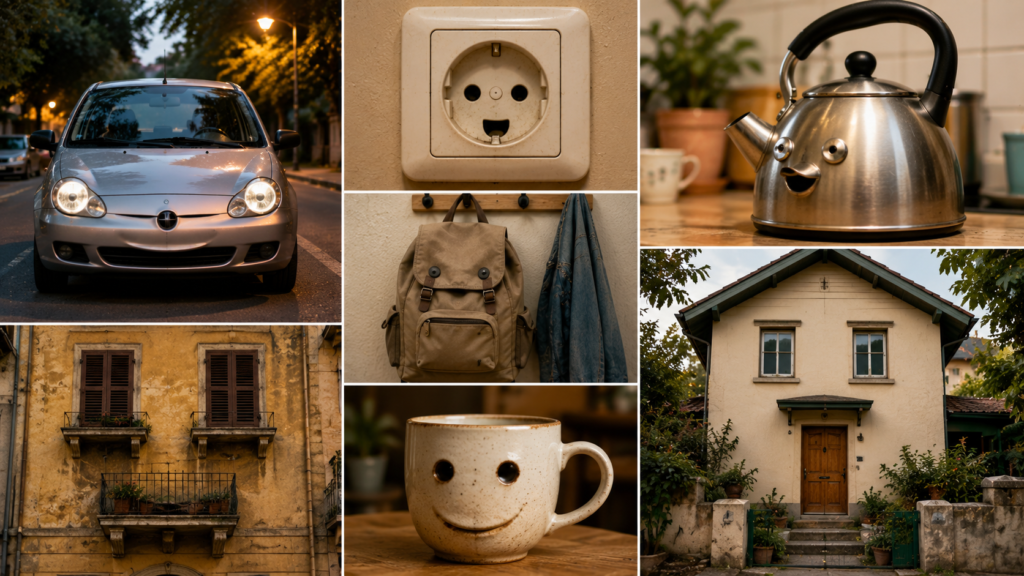
Pareidolia is one of those occasions when the prediction arrives a little ahead of reality.
That is also why faces are so easy to find in everyday objects.
A face does not require many details. Two roughly symmetrical dark spots above a horizontal line are often enough for the brain to begin constructing one. Headlights and a car grille become eyes and a smile. Two windows and a front door transform a house into a friendly expression. Even the craters on the Moon can appear to form a familiar face.
Once the pattern has been recognized, the rest is supplied by imagination.
This remarkable ability is not limited to vision alone.
People sometimes hear hidden words when music is played backwards, discover meaningful messages in random sounds, or notice familiar shapes in mountain ranges and rock formations. The brain is constantly searching for order because finding patterns has helped humans survive, learn, and communicate throughout history.
In many ways, pareidolia is simply the visible side of a much larger process.
It is the same pattern-seeking ability that allows scientists to discover relationships in data, doctors to identify diseases from medical scans, and children to learn language from sounds that once seemed meaningless. The brain is built to connect dots, even when only a few of them are visible.
Occasionally, it connects dots that were never meant to be connected.
Modern life offers endless opportunities to witness this tendency. Social media is filled with photographs of smiling potatoes, surprised-looking buildings, vegetables that resemble animals, and pieces of toast that appear almost human. These images spread so quickly because nearly everyone sees the same illusion within seconds.
It is a reminder that although each of us experiences the world individually, our brains often interpret it in remarkably similar ways.
Perhaps that is the most fascinating lesson of pareidolia.
We like to think that seeing is a straightforward process—that our eyes capture reality exactly as it is. In truth, perception is a partnership between the eyes and the brain. The eyes provide information, but the brain transforms that information into a story it believes is most likely to be true.
Most of the time, that story is astonishingly accurate.
Sometimes it finds a face in a cloud.
Or a smile in a slice of toast.
Yet those little mistakes reveal something beautiful about the human mind.
We are not passive observers of the world around us. We are active interpreters, constantly searching for meaning in the ordinary, familiarity in the unfamiliar, and order within chaos.
Perhaps that is why a child can spend an afternoon discovering animals in the clouds while an adult smiles at a cheerful-looking coffee mug before work.
The face was never really there.
But the brain’s endless search for meaning certainly was.
Author’s Note
Have you ever smiled at a car that seemed to have a face or spotted an animal in the clouds? These playful moments are more than imagination—they reveal one of the brain’s most remarkable abilities. Pareidolia reminds us that the human mind is constantly searching for patterns, helping us make sense of a complex and unpredictable world.
G.C., Ecosociosphere contributor.



Comments
Your content never disappoints. Keep up the great work!