
Imagine if someone told you exactly what tomorrow would bring.
You would know whether it would rain, whether your investments would rise or fall, whether your job interview would succeed, whether your loved ones would remain safe, and perhaps even whether you would meet someone who would change your life forever. Such knowledge would seem almost magical. Yet despite centuries of scientific progress, the future remains one of humanity’s greatest mysteries. And still, we continue trying to uncover it.
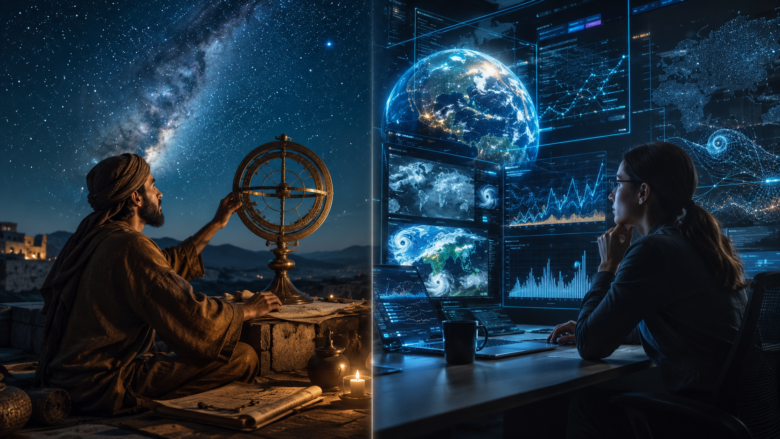
From ancient astrologers watching the stars to modern economists analysing markets, from weather satellites orbiting Earth to artificial intelligence (AI) systems predicting consumer behaviour, humans have always searched for clues about what lies ahead. The methods have changed dramatically, but the motivation has remained surprisingly constant. Deep inside the human mind is a powerful desire not merely to know the future, but to feel prepared for it.
This desire begins with one of the brain’s least favourite experiences: uncertainty.
Although people often say they enjoy surprises, neuroscience paints a more complicated picture. The human brain constantly works by anticipating what is likely to happen next. Every second, it makes countless forecasts without us even noticing. It predicts where a moving object will be, how a conversation might unfold, what someone is about to say, and even how our own body should move through space. Rather than simply reacting to the world, the brain is constantly anticipating it.
This ability evolved because prediction improves survival. Early humans who could anticipate danger before it appeared had a better chance of staying alive. A rustling bush could signal nothing more than the wind, but it could also hide a predator. Someone who expected the worst and prepared accordingly was often more likely to survive than someone who ignored uncertainty altogether.
Over thousands of generations, evolution rewarded brains that looked ahead instead of waiting for events to unfold. Today, although most people no longer worry about wild animals hiding nearby, the same ancient mental machinery now focuses on deadlines, relationships, careers, health, and finances. The objects of uncertainty have changed, but the brain’s discomfort with not knowing has remained remarkably similar.
That discomfort can be surprisingly powerful. Studies have shown that uncertainty often creates more stress than bad news itself. Waiting for medical test results, hearing back after a job interview, or wondering whether an important exam went well can sometimes feel more exhausting than finally learning the outcome. Once uncertainty disappears, the brain can begin adapting, even if the answer is disappointing.
In many ways, prediction is the mind’s attempt to reduce this psychological tension.
Long before modern science existed, people searched for certainty in the natural world. They watched the movement of stars, interpreted dreams, studied animal behaviour, examined unusual weather patterns, and consulted spiritual leaders. Across civilizations, from ancient Mesopotamia and Egypt to India, China, Greece, and the Americas, predicting the future became part of religion, politics, agriculture, and everyday life.
These practices were not simply superstition born from ignorance. Many of these practices developed because people needed guidance when making decisions in an uncertain world. Farmers wanted to know when the rains would arrive. Kings wanted to know whether wars would be successful. Families hoped to avoid disasters and ensure prosperous futures. When reliable information was scarce, symbolic systems offered something almost as valuable as certainty itself: confidence.

Even today, many people continue to consult horoscopes despite living in an age of satellites and supercomputers.
At first glance, this may seem contradictory. Why would someone trust astrology while also believing in modern science?
Part of the answer lies not in the stars but in the way the human brain processes information.
Psychologists have identified what is known as the Barnum effect, a tendency for people to accept vague, general statements as personally meaningful. A horoscope might say, “You sometimes doubt your decisions, but you are stronger than others realize.” Such statements apply to an enormous number of people, yet individuals often feel they describe them with remarkable accuracy.
Confirmation bias strengthens this effect further. Once people expect something to happen, they naturally pay more attention to events that support the prediction while overlooking the many occasions when it proves wrong. Over time, successful “hits” remain memorable, while countless “misses” quietly fade away.
The result is not necessarily irrationality but rather a brain doing what it evolved to do: searching for meaningful patterns.
Humans are exceptionally good at connecting events, even when no real connection exists. Seeing faces in clouds, believing in lucky numbers, assuming that two unrelated events must somehow be linked—these all arise from the same pattern-detecting machinery that once helped our ancestors survive. Evolution generally favoured false alarms over missed dangers. For our ancestors, it was safer to mistake an ordinary shadow for a predator than to overlook a real threat.
Our minds still carry that ancient tendency today.
Yet not all predictions are built on illusion.
Modern civilization depends on prediction more than ever before. Meteorologists forecast storms using atmospheric data collected from satellites and weather stations. Doctors estimate disease risks using decades of medical research. Engineers predict structural failures before bridges collapse. Economists attempt to anticipate inflation and unemployment. Airlines calculate the safest flight paths by forecasting changing weather conditions.
None of these predictions claim absolute certainty. Instead, they estimate probabilities.
That difference is important because science does not promise to eliminate uncertainty. Instead, its goal is to narrow uncertainty by relying on stronger evidence.
This shift from certainty to probability represents one of humanity’s greatest intellectual achievements. Rather than asking, “What will definitely happen?” science asks, “Given everything we know, what is most likely to happen?” While less emotionally satisfying than absolute answers, probabilistic thinking produces far more reliable decisions.
Artificial intelligence has added an entirely new chapter to humanity’s long relationship with prediction.
Recommendation algorithms predict what we will watch next. Navigation apps estimate traffic before we encounter it. Online stores anticipate what we may want to buy. Banks rely on predictive algorithms to identify potentially fraudulent transactions. Hospitals increasingly rely on AI systems that help estimate patient risks. Scientists use machine learning to forecast climate trends, disease outbreaks, and even protein structures.

What makes AI especially fascinating is that it often appears to predict us better than we predict ourselves.
After analysing enormous amounts of data, AI systems can sometimes identify patterns that remain invisible to human observers. This creates an unusual psychological experience. We begin trusting machines not because they understand the future in a mystical sense, but because they recognize statistical relationships hidden within vast oceans of information.
Even then, AI is not seeing tomorrow. It is making educated guesses based on yesterday and today.
That distinction reminds us of an important truth: every prediction, whether made by an ancient astrologer or a modern algorithm, is ultimately an attempt to navigate uncertainty rather than eliminate it.
Perhaps this explains why humanity has never stopped trying to look ahead. Prediction is not simply about satisfying curiosity. It is about reducing anxiety, preparing for change, and creating the comforting feeling that tomorrow may be a little less unknown than it seems.
The future has always been hidden beyond the horizon. Yet with every forecast, every scientific model, every horoscope, every economic projection, and every line of computer code, humans continue reaching toward it.
Not because we expect perfect certainty.
But because hope itself often begins with the belief that tomorrow can, at least in part, be understood.
Author’s Note
Every day, we make hundreds of predictions without realizing it—from guessing when a traffic light will change to planning our careers years in advance. This article explores why prediction is far more than curiosity. It is one of the brain’s oldest survival strategies, shaping everything from ancient astrology to modern artificial intelligence.
G.C., Ecosociosphere contributor.
References & Further Reading
- Friston, K. (2010). The Free-Energy Principle: A Unified Brain Theory? Nature Reviews Neuroscience.
- Kahneman, Daniel. Thinking, Fast and Slow. Farrar, Straus and Giroux.
- Tetlock, Philip E., & Gardner, Dan. Superforecasting: The Art and Science of Prediction.
- Gilovich, Thomas. How We Know What Isn’t So: The Fallibility of Human Reason in Everyday Life.


Comments
Informative Stuff.. brain actively forecasts reality to save our energy.