
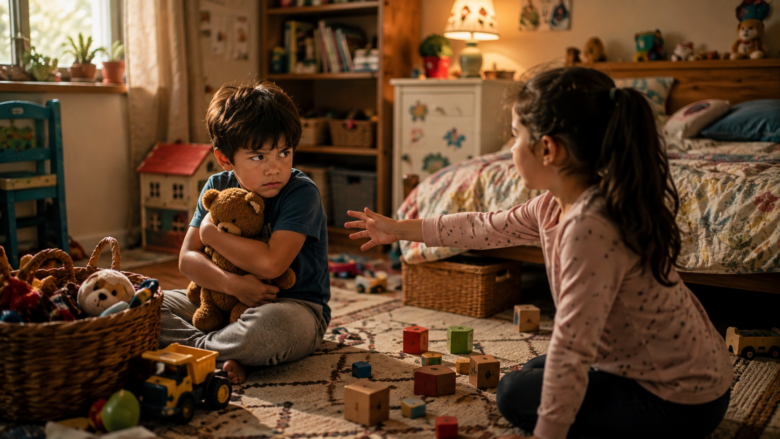
There is something strangely satisfying about drawing a line.
Children divide bedrooms with imaginary boundaries. Neighbours build fences between identical houses. Countries trace borders across mountains, rivers, and deserts.
Even in a crowded café, a laptop and a coffee mug quietly claim a piece of the table as “mine.”
Across cultures and throughout history, humans have displayed an enduring desire to divide space into territories that belong to us and spaces that belong to someone else.
At first glance, borders seem practical. They help organize property, prevent conflict, and define responsibility. But our attachment to borders runs much deeper than law or geography. Long before fences, passports, and property deeds existed, the human brain was already learning to separate the familiar from the unfamiliar. Every invisible line we create today carries echoes of instincts that helped our ancestors survive.
The map of the world may be political, but the first borders were psychological.
Imagine a group of early humans settling near a reliable water source. They learned where food could be gathered, where predators often appeared, and which paths led safely home. That landscape gradually became more than a location. It became their place. Familiar landmarks offered security because they reduced uncertainty. Crossing beyond them meant entering territory filled with unknown dangers.
Evolution rewarded this cautious relationship with space. Individuals who understood the limits of their environment were better equipped to find food, avoid threats, and protect their families. Over thousands of generations, the brain became remarkably skilled at distinguishing between spaces associated with safety and those associated with risk.
Modern borders may be created by governments, but the underlying tendency to organize the world into zones of belonging is far older than civilization itself.
This instinct is visible much earlier than adulthood. Developmental psychologists have observed that young children quickly develop ideas about ownership. A toy becomes “my toy.” A favourite chair becomes “my seat.” Even before children fully understand legal ownership, they instinctively defend objects and spaces they associate with themselves.
These behaviours suggest that territorial thinking is not simply taught by society; it emerges naturally as part of human development.
Ownership begins in the mind long before it appears on paper.

Interestingly, the brain treats physical territory and social identity in surprisingly similar ways. Neuroscientists have found that regions involved in processing information about the self also become active when people think about possessions closely connected to their identity.
A family home, a personal workspace, or even a favourite park can gradually become extensions of who we are. Losing such places often feels less like changing location and more like losing a piece of ourselves.
This psychological attachment explains why arguments over land can become intensely emotional. Two people may disagree over a narrow strip of property, not because of its financial value but because it symbolizes identity, security, and belonging.
Once a place becomes woven into someone’s sense of self, defending it feels deeply personal.
The same principle extends far beyond individual ownership. People naturally organize themselves into groups, from families and neighbourhoods to schools, sports teams, and entire nations. Social psychologists describe this as in-group and out-group thinking.
Simply assigning people to different groups—even randomly—can increase cooperation within the group while creating subtle bias toward outsiders. Borders strengthen these identities by giving abstract communities a physical shape.
A national border, therefore, is not merely a line on a map. It tells millions of strangers that they share a common identity, history, and future. Flags, languages, traditions, and institutions gain additional meaning because they exist within defined boundaries. The border becomes a symbol of collective belonging rather than just geographical separation.
Every border protects something—but it also defines someone.
Of course, borders do not exist only between nations. They quietly shape everyday life in countless invisible ways. We leave an empty seat between ourselves and strangers on public transport whenever possible. We instinctively stand a comfortable distance apart during conversations. Offices have assigned desks. Families have bedrooms.
Even digital spaces contain passwords, privacy settings, and personal accounts that separate “my information” from “everyone else’s.”
These invisible boundaries create order in a world shared by billions of people. Without them, constant uncertainty would replace predictability. Knowing where one person’s responsibilities end and another’s begin allows societies to function smoothly. Psychological comfort often depends on having clear expectations about space and ownership.
Yet the human attraction to borders has another side. Once a line exists, the brain often begins exaggerating its importance. Studies on social identity consistently show that people are more likely to trust and favour those they see as part of their own group, while treating outsiders with greater caution—even when the differences between the groups are minimal or entirely arbitrary.
Borders simplify an incredibly complex world into categories of “us” and “them.”
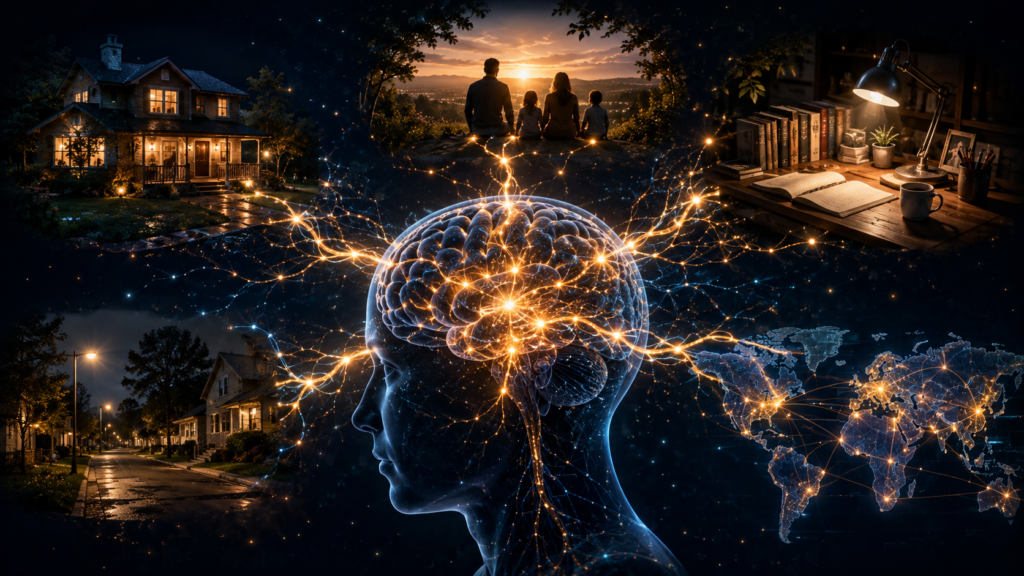
This tendency has helped humans cooperate within communities, but it has also contributed to misunderstanding, prejudice, and conflict throughout history. Many of the divisions people fiercely defend today were drawn relatively recently, while others have shifted repeatedly over centuries.
Nature itself rarely recognizes the neat lines humans place upon it. Rivers change course, forests spread across frontiers, animals migrate freely, and the atmosphere ignores every passport ever issued.
Modern globalization has added another fascinating twist. Information, music, films, ideas, and friendships cross national boundaries almost instantly through the internet. Economies depend on international supply chains, scientific discoveries emerge through global collaboration, and cultures increasingly borrow from one another. The physical border remains, yet many aspects of daily life now flow across it with remarkable ease.
This creates an interesting psychological tension.
Humans continue to seek belonging within clearly defined groups while simultaneously participating in an increasingly interconnected world.
We still need places that feel like home, communities that provide identity, and boundaries that offer stability. But we also depend on cooperation that extends far beyond those same borders.
Perhaps that is why borders remain such powerful symbols. They satisfy an ancient need for order, familiarity, and belonging while constantly reminding us that every line is, in the end, a human decision. The spaces we call “ours” help shape who we become, but they need not prevent us from recognizing the humanity that exists on the other side.
Because the instinct to draw borders may be ancient, but the wisdom lies in remembering that every “them” is also someone else’s “us.”
Author’s Note
Borders shape nearly every aspect of human life, from personal space and private property to nations and cultures. This article explores the evolutionary, psychological, and social reasons behind humanity’s enduring instinct to divide the world into “ours” and “theirs,” while reminding us that every boundary ultimately reflects both our need for belonging and our capacity for cooperation.
G.C., Ecosociosphere contributor.



Comments
Your explanation gave me a thoughtful explanation of the subject today and I look forward to reading more from you