
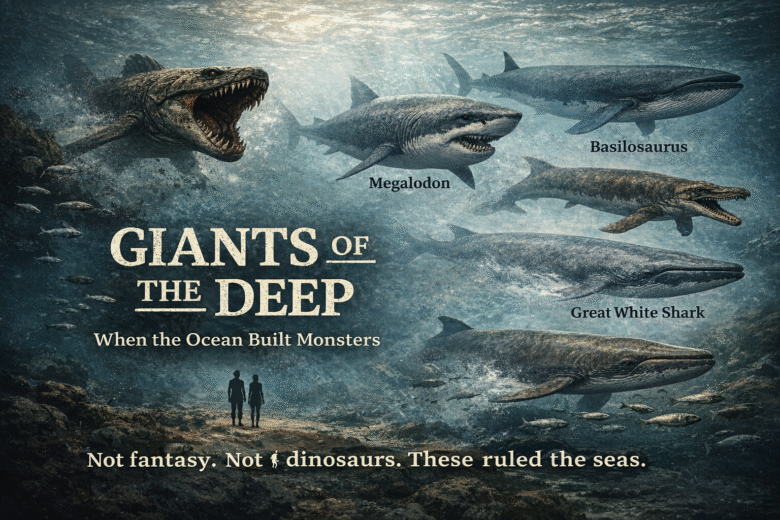
Fun fact: The largest predators that ever lived on Earth were not dinosaurs on land—but monsters that ruled ancient oceans long before humans existed.
When we imagine Earth’s past, our minds usually jump to roaring dinosaurs and fern-covered landscapes. But the real theatre of evolutionary excess was underwater. The oceans of deep time were not calm blue expanses; they were arenas of survival where bizarre super predators ruled with body designs so strange that modern seas feel almost restrained by comparison.
This article, Giants of the Deep: When Oceans Built Monsters, explores a forgotten truth: the most terrifying animals in Earth’s history did not stalk forests—they hunted in silence beneath waves that covered most of the planet.
When the Sea Was the Centre of Power
For most of Earth’s history, land was an afterthought. Life began in water, diversified in water, and perfected predation in water. Ancient oceans were richer, often warmer, and sometimes more oxygenated than today’s seas. That combination created a perfect breeding ground for evolutionary experimentation.
Unlike modern oceans—where food webs are tightly regulated—ancient oceans were chaotic. Nature was still testing what worked. And when evolution experiments without restraint, it produces monsters.
These super predators were not merely large animals. They were ecosystem engineers. Their presence controlled population sizes, shaped prey behaviour, and determined which species survived long enough to evolve further. Remove them, and entire food webs collapsed.
The Cambrian Shock: Predators Before Prey Was Ready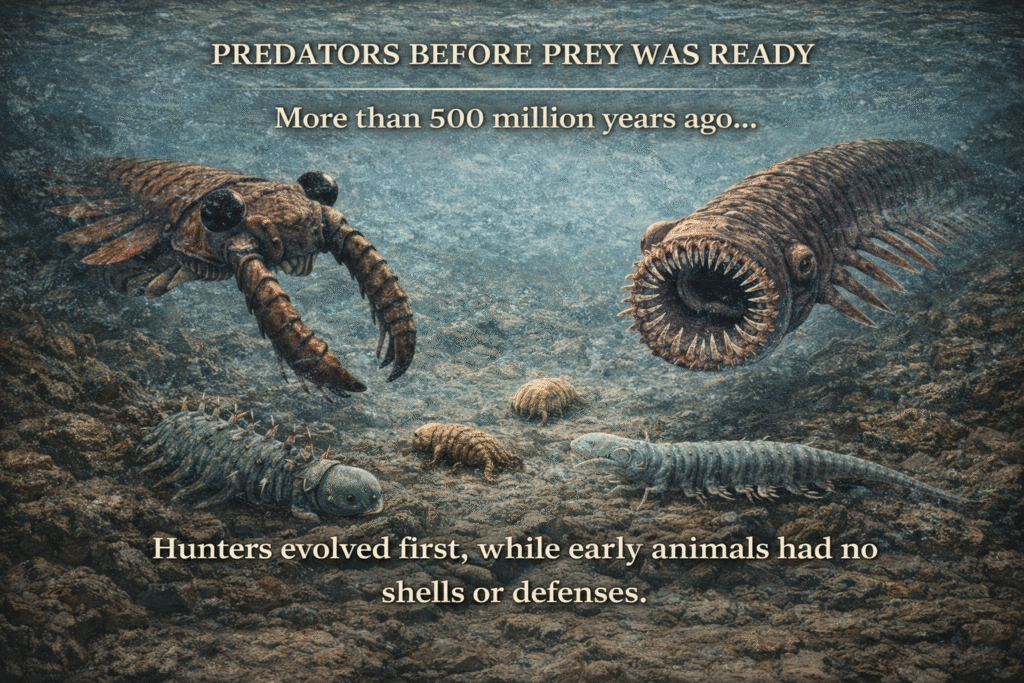
More than five hundred million years ago, life experienced what scientists call the Cambrian Explosion. In a geological blink, simple organisms gave way to complex animals. But what truly accelerated this change was fear.
Early oceans suddenly filled with mobile hunters—creatures equipped with eyes, grasping limbs, and circular mouths lined with spikes. Their prey had no shells, no speed, and no defences. The result was evolutionary panic.
This period forced life to adapt quickly. Hard shells, spines, burrowing behaviour, and camouflage all emerged as responses to predation. In a very real sense, the earliest ocean super predators invented survival pressure itself. Without them, complex animals—including humans—might never have evolved.
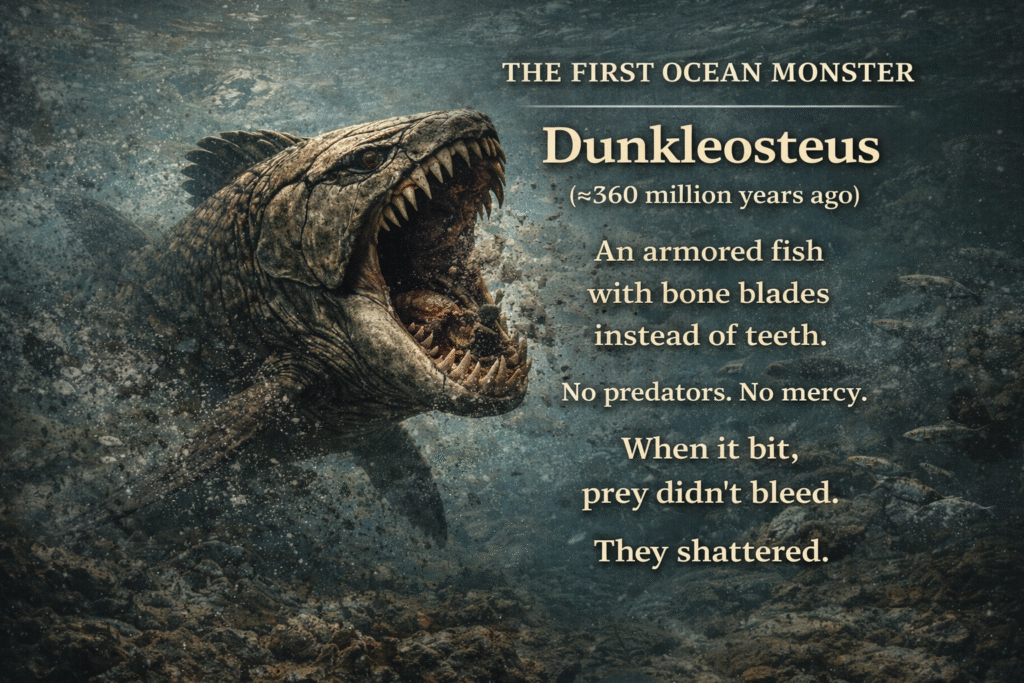 Armoured Fish That Bit Like Machines
Hundreds of millions of years later, the oceans belonged to armoured fish that resembled living war machines. These predators wore thick bone plates instead of scales and used jaw mechanisms that functioned like industrial shears.
What made them truly bizarre was their lack of teeth. Instead, sharpened bone edges sliced through prey with mechanical precision. Some could crush sharks. Others fed on anything slower than themselves—which was almost everything.
These fish did not just dominate the seas; they reshaped them. Their extinction marked one of the first major collapses of marine ecosystems, proving an uncomfortable truth: when top predators disappear, balance disappears with them.
Reptiles That Turned Oceans into Hunting Grounds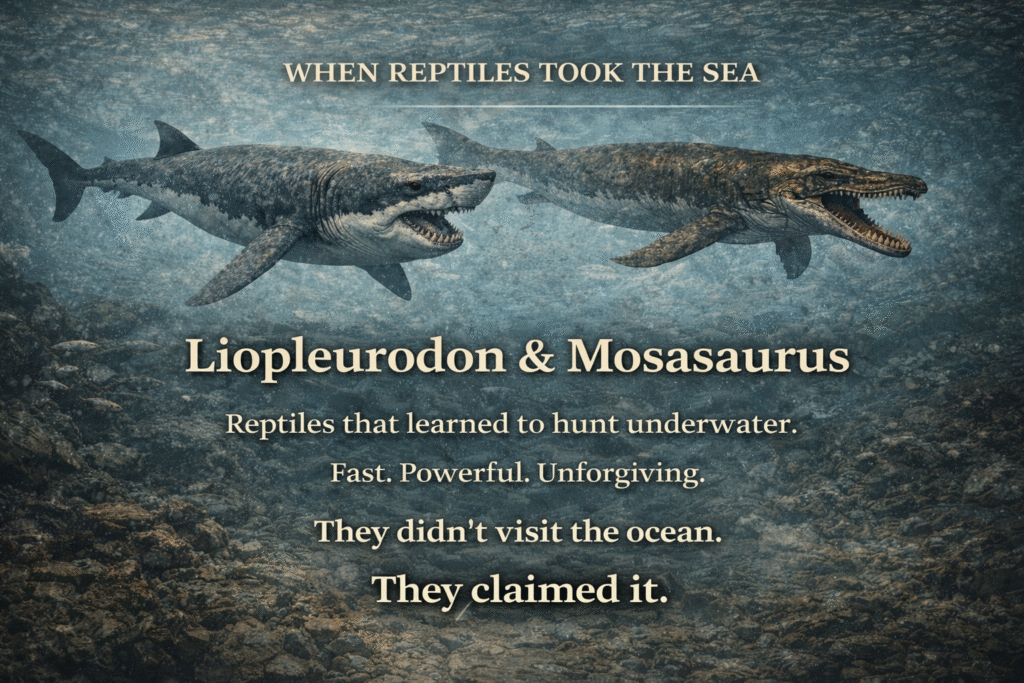
After the greatest mass extinction in Earth’s history wiped out most marine life, reptiles rose from the wreckage and claimed the oceans. And they did so with terrifying efficiency.
Some evolved bodies nearly indistinguishable from modern dolphins—sleek, fast, and built for pursuit. Others resembled floating jaws, with massive skulls designed to ambush prey from below. These creatures hunted fish, squid-like animals, and even other predators.
What made them unsettling was how familiar they feel. These were air-breathing reptiles that gave live birth at sea, migrated across oceans, and hunted cooperatively. They blurred the line between land and water, predator and machine.
Their dominance lasted millions of years—until a cosmic accident ended their reign.
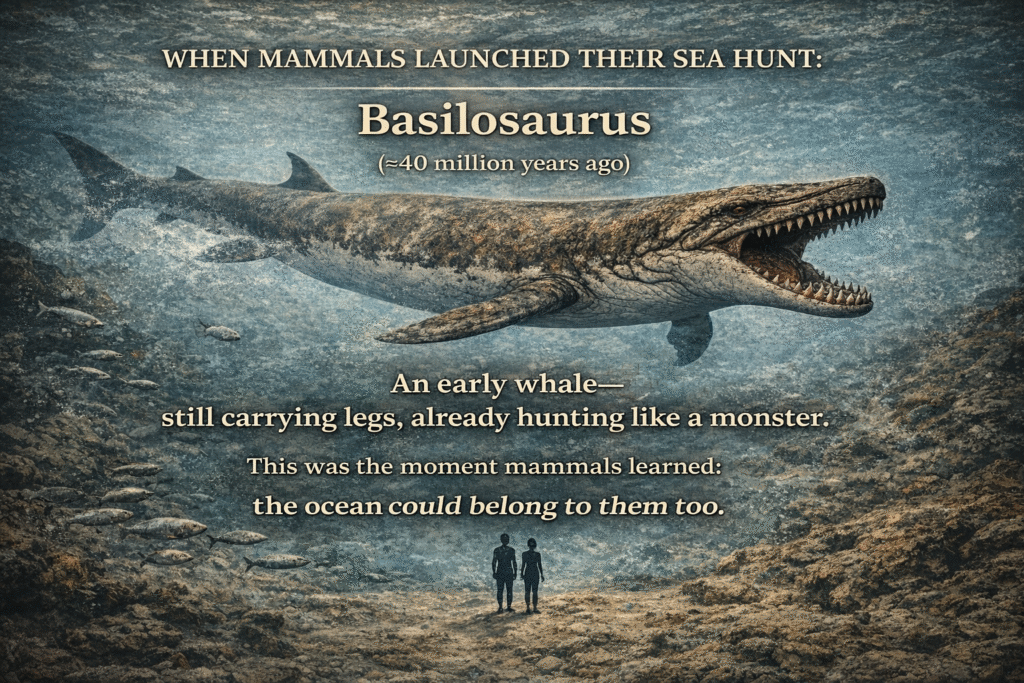 Mammals Take Over—and Bring Relentless Hunger
After the extinction that ended the age of reptiles, mammals stepped into the vacuum. Warm-blooded, intelligent, and endlessly hungry, marine mammals rewrote the rules of oceanic predation.
Some ancient predators from this era hunted early whales. Others controlled entire coastlines. Their success lay not just in size, but in energy. Warm-blooded animals need constant fuel, which means constant hunting.
This era shows a shift in how super predators operate. Raw size mattered less than speed, strategy, and endurance. It was no longer about being the biggest—it was about being the most efficient.
Why Ancient Oceans Allowed Such Extremes
It is tempting to ask why modern oceans do not host creatures like these anymore. The answer is uncomfortable.
Ancient oceans supported:
- Higher biological productivity
- Fewer competitors
- Simpler food chains
Modern oceans, by contrast, are tightly balanced systems. They are also stressed—by climate change, pollution, overfishing, and habitat loss. There is simply not enough surplus life left to support monsters.
In a grim twist, humanity has done what no asteroid could: permanently reduce the ocean’s ability to dream big.
What These Monsters Teach Us Today
Ancient super predators were not mistakes. They were natural outcomes of abundant ecosystems. Their disappearance was often followed by instability, collapse, and long recovery periods.
This matters now more than ever.
As modern apex predators vanish—sharks, large fish, whales—the oceans are becoming quieter, simpler, and less resilient. History shows that ecosystems without top predators do not remain stable. They unravel.
The ancient oceans are not just stories of the past. They are warnings written in fossilized bone.
Conclusion: The Ocean Remembers What We Forget
The oceans once built monsters—not out of cruelty, but out of possibility. They remind us that nature, when given space and time, creates complexity beyond imagination.
If ancient seas could support such super predators, then the absence of similar creatures today is not progress—it is loss.
Perhaps the real question is not why those monsters vanished.
It is whether we will leave behind an ocean capable of creating anything extraordinary at all.
Author’s Note
Some topics refuse to stay academic. This was one of them. Writing about ancient ocean predators felt less like exploring monsters and more like listening to echoes of a world that trusted nature to be large, strange, and unapologetic. Writing matters because it slows us down long enough to notice what has disappeared—and to ask whether we are ready to lose even more.
G.C., Ecosociosphere contributor.
References and Further Reading
- Anomalocaris – One of the Earliest Apex Predators
- Discover Wild Life – Prehistoric Sea Monsters
- ScienceDaily – Ancient Oceans Ruled by Super Predators
- Prehistoric-Life Wiki – Top Aquatic Predators List
- Scienceing – Prehistoric Sea Animals
- Basilosaurus – Early Whale Predator
- Macroraptorial Sperm Whales – Whale Apex Predators