
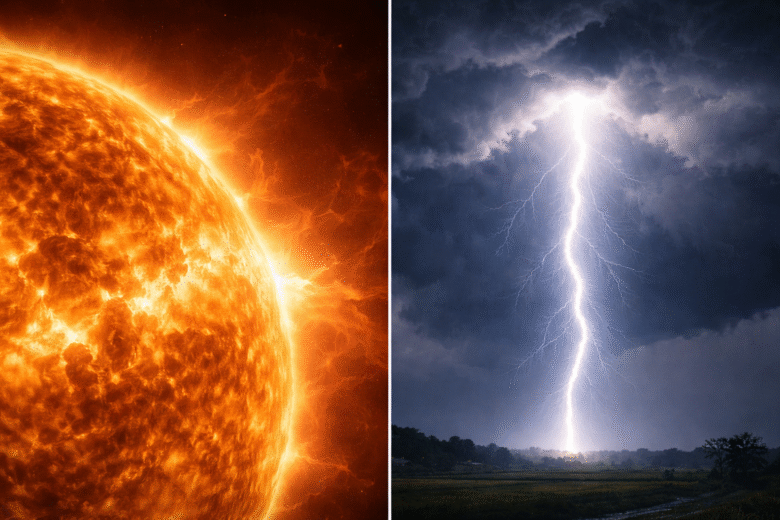
Fun fact first: a single bolt of lightning can briefly heat the air around it to nearly 30,000 degrees Celsius, making it far hotter than the surface of the Sun—right above our heads, during an ordinary monsoon evening.
Yes, you read that right. Lightning is hotter than the surface of the Sun, and not by a small margin. When lightning tears through the sky, it turns the air into something closer to a plasma furnace than a breeze. That idea alone should make us pause mid-scroll. We spend hours debating heatwaves, climate records, and rising temperatures, but casually ignore the fact that nature regularly switches on a temperature five times hotter than the Sun’s surface—just for a few microseconds.
This article is about that contradiction: unimaginable heat wrapped inside something we treat as background drama during a storm.
When the Sky Briefly Becomes an Oven
Let’s start with the number that refuses to sound real. Around 30,000 degrees Celsius. That is the temperature lightning can reach along its path. The surface of the Sun, by comparison, sits at about 5,500 degrees Celsius. So when people say lightning is hotter than the surface of the Sun, they are not exaggerating. They are underselling it.
This extreme heat doesn’t come from fire in the usual sense. It comes from electricity. During a thunderstorm, clouds become charged like giant batteries. When the difference between the cloud and the ground—or between two parts of a cloud—becomes too large, nature does what physics demands: it discharges.
That discharge happens violently. Electrons surge through the air at incredible speeds, colliding with molecules and ripping electrons off them. In that instant, the air stops behaving like air. It becomes plasma, a super-energised state of matter. And plasma, by definition, is hot.
That sudden heating causes the air to expand explosively. The shockwave from that expansion is what we hear as thunder. So thunder is not the sound of lightning striking the ground—it is the sound of air being punched outward by heat that briefly outshines the Sun.
Why Something So Hot Doesn’t Burn Everything
Here’s where common sense protests. If lightning is hotter than the surface of the Sun, why doesn’t it incinerate buildings, roads, and people every time it strikes?
The answer lies in time.
Lightning lasts for microseconds. That heat, extreme as it is, appears and disappears almost instantly. There simply isn’t enough time for that temperature to transfer deeply into surrounding materials. Think of it like touching a hot needle versus holding a warm stone. One is far hotter, but the other burns you more.
This is also why lightning can split trees without setting them on fire. The sap inside the tree flashes into steam faster than it can escape, causing the trunk to explode outward. The damage looks dramatic, but the actual burning is minimal.
So yes, lightning is hotter than the surface of the Sun—but only briefly. Nature turns the heat dial to maximum and then snaps it back to zero before we can fully register it.
India, Monsoons, and Casual Fireworks
In India, lightning deaths quietly outnumber many headline-grabbing natural disasters. Every monsoon season, farmers, construction workers, and people sheltering under trees pay the price for underestimating these “everyday fireworks.”
We treat lightning as visual entertainment. Phones come out. Videos are recorded. There is awe, but rarely respect. Perhaps that is because heat is invisible in lightning. We see the flash, not the temperature. We hear thunder, not the physics behind it.
Understanding that lightning is hotter than the surface of the Sun changes how we look at storms. It turns a pretty light show into a reminder that nature does not scale its power to human comfort. It only scales it to physical laws.
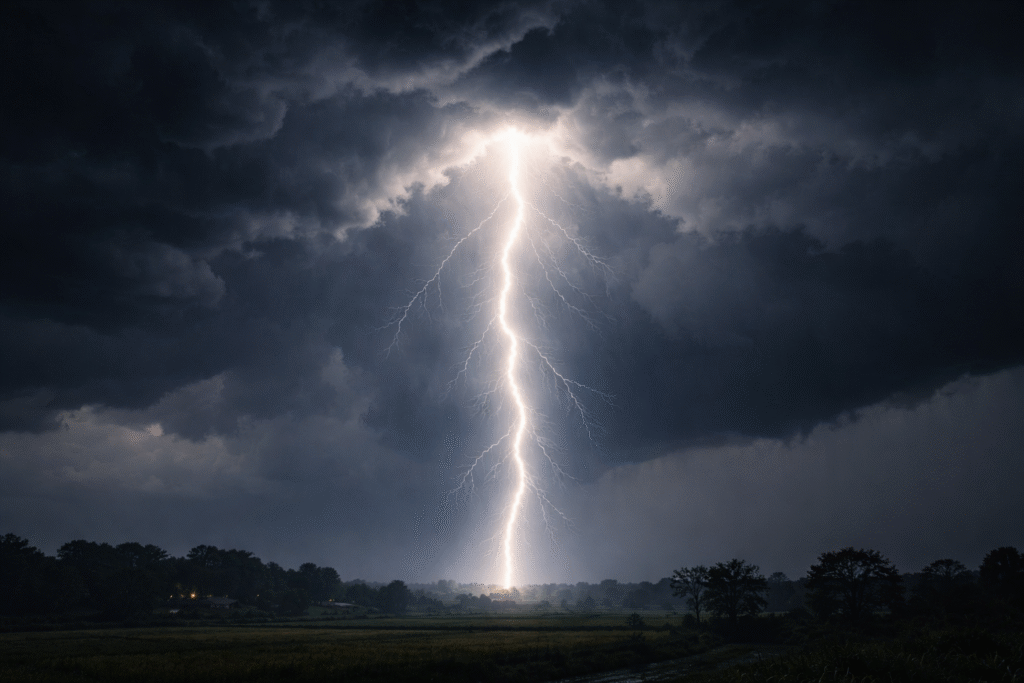
The Physics Hiding in Plain Sight
What makes this even more fascinating is how ordinary the physics actually is. No exotic particles. No cosmic anomalies. No mystery involved—only electric charge doing what it is wired to do.
The same principles that make a small spark jump inside a switchboard are at work in the sky—just magnified millions of times. That spark you avoid while plugging in an appliance is lightning’s humble cousin.
This is where lightning becomes educational, not just dramatic. It shows us that the universe does not reserve its extremes for distant galaxies or black holes. Sometimes, the most violent physics happens right outside your window.
And unlike the Sun, which we mythologise and distance emotionally, lightning feels local. It arrives unannounced. It cracks above temples, schools, farms, and highways. It reminds us that the atmosphere itself is an active, electric system—not empty space.
Hotter Than the Sun, Yet So Familiar
There is something unsettling about the phrase “hotter than the surface of the Sun.” It feels like it belongs in astronomy textbooks, not weather forecasts. Yet lightning drags that phrase down to Earth—literally.
We are used to ranking dangers by scale. Volcanoes feel more dangerous than storms. Space feels more powerful than clouds. But lightning breaks that hierarchy. It compresses solar-level heat into a narrow channel and delivers it within shouting distance.
This also explains why lightning has inspired fear, worship, and symbolism across cultures. Long before thermometers or plasma physics, people sensed that lightning was not just light. It was power concentrated.
Science hasn’t removed that mystery. It has sharpened it.
A Thought Worth Sitting With
If lightning is hotter than the surface of the Sun, what else do we casually ignore because it feels routine?
We walk under charged skies. We live inside a thin atmospheric shell that crackles with energy. We assume safety because familiarity dulls fear. But physics doesn’t care about familiarity.
Perhaps the real lesson of lightning is not about temperature at all. It is about scale and humility. About recognising that the extraordinary often hides inside the ordinary—brief, blinding, and gone before we fully notice.
Conclusion: Respect the Flash, Not Just the Light
Lightning is hotter than the surface of the Sun, not as a trivia point, but as a reminder. A reminder that the natural world routinely reaches extremes we associate with stars and space. A reminder that physics does not switch off just because we are going about our daily lives.
The next time thunder rolls and the sky splits open, don’t just count seconds or admire the flash. Remember what is actually happening. The air is being heated to solar temperatures. The sky is briefly becoming a furnace.
And maybe, just maybe, we should stop calling that ordinary.
Author’s Note
I wrote this because lightning has always felt too familiar for something so violent. We watch it, record it, and move on. But knowing that it briefly burns hotter than the Sun makes it impossible to look at the sky the same way again. Writing, for me, is a way of slowing down these overlooked moments—of reminding ourselves that wonder still exists in everyday things, if we choose to pay attention.
G.C., Ecosociosphere contributor.
References and Further Reading
- National Weather Service (U.S. Government) – Lightning Temperature
- NOAA (National Oceanic and Atmospheric Administration) – What Causes Lightning and Thunder
- NASA Earthdata – Lightning Overview
- Met Office (UK) – Facts About Lightning
- National Geographic Education – Lightning Facts
- UCAR Center for Science Education – Thunder and Lightning