
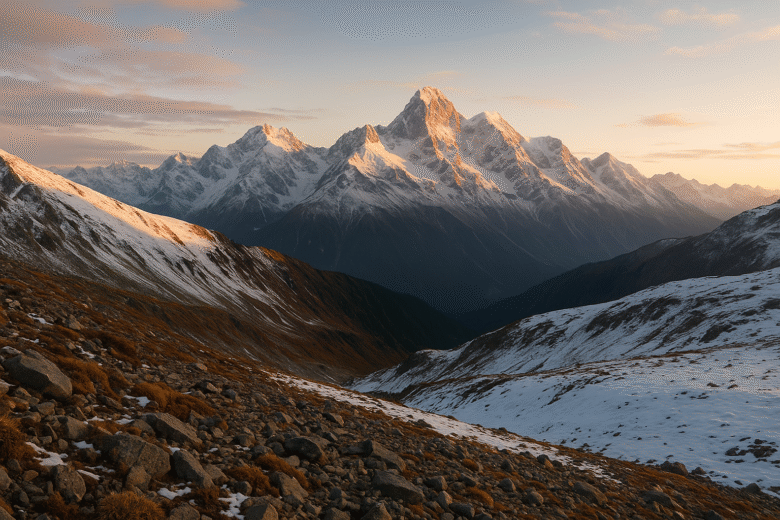
Did you know that some of the world’s most advanced robots are now better climbers than many humans?
“Robots on Remote Mountains” may sound like a science-fiction headline, but it reflects a quiet shift happening high above our cities and farms. As climate change tightens its grip on cold-adapted species and mountain ecosystems grow more fragile, robotics and artificial intelligence are being tested as new tools to observe, document, and protect life in places humans can barely reach.
Mountains have always been difficult to study. They are steep, unpredictable, and dangerous — yet they shelter some of the most specialised and vulnerable species on Earth. Today, as warming temperatures push plants and animals uphill with nowhere left to go, the question is no longer whether we should monitor alpine biodiversity more closely, but how we can do it without destroying the very ecosystems we hope to protect.
Why Alpine Biodiversity Is So Easy to Lose
Alpine ecosystems exist on the edge of survival. Thin soils, short growing seasons, intense ultraviolet radiation, and freezing temperatures mean that every species living there is finely tuned to a narrow range of conditions. A slight shift in snowfall patterns, a warmer summer, or the arrival of an invasive species can unravel these systems quickly.
Yet monitoring these changes is extremely difficult. Field scientists often have only a short window each year to access high-altitude regions. Reaching many sites requires days of trekking, specialised equipment, and considerable risk. As a result, data is often patchy, irregular, and incomplete.
This lack of consistent monitoring creates a dangerous blind spot. Species can decline, habitats can fragment, and entire micro-ecosystems can disappear long before anyone notices.
When Ecology Meets Engineering
This is where robotics enters the picture — not as a replacement for scientists, but as a force multiplier.
Recent advances in robotic and autonomous systems have made it possible for machines to move through rough terrain, collect high-resolution data, and repeat surveys with a consistency that humans simply cannot manage. These robots do not suffer from altitude sickness, fatigue, or fear of unstable slopes. They can return to the same location again and again, quietly building a long-term record of environmental change.
Legged robots, in particular, are proving valuable in alpine environments. Unlike wheeled vehicles, they can step over rocks, balance on loose scree, and navigate narrow ridges. Equipped with cameras, environmental sensors, and artificial intelligence-based image recognition, these machines can document plant cover, identify species, and detect subtle changes over time.
The result is not dramatic rescue missions or flashy technology, but something far more powerful: continuity.
Walking Robots on Fragile Slopes
One of the most promising applications of robotics in alpine biodiversity research involves quadruped robots designed to traverse unstable, rocky terrain. In multi-year field trials, such robots have been deployed alongside botanists to monitor alpine scree habitats — loose rock slopes where rare plants survive in tiny pockets of stability.
These robots act like tireless field assistants. They move methodically across dangerous terrain, capturing detailed imagery and environmental data while reducing the physical risk to human researchers. Artificial intelligence tools then help analyse this data, identifying plant species and tracking changes in their distribution.
For habitats that were previously visited once every few years — if at all — this represents a major shift. Regular monitoring becomes possible, not just for flagship species but for entire plant communities that quietly underpin mountain ecosystems.
Drones: The Eyes in the Sky
Ground robots are only part of the story. Drones, formally known as uncrewed aerial vehicles (UAVs), are transforming how scientists view mountain landscapes at a larger scale.
Flying over ridges, valleys, and glaciers, drones equipped with thermal sensors, multispectral cameras, and laser-based mapping tools can create detailed, three-dimensional models of alpine terrain. These models reveal patterns invisible to the naked eye — vegetation stress, soil movement, snowmelt timing, and habitat fragmentation.
When combined with ground-based robotic surveys, drones allow researchers to link fine-scale biological observations with broader landscape changes. This layered approach helps scientists understand not just what is changing, but why.
What Robots Can — and Cannot — Do
It is tempting to imagine technology as a silver bullet for conservation. But robotics, for all its promise, has limits.
Many alpine species are small, cryptic, or seasonal. Some insects, fungi, and soil organisms remain extremely difficult to detect using current sensors. Harsh weather can disrupt robotic missions, and battery life remains a challenge in cold, remote environments.
There are also ethical and practical concerns. Over-reliance on technology risks sidelining local ecological knowledge and reducing the role of human observation. Conservation is not just about data — it is about values, communities, and choices.
Most researchers therefore emphasise balance. Robots should support human expertise, not replace it. They are tools for seeing more clearly, not excuses for disengagement.
Why This Matters Now
Climate change is compressing alpine life into shrinking refuges. Species that once occupied broad elevational ranges are being pushed upward, step by step, until there is nowhere left to climb. Without reliable monitoring, these losses often go undocumented — disappearing quietly, without headlines or public outrage.
Robotics offers a way to bear witness.
By extending our reach into remote mountain ecosystems, these technologies help us notice change early, respond intelligently, and argue more convincingly for protection. They turn inaccessible places into measurable realities — and what can be measured is harder to ignore.
Conclusion
Robots on remote mountains are not symbols of technological dominance over nature. They are signs of humility — acknowledgements that human limits should not become excuses for ecological neglect. When used wisely, robotics and artificial intelligence can help us listen more closely to landscapes that are already under strain.
Alpine biodiversity does not need saving by machines alone. It needs attention, patience, and sustained care. If robots can help us see what is changing before it is too late, then they become something more than machines. They become witnesses — and sometimes, quiet guardians.
Author’s Note
I keep returning to mountains in my writing because they remind me how fragile resilience really is. Teaching during the day, I see how easily young minds assume nature is permanent. Writing at night, I’m more aware of how temporary it can be. This piece mattered to me because attention is the first form of care. If technology helps us pay attention — especially where we rarely look — then writing about it becomes a small act of responsibility.
G.C., Ecosociosphere contributor.
References and Further Reading
- Opportunities and Challenges for Monitoring Terrestrial Biodiversity with Robotic and Autonomous Systems
- Botany Meets Robotics in Alpine Scree Monitoring
- Integration of Drones in Landscape Research
- Robotics, Drones and Sensors: Biodiversity — Boom or Bust?
- Legged Robots for Environmental Monitoring (Natural Intelligence Review)