
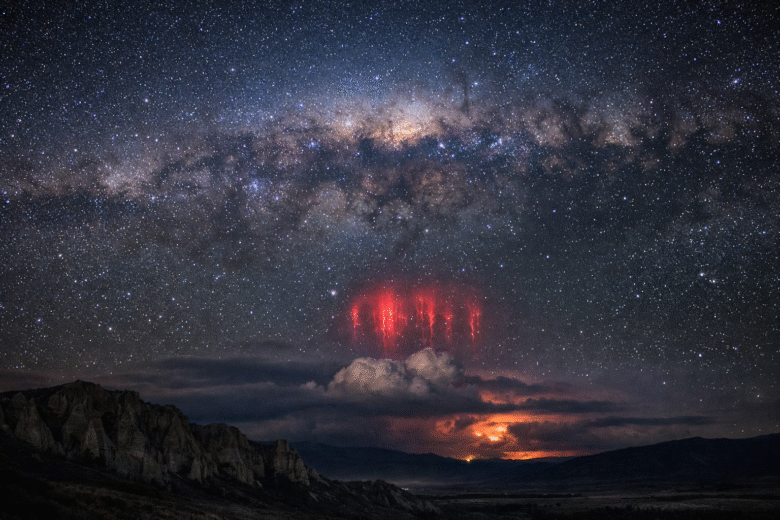
Fun fact: Earth regularly produces lightning above storms that shoots upward into space—but almost no human ever sees it.
When the Sky Turned Red: Lightning We Weren’t Meant to See is not a headline from science fiction, even though it sounds like one. In October 2025, the skies above New Zealand briefly revealed a phenomenon so rare and fleeting that it exists at the edge of human perception. Red sprites—enormous electrical discharges glowing crimson in the upper atmosphere—flashed silently above a distant thunderstorm while photographers were busy framing the Milky Way. They were not hunting lightning. They were not expecting the sky to answer back.
What followed was not just a spectacular photograph, but a reminder that Earth still holds secrets above our heads—phenomena that happen whether or not we are watching. The red sky did not announce itself. It appeared, vanished, and left behind a question: how much of our planet’s drama unfolds without us noticing?
Lightning That Defies Direction
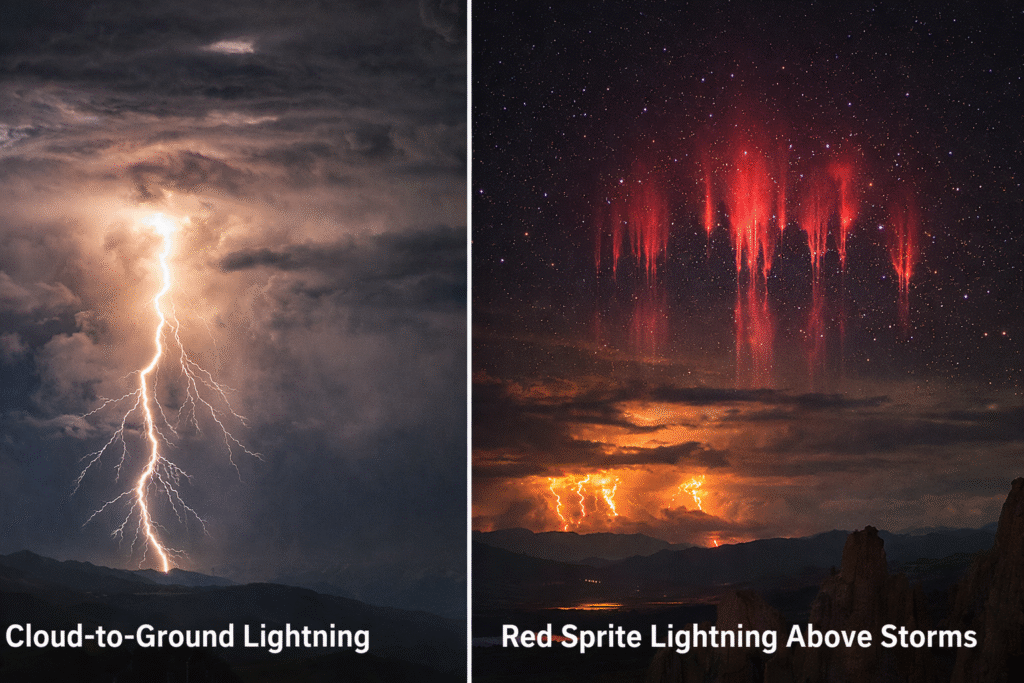
Most of us grow up believing lightning moves one way—downward, violent, loud, and unmistakable. But red sprites do the opposite. They erupt upward from thunderclouds, racing into the upper layers of the atmosphere at altitudes far higher than commercial aircraft ever fly. These flashes are enormous, sometimes stretching tens of kilometres, yet they last only milliseconds. Blink, and they are gone.
That contradiction—huge but invisible, powerful yet silent—is part of what makes red sprites unsettling. They expose how limited our senses really are. Storms we think we understand are quietly interacting with the edge of space, exchanging energy in ways textbooks barely mention.
The Night the Sky Gave Away a Secret
The New Zealand sighting was not planned. Three astrophotographers were photographing the Milky Way over the South Island when their cameras captured faint red tendrils rising above the horizon. At first, the images looked like digital artefacts—errors, reflections, sensor noise. Only later did the truth emerge: they had recorded red sprites triggered by lightning from a storm hundreds of kilometres away.
This is the uncomfortable beauty of the story. The photographers were not chasing science. Science found them anyway. The universe did not care about intention. It rewarded patience, stillness, and timing—qualities increasingly rare in a world obsessed with instant results.
Why Red Sprites Stay Hidden
Red sprites occur high in the mesosphere, a region of the atmosphere that sits awkwardly between weather and space. Too high for balloons, too low for satellites, and too brief for casual observation, this zone remains one of Earth’s least explored layers. Sprites only appear under specific electrical conditions, usually following powerful lightning strikes below.
Human eyes are simply not built to catch them. Cameras, however—sensitive, patient, unblinking—have become accidental witnesses to a layer of reality we evolved without needing to see. Technology, in this case, is not distancing us from nature. It is revealing just how incomplete our view has always been.
A Sky That Refuses to Be Ordinary
There is something quietly provocative about red sprites. They challenge the idea that Earth is predictable, mapped, and fully understood. We speak confidently about climate systems, weather patterns, and atmospheric models, yet phenomena like these still surprise us decades after their first documentation.
In a time when headlines are crowded with human-made crises, red sprites feel like a cosmic interruption. A reminder that the planet is not merely reacting to us—it is performing its own ancient choreography, indifferent to our schedules and assumptions.
Art, Science, and Accidental Discovery
The photographs matter not just for their rarity, but for what they represent. They sit at the intersection of art and science, where curiosity rather than control drives discovery. The photographers did not measure the sprites. They did not explain them. They noticed them.
That act—simply noticing—is increasingly radical. We scroll past wonders daily, eyes trained for outrage rather than awe. Red sprites ask us to slow down and admit that some truths arrive quietly, without explanation or permission.
Why This Moment Resonates Now
There is a deeper reason this story has captured attention. It is not just about rare lightning. It is about humility. In an age where algorithms predict our desires and satellites map every inch of Earth, the idea that the sky can still surprise us feels almost rebellious.
Red sprites do not threaten us. They do not ask anything from us. They simply exist—brief, brilliant, and uninterested in being photographed. That indifference is what makes them powerful. They remind us that wonder is not something we manufacture. It is something we stumble upon when we are paying attention.
Conclusion
When the sky turned red over New Zealand, it was not announcing a new era of discovery. It was quietly reminding us that discovery never stopped. The planet continues to speak in flashes, whispers, and signals beyond our senses, waiting for moments when technology and curiosity accidentally align.
Perhaps the real lesson of red sprites is not scientific at all. It is human. We are not spectators standing outside nature—we are participants inside it, often too distracted to notice. The sky does not owe us explanations. But every now and then, it offers a glimpse anyway.
The question is not whether Earth still holds mysteries. The question is whether we are still capable of seeing them.
Author’s Note
This story stayed with me because it felt deeply familiar. Writing, for me, is not about providing answers—it is about reopening the space for wonder. If the sky can still surprise us, perhaps our thinking should remain unfinished too.
G.C., Ecosociosphere contributor.
References and Further Reading
- Rare Red Lightning Captured Over New Zealand Skies
- What Are Red Sprites? NASA Explains Upper-Atmospheric Lightning
- Transient Luminous Events: Sprites, Jets, and ELVES
- First Photographic Evidence of Red Sprites
- The Mesosphere: Earth’s Least Explored Atmospheric Layer
- How Cameras Capture What Human Eyes Cannot See