Fun fact: The same human body that can survive a freezing night on a Himalayan slope can also boil itself alive with a fever only a few degrees higher than normal.
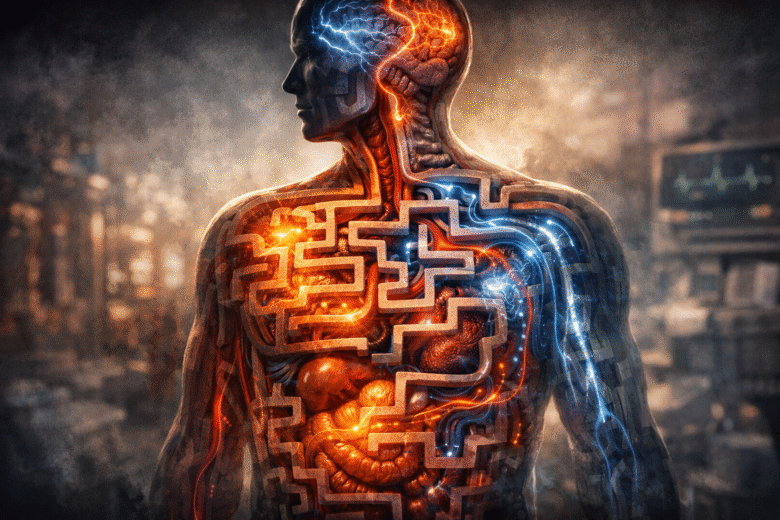
Your body is a maze of extraordinary extremes, and most of us walk through it every day without noticing the quiet madness inside. From the outside, the human body looks predictable: two hands, two legs, a familiar face in the mirror. But beneath the skin is a landscape of contradictions—fragile yet stubborn, precise yet chaotic, capable of breathtaking resilience and sudden failure. We celebrate technology, cities, and machines as marvels of complexity, but we forget that the most extreme system we will ever inhabit is already breathing, digesting, repairing, and occasionally betraying us from within.
This article, Your Body Is a Maze of Extraordinary Extremes, is not about trivia for trivia’s sake. It is about re-learning awe. About remembering that survival is not neat or elegant—it is loud, messy, and full of biological compromises. And perhaps, if we look closely enough, it might change how casually we treat ourselves.
The Body’s Narrow Survival Window
Let us begin with temperature—because here, the extremes are brutal. Your body operates best within a narrow thermal band. Just a few degrees too cold, and enzymes slow, nerves misfire, and organs stumble. A few degrees too hot, and proteins begin to unravel like badly knitted sweaters. There is no heroic margin here. Evolution did not give us much room to improvise.
And yet, humans live in deserts, polar regions, and everything in between. How? Not because the body is invincible, but because it is relentlessly adaptive. Sweat glands trade water for cooling. Blood vessels widen and tighten like adjustable valves. Shivering becomes a desperate engine of heat production. These are not elegant solutions; they are emergency responses, buying time rather than guaranteeing comfort.
We often talk about “pushing our limits,” but biologically, most of life is about not crossing them.
Strength Where You Least Expect It
Your bones feel solid, permanent, dependable. But bone is not dead scaffolding. It is living tissue, constantly breaking down and rebuilding itself. Every step you take sends micro-fractures rippling through your skeleton—and every night, specialized cells rush in to repair the damage. Without this quiet demolition and reconstruction, bones would become brittle and useless.
Here is the extreme: bones must be rigid enough to support your weight and flexible enough to absorb shock. Too stiff, and they shatter. Too soft, and they bend. The human skeleton exists in a tense compromise, tuned by hormones, nutrients, and mechanical stress. It is not built for immortality; it is built for use.
That is why inactivity weakens bones just as surely as trauma breaks them. The body rewards movement not with aesthetics, but with structural integrity.
The Brain: A Power-Hungry Dictator
Your brain weighs roughly as much as a coconut, yet it consumes about one-fifth of your body’s energy. It demands sugar and oxygen with the impatience of a spoiled monarch. Deprive it for minutes, and consciousness fades. Deprive it longer, and the damage becomes permanent.
But this dependency buys something extraordinary. The brain can rewire itself. Neurons form new connections, discard old ones, and reshape entire networks based on experience. This plasticity allows recovery after injury, learning across a lifetime, and adaptation to environments our ancestors never imagined.
The extreme here is not intelligence—it is cost. The brain’s brilliance comes at the price of vulnerability. We carry our most precious organ in a fragile skull, one accident away from irreversible change. And still, we risk it daily without a second thought.
Your Immune System: Paranoia as a Survival Strategy
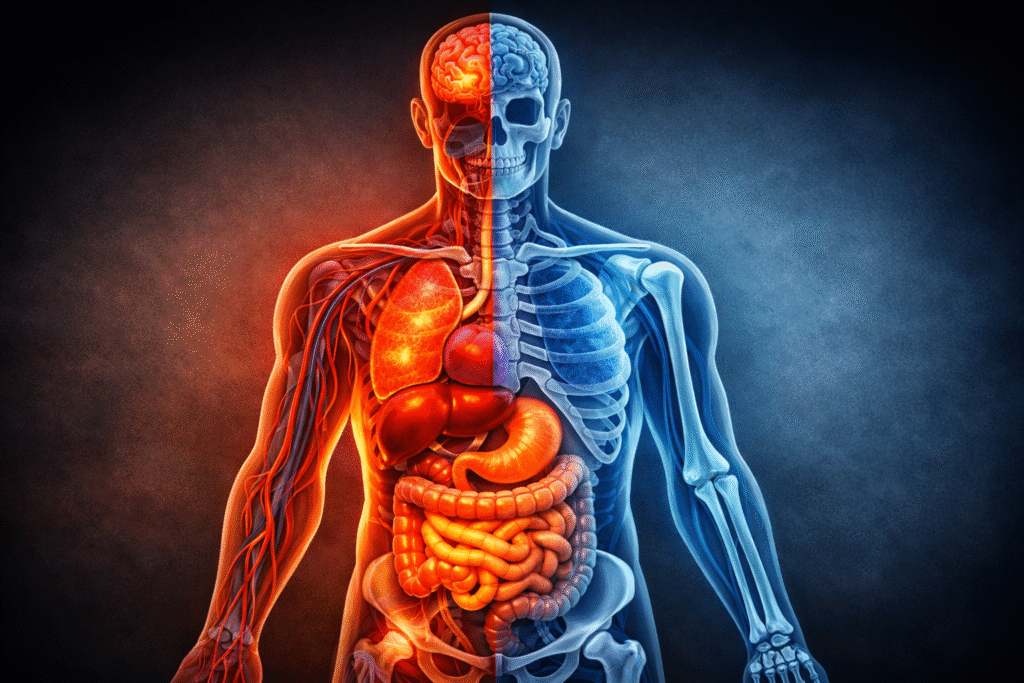
If your immune system were a person, it would be accused of overreacting. It attacks aggressively, remembers grudges for decades, and sometimes mistakes harmless substances for existential threats. Allergies and autoimmune disorders are not bugs in the system; they are the shadow side of an organism trained to expect danger.
This system operates at extremes of speed and precision. It must distinguish between self and non-self with terrifying accuracy, yet respond fast enough to stop infections before they spread. Too slow, and pathogens win. Too aggressive, and the body attacks itself.
Every fever, every swelling, every ache during illness is evidence of a war being fought on your behalf—often with collateral damage. The immune system does not aim for comfort. It aims for survival.
The Gut: Where You Are Outnumbered
You are not alone inside your own body. Trillions of microbes live in your digestive system, outnumbering your own cells and performing tasks you cannot. They help digest food, train the immune system, and even influence mood and behaviour through chemical signalling.
This is an extreme partnership. Feed them poorly, and they shift in ways that promote inflammation and disease. Care for them, and they return the favour with resilience and balance. The gut is not just a pipe for food; it is an ecosystem, sensitive to diet, stress, and lifestyle.
We like to imagine ourselves as singular beings. Biology insists otherwise.
Pain, Healing, and the Illusion of Control
Pain is another extreme we misunderstand. It is not merely a warning signal; it is a negotiation tool. Pain forces behaviour change—rest, avoidance, caution—long before damage becomes catastrophic. But pain can also outlive its usefulness, persisting long after tissues have healed.
Healing itself is messy. Scar tissue is stronger but less flexible. Regeneration is often incomplete. The body prioritizes speed over perfection because, in evolutionary terms, surviving now mattered more than functioning flawlessly later.
This is a hard truth: the body does not care about aesthetics, symmetry, or long-term comfort. It cares about making it to tomorrow.
Conclusion
Your body is a maze of extraordinary extremes—fragile thresholds, excessive demands, brutal trade-offs, and astonishing recoveries. It is not a machine designed for ease or efficiency, but a living compromise shaped by millions of years of risk. Every breath, every heartbeat, every repair is a small act of defiance against entropy.
Perhaps the most provocative idea is this: if we truly understood how precarious and miraculous our bodies are, we might stop treating them as disposable. We might rest without guilt, eat with intention, move with gratitude, and listen when discomfort whispers before it has to scream.
The maze is not something to conquer. It is something to respect.
Author’s Note
I wrote this because teaching biology often feels like explaining miracles using ordinary words. Somewhere between the syllabus and the stopwatch, wonder gets lost. This topic mattered to me because the human body deserves more than casual familiarity—it deserves attention. Writing, for me, is a way of slowing down long enough to notice what we usually rush past. Not to impress, but to remind. Not to instruct, but to awaken.
G.C., Ecosociosphere contributor.
References and Further Reading
- Physiology, Temperature Regulation – StatPearls (NIH)
- A systematic framework for the microbiome in human health and disease (Nature)
- Human gut microbiota in health and disease (Frontiers in Microbiology)
- Gut microbiota and host temperature tolerance (BMC Microbiology)
- Osteoimmunology overview (Wikipedia)
- Thermal effects on bone microenvironment (MDPI)
- The immunology of sickness metabolism (Nature)
- Neuroplasticity and microbiome interaction (Frontiers)