
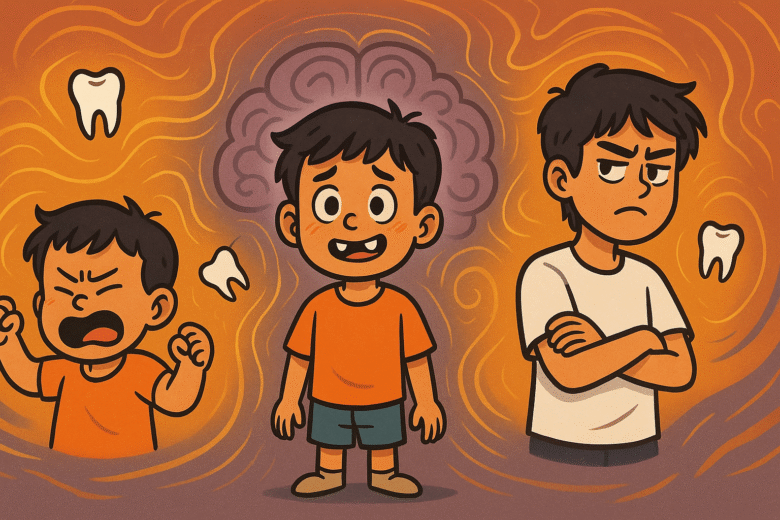
Fun Fact: Scientists in Germany actually coined a term for the dramatic behaviour shift in six-year-olds—they call it Wackelzahnpubertät, or “Wobbly-Tooth Puberty.”
If your six-year-old has recently started arguing like a teenager, slamming doors (sometimes dramatically but not very effectively), rolling their eyes with surprising skill, or negotiating bedtime with the confidence of a corporate lawyer, welcome to the club—and welcome to Wobbly-Tooth Puberty. In this strange little window between toddlerhood and adolescence, children go through a phase so chaotic and emotionally explosive that psychologists decided to name it after… loose teeth.
But behind the sudden sass, emotional storms, and “You can’t tell me what to do!” moments, Wobbly-Tooth Puberty reveals something deeper: a massive shift happening inside the child’s brain, identity, and sense of self. And if it feels like your once-sweet child has transformed into a tiny rebel committee, you’re not imagining it. This phase is real, universal, and weirdly under-discussed.
What Exactly Is Wobbly-Tooth Puberty?
Around ages six to eight, children experience rapid brain development. Their reasoning improves, their emotional regulation wavers, and their self-awareness spikes—just enough to cause chaos. Psychologists compare Wobbly-Tooth Puberty to a mini-adolescence: the child is caught between two worlds.
They’re not small enough to rely on you blindly.
They’re not old enough to handle big feelings gracefully.
So instead, they oscillate between independence and meltdown, often within five minutes.
This phase is marked by:
- More arguments
- Fierce opinions
- Mood swings
- Dramatic emotional reactions
- Sudden defiance
- Heightened sensitivity
- A growing desire for autonomy
The article from your uploaded file captures this perfectly—children resisting instructions, demanding “more TV time,” or declaring “no more karela!” with a conviction that could start a small movement.
The Science Under the Sass
What makes Wobbly-Tooth Puberty unique is that it happens when the child’s baby teeth begin to fall out—an oddly symbolic timing.
Inside the brain, neural pathways are forming rapidly.
Outside, the child’s identity is forming even faster.
They begin to ask questions such as:
- “Who am I compared to others?”
- “Why should I listen to you?”
- “Do I get to decide anything?”
Logical reasoning improves—but emotional reasoning lags behind.
This is the perfect recipe for arguments.
For example:
A six-year-old can now understand why certain rules exist, but their desire for independence makes them resist these rules anyway. They want to feel in control, even if they don’t fully understand the consequences of their choices.
Parents Feel the Shock First
The article captured the exhaustion of many parents who thought the toddler stage was the toughest. But suddenly, the “easy” six-year-old becomes argumentative.
“When the boys were little, I could lay certain boundaries. Now, they push back so much,” says one mother.
Another parent calls this stage harder than the toddler years because the child now has arguments, not just tantrums.
A parent coaching expert in the article explains that this sudden rudeness isn’t actually rudeness—it’s the child asserting autonomy. Unfortunately, it looks like rudeness, which leads to more parent-child conflict.
Why This Phase Feels So Intense
Two reasons:
Children Now See Themselves as Separate Individuals
This is a new feeling.
A powerful feeling.
A confusing feeling.
It makes them experiment with emotional expression—sometimes aggressively.
The World Around Them Is Bigger
Exposure to school environments, peer groups, and online influences shapes their tone and reactions. Children imitate what they observe, often without nuance or understanding.
So yes—if your child suddenly argues like a “mini teen,” they’re not plotting a coup. They’re just processing the world.
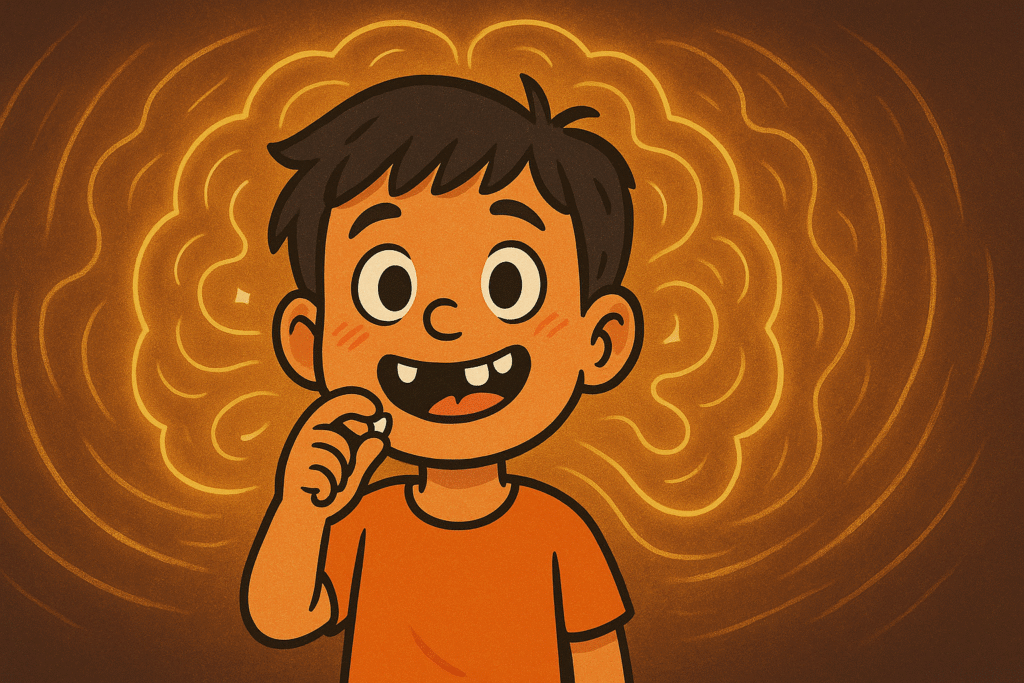
How Parents Can Survive Wobbly-Tooth Puberty
The article gives a helpful set of suggestions, which I’ll expand into a broader understanding.
Acknowledge Their Feelings
Children in Wobbly-Tooth Puberty crave respect.
Not adult-level respect—but the dignity of being heard.
Simply saying “I understand” can calm a storm.
Offer Choices, Not Commands
Instead of
“Sit down and finish your homework,”
try
“Do you want to start with writing or reading?”
Control—even small control—soothes the chaos.
Stay Consistent With Boundaries
Children push boundaries to check stability.
If the rules wobble, they wobble harder.
Model Calm Assertiveness
If we shout, they learn shouting.
If we negotiate calmly, they absorb that too.
Don’t Take the Backtalk Personally
Their emotional brain is still under construction.
The behaviour is developmental, not disrespectful.
Praise Effort
Children in this stage respond deeply to encouragement.
It reduces their need to rebel for attention.
The Bigger Picture: Childhood Is Not Linear
One of the most important ideas the article hints at is the myth of the “easy middle years.” We act as if ages five to ten are a smooth runway between toddler chaos and teenage turbulence.
But the truth is different:
Middle childhood is loud, messy, emotional, and deeply transformative.
Wobbly-Tooth Puberty reminds us that children are not passive passengers on a growth timeline. They shift, question, struggle, and stretch. Their emotions flare and fold back in. Their identities tug in different directions.
If toddlers learn how the world works,
then six-year-olds learn how they work within the world.
That is not a small thing.
Conclusion
Wobbly-Tooth Puberty is not a disruption in childhood—it is childhood. The arguments, the tiny rebellions, the sudden questions about fairness and control are all signs that the child’s brain and identity are maturing. This phase can feel overwhelming, but it is also a rare glimpse into the formation of a person: a small human discovering their place in a very large world.
So the next time your six-year-old argues like a teen, step back.
This isn’t disobedience.
It’s development.
And the job is not to silence the storm, but to teach them how to sail through it.
Author’s Note
Some phases in childhood sneak up on us—quietly, suddenly, sharply. Writing about Wobbly-Tooth Puberty reminded me how often we underestimate the emotional lives of children. They feel everything at full volume. They stretch into themselves with urgency and uncertainty. And somewhere in the middle of all this, grown-ups must hold the space steady. That, to me, is the quiet courage of parenting: staying grounded while someone else learns to rise. Writing this piece mattered because understanding children is not an academic task; it is an act of empathy—a reminder that growth is always a little wild before it becomes wise.
G.C., Ecosociosphere contributor.



Comments
It’s actually a great and helpful piece of information. I am happy that you just shared this
helpful information with us. Please keep us up to date like this.
Thanks for sharing.
Does your blog have a contact page? I’m having a tough time locating it
but, I’d like to send you an e-mail. I’ve got some ideas for your blog you might be interested in hearing.
Either way, great website and I look forward to seeing it expand over time.