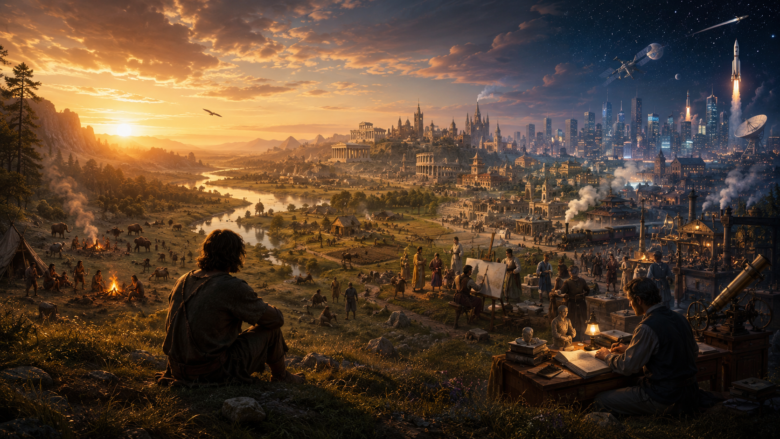
Boredom feels like a problem waiting to be solved.
We complain about it, avoid it, and increasingly design our lives around escaping it. A quiet moment appears and we instinctively reach for something to fill it. A phone, a video, a conversation, a notification. Modern life offers countless ways to ensure that we are rarely left alone with our thoughts for very long.
Yet boredom refuses to disappear.
That persistence is strange when you think about it. If boredom has survived for thousands of generations, it is probably doing more than simply making us uncomfortable. Pain protects us from injury. Hunger encourages us to eat. Fear helps us avoid danger. If boredom has accompanied human beings throughout history, then perhaps it is doing something more important than simply making us uncomfortable.
Maybe boredom was never a flaw. Maybe it was a feature.
For most of human history, life contained long stretches of repetition. There were no endless streams of entertainment waiting to occupy attention. People walked long distances, performed routine tasks, watched the weather, and waited. For much of human history, life unfolded at a pace that would feel almost unimaginable today.
In that environment, a mind that occasionally became restless may have held an advantage.
A hungry brain finds food. A bored brain finds possibilities.
Researchers often describe boredom as a signal that our attention is no longer meaningfully engaged with the present moment. Something feels incomplete. Something feels insufficient. The mind begins searching for alternatives.
For our ancestors, that search may have mattered more than we realize.
Imagine an early human living beside a familiar river. The area is safe. The routines are known. The resources are predictable. There are good reasons to stay exactly where they are.
But there are also reasons to leave.
A person completely satisfied with repetition might never explore beyond what is already familiar. A restless person, however, might wander farther, discover new resources, find better opportunities, or notice possibilities that others missed. What feels like boredom today may once have been a small evolutionary push toward exploration.

Before boredom inspired creativity, it probably inspired movement.
The first frontier humans encountered was the physical world. Mountains, forests, rivers, and coastlines all represented unknown territory. Curiosity and restlessness helped drive people beyond the boundaries of what they already understood.
But eventually something changed.
The frontier moved inside the human mind.
As societies became more stable, exploration was no longer only about discovering new places. It became about discovering new ideas. The same restlessness that once pushed people beyond familiar horizons could now push them toward ideas, inventions, stories, and new ways of understanding the world.
Creativity may be one of boredom’s descendants.
Many of humanity’s most important ideas did not emerge during moments of intense stimulation. They appeared during walks, quiet afternoons, repetitive work, and periods of reflection. They emerged when the mind had room to wander.
That wandering is more important than it seems.
Neuroscientists have found that when attention is not focused on an immediate task, the brain often shifts into a mode associated with reflection, imagination, memory, and future planning. Ideas connect. Patterns emerge. Questions combine with old experiences in unexpected ways.
What feels like doing nothing is often the brain doing something important.
This is where the modern relationship with boredom becomes interesting.
For most of history, boredom had nowhere to go.
A long afternoon remained a long afternoon. Waiting remained waiting. A person sitting beside a fire or looking out across a field could not instantly replace boredom with a fresh source of stimulation. The mind had little choice but to engage with itself.
Today, boredom rarely gets the chance.
The moment discomfort appears, distraction is available. We carry entire entertainment systems in our pockets. Algorithms compete to keep our attention occupied. Silence has become optional.
That may be convenient.
It may also come with a cost.
If boredom is one of the conditions that encourages reflection, imagination, and creativity, constantly escaping it means losing some of the opportunities it creates. The issue is not entertainment itself. Human beings have always enjoyed stories, games, music, and conversation.
The difference is that boredom now has far less room to breathe.
And creativity often needs breathing room.
There is another reason boredom may have survived for so long.
It does more than push us toward stimulation. It pushes us toward meaning.

Researchers increasingly suspect that boredom is connected not only to attention but also to purpose. Sometimes the feeling is not telling us that we need something more exciting. Sometimes it is telling us that what we are currently doing does not feel important, engaging, or worthwhile.
That distinction matters.
A person can be surrounded by entertainment and still feel bored. They can be constantly occupied and still feel restless. In those moments, boredom may be asking deeper questions than we assume. What are you paying attention to? Why are you doing it? Does it actually matter to you?
The feeling is uncomfortable because the questions often are.
Boredom feels like nothing is happening. Human history suggests the opposite.
The same restlessness that pushed people beyond familiar horizons may have eventually pushed them toward inventions, discoveries, art, science, and stories. It may have helped transform curiosity into creativity and routine into innovation.
Modern life has become remarkably effective at preventing boredom from lingering for very long.
Yet some of the things that make us most human may have emerged from exactly that feeling.
The next time boredom arrives, it might be worth waiting a little longer before reaching for an escape.
After all, the sensation that feels like emptiness may actually be an invitation.
An invitation to explore something beyond the present moment.
The same invitation our ancestors have been receiving for thousands of years.
Author’s Note
Boredom is usually treated as something to escape. We fill it with screens, noise, and distractions almost automatically. But what if boredom is not an obstacle to a meaningful life? What if it is one of the mechanisms that helped create meaning in the first place? The history of our species suggests that restlessness may have been one of humanity’s most productive emotions.
G.C., Ecosociosphere contributor.