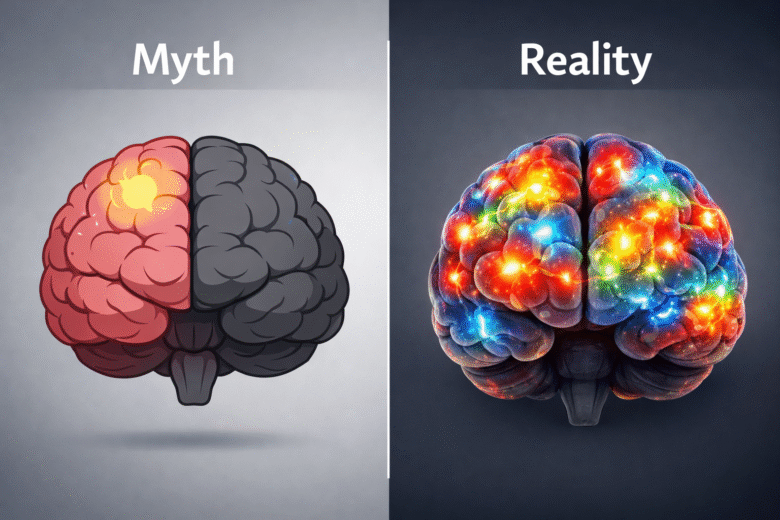
Fun fact: if humans truly used only 10% of their brains, neurologists would notice massive “dead zones” on brain scans—and they simply don’t exist.
The idea that we use just a tiny fraction of our brain has become one of the most stubborn scientific myths of modern life. It shows up in school corridors, motivational speeches, self-help books, and blockbuster films that promise hidden mental superpowers. The title of this piece, “The 10% Brain Myth: You’re Using Far More Than You Think,” exists because this belief refuses to die—even though neuroscience buried it decades ago.
The truth is less magical, but far more interesting: you are using nearly all of your brain, nearly all of the time. There is no secret vault of unused grey matter waiting for enlightenment, training, or a dramatic life crisis to unlock it. And once you understand why this myth took root, you begin to see how badly we misunderstand our own minds.
Where the 10% Brain Myth Came From
The 10% brain myth did not begin as a lie; it began as a misunderstanding. Early psychologists and neurologists, working more than a century ago, observed that damage to certain parts of the brain did not always produce obvious deficits. From this, a careless interpretation spread: maybe those areas were unused.
Popular culture took that uncertainty and ran with it. Over time, the myth became comforting. If we were only using 10% of our brains, then human potential would feel infinite. Failure could be blamed on untapped capacity rather than limits, effort, or environment. The 10% brain myth became a psychological safety net.
By the time cinema embraced it, the idea was unstoppable. Films portrayed ordinary people unlocking dormant brain regions and becoming geniuses, assassins, or psychic savants. It was seductive storytelling—but it was never science.
What Brain Scans Actually Show
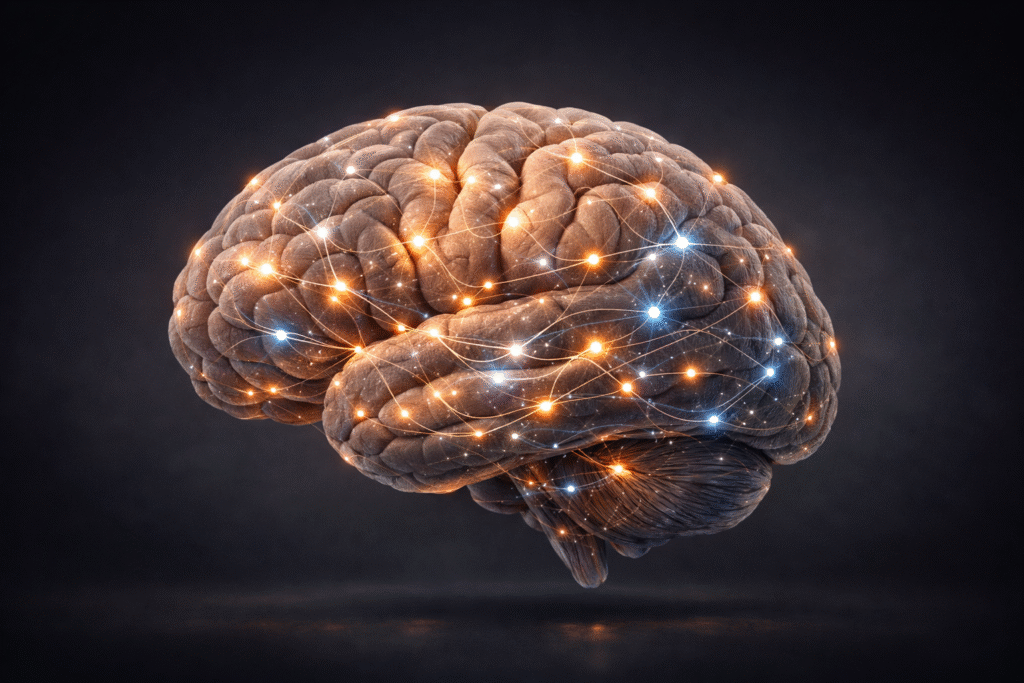
Modern neuroscience leaves no room for the 10% brain myth. Technologies like functional magnetic resonance imaging (fMRI) and positron emission tomography (PET) allow scientists to watch the living brain at work. These scans reveal something striking: activity lights up across the brain even during simple tasks.
Reading a sentence activates visual areas, language networks, memory circuits, emotional centres, and motor planning regions almost simultaneously. Resting quietly does not switch the brain off either. A system called the default mode network (default mode network) becomes active when you daydream, reflect, or think about yourself.
There are no large areas sitting idle. Evolution does not favour waste. The brain consumes roughly twenty percent of the body’s energy while making up only about two percent of body weight. Carrying around ninety percent unused tissue would be biologically absurd.
“But I’m Not Using All of It at Once, Right?”
Here is where confusion often creeps in. You are not using every brain region at maximum intensity at the same moment—but that is not the same as not using them at all.
Think of a city at night. Not every building has its lights blazing simultaneously, yet the city is fully alive. Different neighbourhoods become active depending on what is happening. The brain works the same way. Regions shift in activity depending on whether you are listening, moving, remembering, feeling fear, or solving a problem.
The 10% brain myth mistakes flexibility for absence. Neural efficiency is not about switching parts off forever; it is about dynamic coordination.
Damage Proves the Myth Wrong
One of the strongest arguments against the 10% brain myth comes from brain injuries. If ninety percent of the brain were unused, damage should rarely matter. In reality, even small injuries can produce profound changes in speech, personality, movement, or memory.
Strokes affecting tiny regions can erase language or recognition. Trauma to specific networks can alter emotional regulation or impulse control. These effects exist because those regions were already doing something important before the injury occurred.
Brains reorganize after damage, but reorganization is not evidence of unused capacity. It is evidence of adaptability under constraint.
Why the Myth Refuses to Die
The persistence of the 10% brain myth says less about science and more about culture. We crave narratives of hidden potential. The myth flatters us by implying we are unfinished masterpieces rather than limited biological beings.
Self-improvement industries have quietly benefited too. If unused brain power exists, then courses, techniques, or products can promise to unlock it. The myth sells hope cheaply.
But neuroscience offers something more honest—and more empowering. Growth does not come from discovering unused brain parts. It comes from strengthening connections, practising skills, and reshaping networks through learning.
What “Using Your Brain Better” Actually Means
Rejecting the 10% brain myth does not mean accepting stagnation. Brains change throughout life through neuroplasticity. Learning a new language, practising music, exercising, sleeping well, and managing stress all reshape how brain networks communicate.
The difference is crucial. Improvement is about refinement, not revelation. There is no dormant genius region waiting to awaken. There is only a living, active brain constantly rewiring itself in response to experience.
This truth is less cinematic, but more humane. It places responsibility back where it belongs: in education, environment, health, and patience.

The Real Cost of Believing the Myth
The 10% brain myth may seem harmless, but it subtly distorts how we view intelligence. It suggests intelligence is about access rather than effort, privilege, or opportunity. It ignores structural inequalities in nutrition, education, and safety that shape cognitive development.
Believing we all have the same hidden reserves makes failure feel personal and success feel mystical. In reality, brains grow within contexts. Understanding that can shift how societies invest in children, teachers, and mental health.
A Better Story About the Human Brain
The real story is not that your brain is mostly asleep. It is that it is astonishingly busy, even when you are not aware of it. Every memory, habit, fear, and idea is the result of coordinated activity across vast networks refined over years.
You are not underusing your brain. You are living inside one of the most energy-demanding, adaptable systems evolution has ever produced.
Perhaps the myth we need to abandon is not about percentages—but about shortcuts.
Conclusion: Stop Waiting for the Unlock
The 10% brain myth promises transformation without work. Neuroscience offers something more demanding and more hopeful: change through practice, care, and understanding.
There is no hidden switch to flip. No sealed chamber of genius. What you have instead is a brain already working hard, shaped by what you feed it—information, relationships, rest, curiosity, and challenge.
If that feels less magical, look again. Reality, in this case, is far more impressive than fiction.
Author’s Note
I wanted to write this because I see the 10% brain myth passed along casually—between students, parents, even teachers—as if it were harmless trivia. It is not harmful in intent, but it quietly teaches us to underestimate effort and misunderstand growth. Writing, for me, is a way of slowing these ideas down, holding them up to the light, and asking whether they still deserve our belief. If this piece nudges someone to trust learning over shortcuts, it has done its work.
G.C., Ecosociosphere contributor.
References and Further Reading
- Debunking the 10% Brain Myth – Scientific American
- Brain Imaging Shows We Use Most of the Brain – National Institute of Neurological Disorders and Stroke
- Neuroplasticity Explained: How the Brain Changes with Experience – Harvard Medical School
- The Default Mode Network and the Active Resting Brain – National Library of Medicine (Research Review)
- Why the “10% of the Brain” Idea Refuses to Die – British Psychological Society (Research Digest)