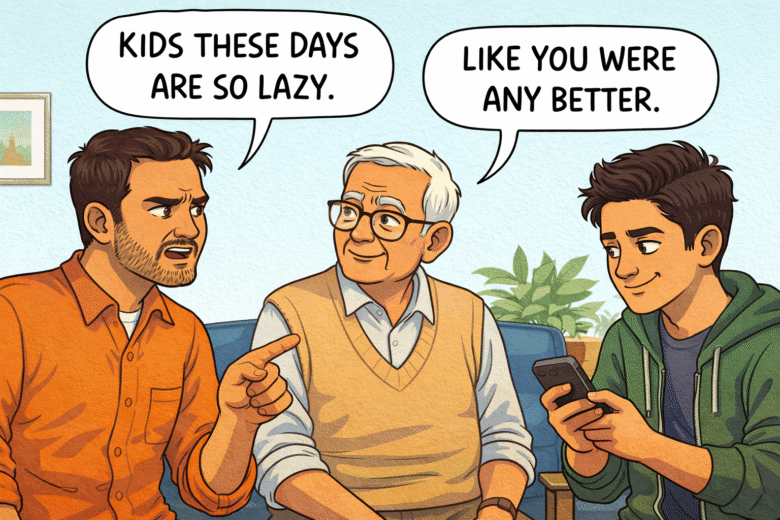
Fun fact: the complaint that “young people are lazy” is more than 2,000 years old—ancient philosophers were already grumbling about the next generation long before smartphones or social media existed.
That makes the modern debate around youth culture strangely familiar. Open any social media comment section, scroll through opinion columns, or listen to a family conversation during dinner, and you will hear the same accusation repeated again and again: the next generation is lazy.
Which raises a fascinating question. If every generation thinks the next one is lazy, then who exactly is right? The idea that youth are losing their work ethic seems to appear in every era. Today, the criticism is directed at Generation Z and young Millennials. In earlier decades it was directed at Generation X. Before that, the Baby Boomers were accused of the same thing.
In other words, the complaint keeps moving forward in time, as a baton passed from one generation to the next. This blog explores why every generation thinks the next one is lazy, and why the truth is often far more complicated than that simple accusation.
The Oldest Complaint in History
To understand this thought process, we have to begin with a simple historical reality: older people have always been suspicious of younger people.
Ancient writers complained that young people were disrespectful and unwilling to work hard. In the nineteenth century, newspapers worried that new technologies like telegraphs and railways were making young minds impatient. In the twentieth century, older adults worried that rock music, television, and later video games were destroying discipline.
And today, the targets are smartphones, social media, and remote work. The pattern is almost comical. Each generation grows up believing its struggles built character. Then, when the world changes, the next generation appears to have it easier. But appearances can be misleading.
When Hard Work Looks Different
One reason is that work itself keeps changing. Consider the difference between physical labour and digital labour.
Older generations often associate work with visible effort: construction sites, factories, long hours in offices, or physically demanding tasks. When work looks physically exhausting, it feels legitimate.
But younger generations increasingly work in digital spaces. Coding software, managing online communities, designing content, or analysing data often happens quietly on a laptop.
To someone who grew up equating effort with sweat, this kind of work can look suspiciously like doing nothing. But that perception ignores the reality that mental labour can be just as exhausting as physical labour.
In many cases, modern work demands constant learning, multitasking, and adaptation. Instead of repeating the same job for decades, younger workers are expected to update their skills continuously.
What looks like laziness from the outside can actually be a different kind of effort.

The Myth of the “Harder Past”
Another reason is nostalgia. Human memory is selective. We tend to remember our youth as a time of discipline and resilience, while forgetting the shortcuts and conveniences we also enjoyed.
For example, older generations sometimes claim they worked harder because life was simpler. But in reality, technological change has altered the challenges rather than eliminated them. Today’s young people face different pressures.
Housing prices are dramatically higher in many cities. Job markets are more competitive. Career paths are less stable than they once were. Digital culture also means work and personal life are often blended together in ways previous generations never experienced.
A student studying late at night with multiple browser tabs open might not look like they are working hard. But behind that screen could be research, communication, creative work, or learning new skills.
The struggle is simply less visible.
The Speed of Change
A deeper explanation for it lies in the speed of cultural change. Technological shifts now happen faster than ever before. Smartphones, artificial intelligence (AI), and digital platforms have transformed communication, work, and education within a single generation.
This creates a strange situation. Older generations learned one system of life and built their identity around it. Younger generations grow up navigating a completely different system.
When habits differ, misunderstandings follow. For example, younger workers often prioritise flexibility, mental health, and work–life balance. Older workers sometimes interpret this as a lack of dedication.
But younger workers may see it differently. They watched previous generations struggle with burnout and unstable employment. Many are simply trying to avoid repeating those mistakes. What looks like laziness might actually be a different philosophy of work.
The Generational Mirror
Perhaps the most interesting reason is psychological. Criticising the next generation allows people to protect their own identity. If younger people succeed in a different way, it can challenge the idea that older methods were the only correct ones.
So the mind often chooses a simpler explanation: the younger generation must simply be less hardworking. But history repeatedly disproves this belief. Young people continue to innovate, create businesses, build technologies, organise social movements, and redefine culture.
They may not work in the same way previous generations did, but they are rarely doing less. They are simply doing things differently.

What Each Generation Gets Wrong
Ironically, the belief that every generation thinks the next one is lazy often hides something deeper. Every generation underestimates how difficult the world has become for the next one.
Older generations faced their own challenges: economic instability, political upheaval, or limited opportunities. But younger generations face a different set of uncertainties: climate anxiety, automation, rapidly changing career landscapes, and digital overload.
The problem is not laziness. The problem is perspective.
Each generation views effort through the lens of its own experiences. When those experiences change, misunderstanding is almost inevitable.
Conclusion
The idea that every generation thinks the next one is lazy says more about human psychology than about actual work ethic. It reflects nostalgia, fear of change, and the discomfort of watching the world evolve in ways we did not expect.
But history suggests something hopeful. Every generation eventually proves the previous one wrong. Young people grow up, build careers, create families, invent technologies, and shape the future in ways no one predicted. The cycle repeats.
Which means one day, today’s young critics will probably find themselves saying the same thing about the generation that comes after them. And somewhere, a teenager will roll their eyes and quietly get back to work.
Author’s Note
Spending time with students teaches you something adults often forget: every generation is trying to make sense of a world it did not design. Young people are not lazy. They are simply adapting to realities that older generations sometimes struggle to see. Sometimes the real lesson is not about laziness at all. It is about learning to listen across time.
G.C., Ecosociosphere contributor.
References and Further Reading
- The 2,500-Year History of Adults Complaining About the Younger Generation
- The Psychology Behind the Generation Gap
- Debunking the Myth That Younger Workers Are Lazy
- The Younger Generation Isn’t Lazy—They’re Burned Out
- Why the “Lazy Millennial” Narrative Is Misleading
- What the Generation Gap Actually Means