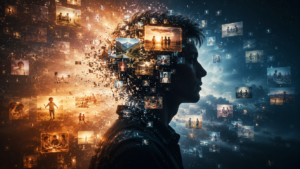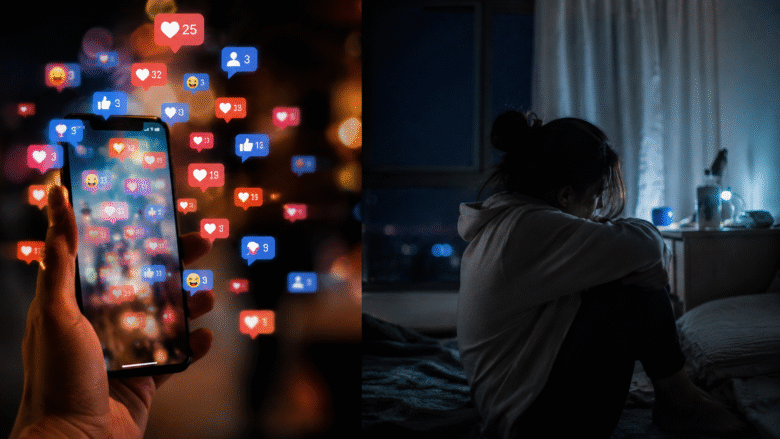
A surprising study once found that many people today interact with more humans in one day online than their grandparents did in an entire month—yet loneliness is rising almost everywhere.
“The New Loneliness of Being Seen Online” is not about people being abandoned. It is about something stranger. Millions of people are surrounded by notifications, reactions, views, and conversations, but still feel emotionally invisible. We are living in a time where people know what you ate, where you travelled, what song you are listening to, and even your relationship status—but often have no idea who you really are when life becomes difficult.
This is the first generation in history where human beings can broadcast themselves constantly without necessarily being understood by anyone.
There was a time when loneliness looked obvious. It looked like isolation. A person sitting alone. A house too quiet. A phone that never rang. Today loneliness wears better clothes. It smiles in profile pictures. It posts birthday stories. It replies with memes and laughing emojis. Modern loneliness often hides inside hypervisibility.
Social media platforms like Instagram, a photo and video sharing platform, and TikTok, a short-video entertainment platform, have created an environment where people are constantly performing tiny versions of themselves. Everyone is visible. Everyone is available. Everyone is presenting updates. But visibility is not intimacy.
That difference matters more than people realize.
Many individuals today maintain dozens of conversations while having almost nobody they can call at two in the morning. They know how to maintain engagement but not emotional closeness. Friendship increasingly looks like passive observation. People watch each other’s lives unfold silently through stories and posts without actually entering those lives.
Someone may know your favourite coffee shop but not your fears.
Someone may react to every photo but never notice when your voice changes.
Someone may know your “content” without knowing your character.
This creates a deeply confusing emotional condition. Humans are social creatures. The brain interprets visibility as connection. But emotionally, the body can still feel abandoned. That contradiction exhausts people in ways they struggle to explain.
The strange part is that many people no longer even expect to be deeply known. They expect attention instead.
Modern culture rewards exposure more than vulnerability. Exposure means showing pieces of yourself publicly. Vulnerability means allowing someone to see the parts that are unfinished, embarrassed, uncertain, or frightened. One attracts audiences. The other builds intimacy. Unfortunately, audiences are easier to gather than trust.
The result is a generation that often feels emotionally crowded but personally unknown.
This is especially visible among young adults. A college student may spend six hours communicating digitally and still feel painfully disconnected at night. A working professional may spend the entire day in meetings, messages, and group chats, then return home with the feeling that nobody truly noticed them as a person. Even families sometimes communicate more through forwarded reels than honest conversations.
Many people now document their emotions instead of processing them.
Sadness becomes a caption.
Loneliness becomes aesthetic.
Confusion becomes content.
And somewhere along the way, people start performing emotions instead of fully experiencing them.
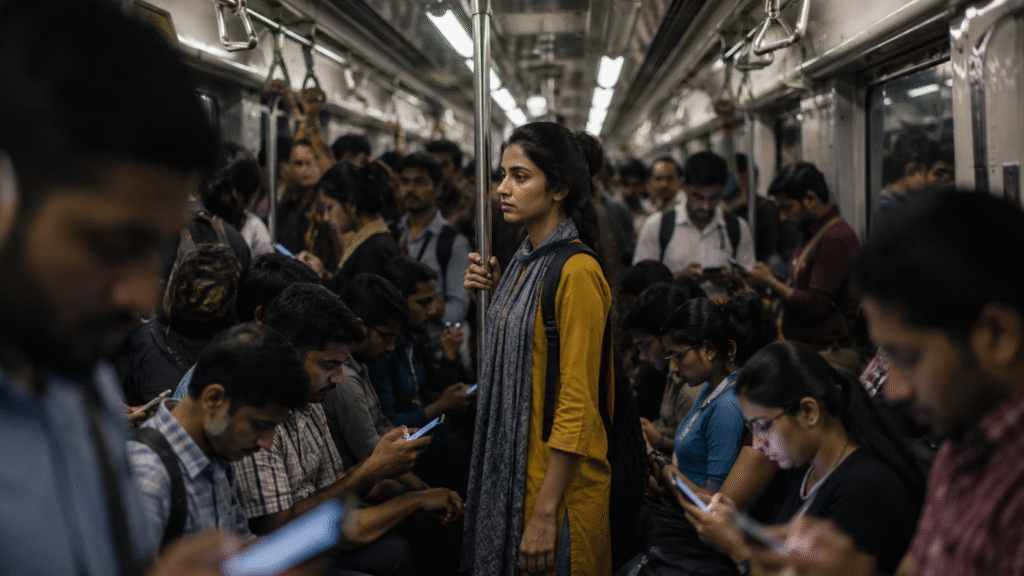
This does not mean technology itself is evil. The internet has helped people find communities, friendships, careers, and support systems that were impossible before. For many isolated individuals, digital spaces genuinely save lives. But there is a growing emotional side effect that society still does not fully acknowledge: constant visibility creates pressure to remain emotionally consumable.
People feel watched all the time. Not by governments or spies necessarily, but by peers. By acquaintances. By invisible audiences. By the possibility that every thought, photograph, opinion, or moment could be evaluated publicly.
That kind of visibility changes human behaviour.
People become careful instead of honest.
Polished instead of intimate.
Expressive instead of vulnerable.
Even grief has become performative in some corners of the internet. There is pressure to react publicly to tragedies, birthdays, breakups, achievements, and political events. Silence itself starts looking suspicious. The emotional self becomes a public relations project.
And public relations cannot replace closeness.
Psychologists have repeatedly warned that emotional intimacy depends on risk. Real connection requires awkwardness, slowness, misunderstanding, patience, and private honesty. But modern online culture rewards speed, presentation, and emotional efficiency. Relationships are expected to remain entertaining.
The moment things become emotionally difficult, many people quietly disappear.
That disappearance hurts more today because people remain digitally present afterward. You still see their updates. Their vacations. Their jokes. Their meals. Their lives continue floating past your screen while the relationship itself quietly dies. Human beings were never psychologically designed for this kind of permanent semi-presence.
Perhaps that is why so many people feel emotionally restless even while socially active.
The new loneliness is not the absence of people. It is the absence of being deeply recognized.
It is the feeling that everybody has access to your image but very few have access to your inner world.

And maybe that is why private conversations feel increasingly sacred now. A long walk without phones. A friend who notices silence. Someone who remembers a small detail you never repeated. Someone who asks a question and actually waits for the answer.
Those moments feel rare because they are becoming rare.
Modern life trains people to observe each other continuously while understanding each other less and less.
The solution probably will not come from deleting every app and escaping to the mountains. Human beings are not going backward technologically. But perhaps people need to become more intentional about protecting spaces where performance is unnecessary.
Not every emotion needs an audience.
Not every memory needs proof.
Not every silence needs filling.
And not every relationship should survive only through notifications.
Maybe the real rebellion now is allowing yourself to be fully known by a few people instead of vaguely seen by thousands.
Because attention can create popularity.
But only intimacy makes human beings feel less alone.
Author’s Note
I wanted to write about this because the loneliness people carry today often looks invisible from the outside. Many students, workers, parents, and even teachers appear socially connected all day while quietly feeling emotionally distant from everyone around them. It fascinates me how humanity has invented endless ways to communicate yet still struggles to truly know one another. Writing about these contradictions feels important because sometimes a sentence can help people recognize feelings they thought they were carrying alone.
References and Further Reading
Harvard Study of Adult Development on Human Relationships