A strange thing happens when people know they are being watched: they start editing themselves—even when nobody asked them to.
“Why Is Everyone Performing Their Personality Online?” sounds like an exaggerated question until you spend ten minutes on the internet and realize nearly everyone is selling a version of themselves. Not products. Not services. Themselves. Their humor. Their sadness. Their intelligence. Their routines. Their opinions. Their relationships. Their trauma. Their breakfast. Somewhere between selfies, career advice, aesthetic desk setups, gym reels, and “day in my life” videos, identity stopped being something we discovered quietly and became something we packaged publicly.
The internet did not just give people a platform. It gave them an audience. And audiences change behaviour.
A teenager today does not simply listen to music. They curate a music taste. A person does not merely travel. They document a lifestyle. Even loneliness has become visual content now—sad mirror selfies, blurry café photographs, captions about healing. Somewhere deep down, many people are no longer asking, “Who am I?” They are constantly wondering, “How am I coming across?”
That difference changes everything.
Social media platforms like Instagram, a photo and video sharing platform owned by Meta, and TikTok, a short-form video platform known for algorithm-driven content discovery, reward performance more than authenticity. The algorithm cannot measure sincerity. It measures engagement. And engagement often comes from exaggeration, confidence, outrage, beauty, aspiration, or emotional intensity.
So people adapt.
Quiet people become louder online. Funny people become funnier. Intellectual people become aggressively opinionated. Even vulnerability now comes with lighting, editing, subtitles, and carefully chosen background music. We are watching human beings slowly transform into characters optimized for attention.
And perhaps the most disturbing part is this: many of us no longer know when we are being genuine.
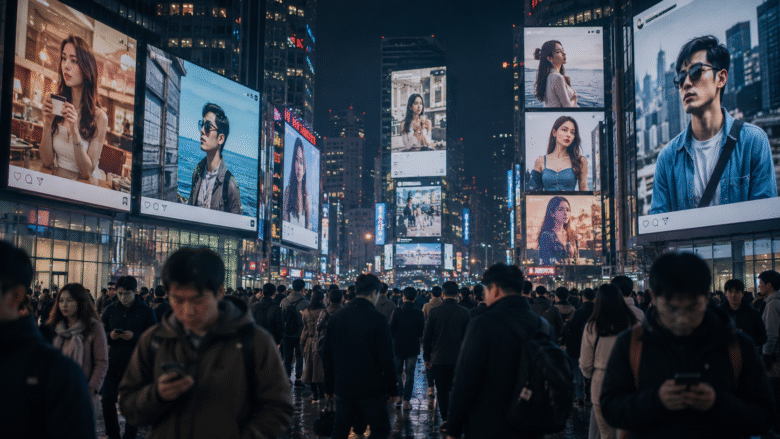
There was a time when personality developed slowly. It was shaped in classrooms, family conversations, awkward silences, friendships, heartbreaks, mistakes, and private thoughts. Now identity develops under constant surveillance. Young people especially grow up with an invisible camera in their minds. Even when no one is recording them, they imagine how moments would look if posted.

A sunset is no longer just a sunset. It is “content.”
This pressure is exhausting, even for people who appear successful online. Influencers speak openly now about burnout, anxiety, and feeling trapped inside their own digital persona. Once an audience expects a certain personality from you, deviating from it becomes risky. The funny creator must stay funny. The productivity expert must remain productive. The “perfect couple” must keep looking perfect.
A brand cannot have an off day.
But humans do.
And that is the conflict nobody talks about enough.
The internet keeps telling people to “be yourself” while simultaneously rewarding only the most marketable versions of the self. It is authenticity filtered through performance. Realness rehearsed for the camera. Even rebellion becomes aesthetic eventually. Anti-social media influencers become influencers. Minimalism becomes branding. “Not caring what people think” becomes content designed precisely so people will think something.
Modern identity has started resembling a small business.
This is not entirely accidental. Companies benefit from it. Platforms benefit from it. The more people turn themselves into content, the more content exists to keep everyone scrolling. YouTube, the world’s largest video-sharing platform, profits from creators uploading endless pieces of their lives. LinkedIn, a professional networking platform, encourages users to present polished professional personalities almost like corporate advertisements. Even everyday conversations now sound like marketing pitches: “self-improvement,” “networking,” “staying visible,” “creating a personal brand.”
Somewhere along the way, existing stopped feeling sufficient. You now have to present yourself correctly too.
This pressure affects ordinary working people more than many realize. Young professionals feel they must maintain polished online identities to stay employable. Students feel pressure to appear talented, socially aware, attractive, ambitious, and emotionally intelligent all at once. Even hobbies now seem incomplete unless displayed publicly.
People are no longer only living life.
They are managing perception.
And perception management is tiring because it never ends.
The internet also creates a dangerous illusion that everyone else has a stronger identity than you do. Online, people appear incredibly certain about themselves. Their aesthetics are consistent. Their opinions are sharp. Their goals are clear. Their personalities look fully formed. Meanwhile, real human identity is usually messy, contradictory, confused, and changing.

Most people are improvising through life.
But online culture punishes uncertainty.
That is why so many people feel strangely disconnected today. They are visible everywhere but known nowhere. They have followers but not intimacy. Audiences but not understanding. Constant expression but very little honesty. Many people spend so much time performing themselves that they rarely experience themselves privately anymore.
The tragedy is not that people share their lives online. Human beings have always wanted recognition. The deeper issue is that many now feel invisible unless they are performing.
Silence feels unproductive. Privacy feels suspicious. Ordinary life feels inadequate.
And yet the most meaningful parts of being human usually happen away from performance. Quiet conversations. Unposted acts of kindness. Unfiltered grief. Awkward growth. Doubt. Changing your mind. Sitting alone without documenting it.
The internet has convinced people that identity must always be visible to be real.
It does not.
You do not need to constantly prove your personality to deserve existence. You are allowed to be unfinished. You are allowed to be inconsistent. You are allowed to enjoy things privately without converting them into content for strangers. You are allowed to disappear sometimes from the digital stage.
Perhaps the healthiest thing a person can do today is reclaim a part of themselves that no audience can access.
Because once every emotion becomes performance, every moment becomes labor. And eventually, people stop asking whether they are happy. They start asking whether they look happy enough online.
That is not self-expression anymore.
That is emotional advertising.
Conclusion
The pressure to turn identity into a brand did not appear overnight. It grew slowly through algorithms, attention economies, influencer culture, and our very human desire to be seen. But somewhere in the middle of all this, people stopped simply living and began carefully packaging themselves for display.
Maybe the real rebellion now is not becoming famous online. Maybe it is learning how to remain human while the internet keeps asking you to become a product.
Because the moment your entire personality becomes content, you risk forgetting that you were a person before you were a profile.
Author’s Note
I wanted to write this because the internet increasingly feels like a giant stage where everyone is performing confidence while quietly negotiating exhaustion. As someone who spends time around students and young people, I keep noticing how early this pressure begins now. People are learning branding before they fully understand themselves. That feels important to talk about. Writing, at its best, should not merely describe the world. It should gently interrupt it long enough for us to notice what we are becoming.
G.C., Ecosociosphere contributor.
References and Further Reading
- [National Center for Biotechnology Information (NCBI) Study on Self-Presentation]
- [WIRED Article on Psychological Cost of Living Online]
- [The Guardian on Oversharing and Online Anxiety]
- [The Guardian on Beauty Filters and Online Identity]
- [Vogue on Parasocial Relationships and Internet Culture]
- [FLAME University Article on Social Media and Self-Identity]