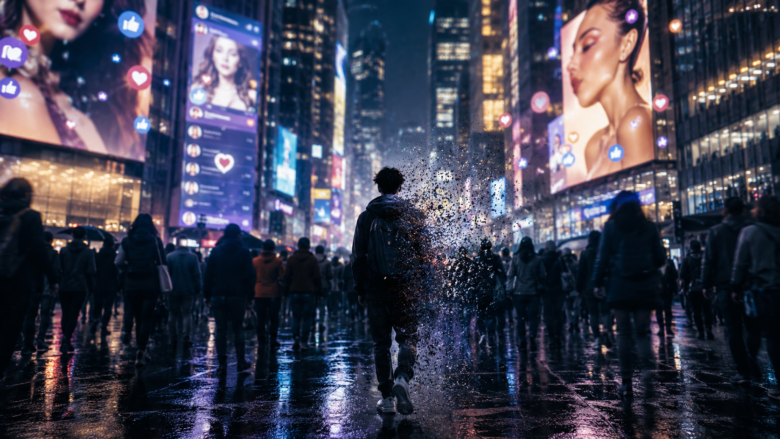
Did you know that searches related to “disappearing from social media” and “starting over alone” have quietly exploded over the past few years across platforms used mostly by young adults?
There is a strange fantasy quietly living inside modern youth culture right now. It appears in jokes, memes, late-night conversations, and exhausted social media captions. It often sounds like this: “I just want to disappear.” Not to die. Just to stop existing for everyone else for a while. Not necessarily run away forever. Just vanish for a while. Delete everything. Stop replying. Leave the city. Change the number. Become unreachable. Be forgotten long enough to finally breathe.
“Why Young People Romanticize Disappearing” is not really about travel fantasies or digital detox trends. It is about emotional exhaustion. It is about people feeling so overstimulated, watched, evaluated, compared, and emotionally crowded that disappearing starts to feel less like escape and more like recovery.
A generation raised online was told connection would make life fuller. Instead, many people feel permanently available and emotionally drained. Phones turned every silence into a notification. Social media transformed ordinary existence into performance. Even rest now comes with an audience. People document vacations while on vacation. They post gym transformations while still struggling mentally. They share “healing journeys” while privately breaking apart.
Young people are not romanticizing disappearing because they hate life. Many are romanticizing it because life no longer feels quiet enough to hear themselves think.
The internet created a strange kind of visibility. Everyone can see everyone all the time, yet very few people feel deeply understood. A person can post every detail of their life online and still feel emotionally invisible. In fact, sometimes the more visible people become, the lonelier they feel. Because visibility is not intimacy.
This is why disappearing fantasies often sound peaceful rather than dramatic. People imagine remote cabins, silent train journeys, small towns where nobody knows their name, phones switched off beside oceans, empty roads at night. Notice how these fantasies are rarely about luxury. They are about relief.

Relief from being reachable.
Relief from expectations.
Relief from endless emotional noise.
A student feels exhausted before turning twenty because they are not just managing studies anymore. They are managing an identity. A social presence. Career anxiety. Relationship anxiety. Family expectations. Economic uncertainty. Constant comparison. Algorithms that quietly remind them every day that somebody else is younger, richer, prettier, fitter, more successful, more productive.
Human beings were never designed to emotionally process this many lives at once.
And yet modern culture keeps pushing the idea that if you are overwhelmed, the problem is your mindset. Download another productivity application. Wake up earlier. Meditate harder. Optimize yourself better. Meanwhile, the real issue is often simpler: people are tired of existing like open tabs.
The romanticization of disappearing also reflects something deeper about modern trust. Many young people no longer believe the world will slow down for them. So instead of asking for rest, they fantasize about escape. Taking a break feels socially dangerous now. Falling behind feels terrifying. There is a growing fear that if someone stops performing life for even a few weeks, they will become irrelevant.
This is especially visible online. Platforms owned by companies like TikTok, which specializes in algorithm-driven short videos, and Instagram, a social networking platform centered around visual identity and engagement, reward constant visibility. The algorithm does not care if somebody is emotionally exhausted. It rewards consistency. Presence. Engagement. Activity.
So people keep showing up digitally even when they feel emotionally absent in real life.
The result is a generation that sometimes dreams about disappearing not because they are lazy, but because they are overexposed.
There is also another uncomfortable truth hidden underneath this phenomenon: many young people secretly believe nobody would truly notice if they vanished anyway. Hundreds of followers. Dozens of chats. Constant notifications. Yet emotionally, many relationships have become thin. Transactional. Passive. Built around reacting rather than genuinely knowing.
People increasingly feel socially surrounded but psychologically alone.
That combination creates emotional numbness. And numbness often produces strange fantasies. Some people fantasize about fame. Others fantasize about isolation. One fantasy says, “Maybe everybody finally sees me.” The other says, “Maybe nobody can reach me anymore.”
Both are responses to emotional hunger.
Of course, disappearing rarely solves the real problem. Isolation can become its own kind of darkness. Cutting everyone off does not automatically create peace. Sometimes it simply removes distractions long enough for unresolved pain to become louder.
But the fantasy itself deserves attention because it reveals something important about the emotional condition of young people today.
When millions of people begin fantasizing about vanishing, the issue is not individual weakness. It is cultural exhaustion.
Maybe the deeper problem is that modern life leaves very little room for private humanity. Every feeling becomes content. Every opinion becomes debate. Every achievement becomes comparison. Every mistake becomes permanent digital memory. People are no longer just living life. They are archiving it while surviving it.
And somewhere inside all that noise, disappearing begins to feel romantic because anonymity starts to resemble freedom.
Perhaps what young people actually want is not disappearance itself.
Perhaps they want permission.
Permission to stop performing.
Permission to not constantly explain themselves.
Permission to be unreachable without guilt.
Permission to exist without turning existence into content.
The heartbreaking part is that what many young people call a desire to disappear is often just a desperate need for peace, community, silence, and people who love them without demanding a curated personality in return.
Maybe the healthiest future is not one where everybody disappears.
Maybe it is one where people no longer feel the need to.
Conclusion
The urge to disappear is not just a trend or dramatic internet humour. It is a quiet emotional signal coming from a generation struggling under nonstop visibility, pressure, and exhaustion. Young people are not weak for feeling overwhelmed by modern life. In many ways, they are reacting normally to an environment that rarely allows genuine stillness.
A society that makes disappearing feel comforting should probably ask itself why ordinary existence feels so emotionally heavy in the first place.
Because people should not have to fantasize about vanishing just to imagine peace.
Author’s Note
I think this topic stayed with me because I keep noticing how many young people joke about disappearing while sounding only half-joking. Beneath the humour, there is often exhaustion that nobody fully talks about. As a teacher, you hear it between casual conversations. As a writer, you notice it hiding beneath modern language. Sometimes writing matters because it helps people recognize emotions they thought were only theirs. And once something is recognized clearly, maybe it becomes a little less lonely.
G.C., Ecosociosphere contributor.