A surprising psychological finding is that human beings often feel more stress from comparing themselves to people their own age than from actual financial hardship.
There was a time when the internet mainly gave people Fear of Missing Out (FOMO). Someone posted vacation photos, party pictures, concert clips, or late-night hangouts, and suddenly everyone else felt left out. It was painful, but temporary. You felt bad for an evening and moved on.
But something darker has quietly replaced it.
The modern internet no longer just makes people afraid of missing experiences. It makes them afraid of falling behind in life itself.
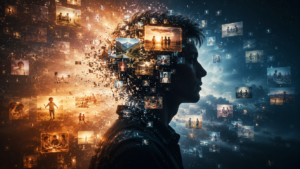
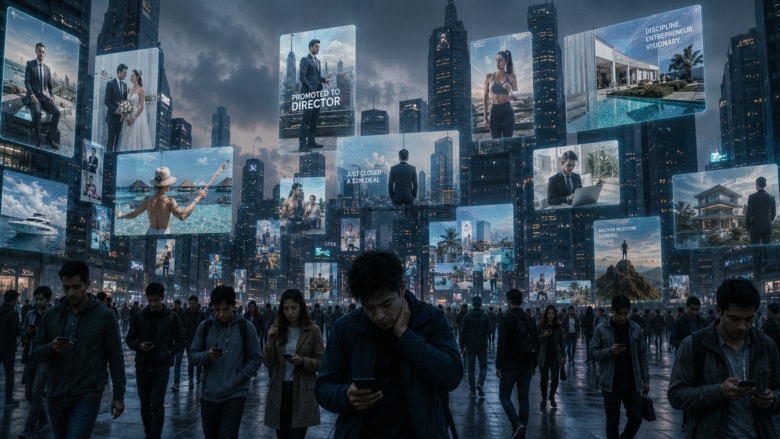
That anxiety feels heavier because it follows people everywhere. It wakes up with them in the morning and scrolls beside them at night. Someone opens social media for five minutes and immediately sees a former classmate buying a house, another launching a startup, someone else getting married, someone travelling through Europe, and a twenty-two-year-old explaining how they became financially independent before breakfast.
The old Fear of Missing Out was social.
This new fear is existential.
Now people are not just asking:
“What am I missing?”
They are asking:
“What if everyone else is moving ahead while I stay stuck?”
That changes everything.
Platforms like LinkedIn turned career growth into public performance. Every promotion, internship, certificate, side hustle, and achievement became content. Meanwhile, Instagram and TikTok transformed ordinary life into a nonstop highlight reel where success appears constant and effortless.
The result is a generation living inside permanent comparison.
And unlike older forms of competition, this one never really ends.
Earlier, people mostly compared themselves with neighbours, cousins, classmates, or coworkers. The comparison circle was limited. Today a student in Jaipur can compare their life with millionaire entrepreneurs in California before even getting out of bed. A twenty-five-year-old can feel unsuccessful because someone online became rich through cryptocurrency at nineteen.
Human beings were never psychologically designed for this scale of comparison.
The internet collapsed distance, but it also collapsed perspective.
Everyone now sees the best moments of millions of lives simultaneously. That creates the illusion that progress is happening everywhere except inside your own room.
You can see the consequences in ordinary conversations now. Young people increasingly speak like exhausted project managers trying to optimize their own existence. Rest feels dangerous. Hobbies feel unproductive. Free time feels suspicious.
Someone spends a quiet Sunday doing nothing and immediately feels guilty because another person somewhere is “building a brand,” “learning Artificial Intelligence (AI),” “networking,” or “monetizing their passion.”
Even success no longer feels stable enough.

A person gets a job and instantly worries about someone earning more.
Someone gets married and worries they are emotionally behind others.
Someone buys a house and suddenly feels financially late compared to people online discussing “passive income.”
The finish line keeps moving because social media keeps moving it.
And perhaps the cruellest part is how invisible this anxiety often looks from the outside.
People still smile in photos.
They still post motivational captions.
They still joke online.
But privately, many feel like they are constantly losing a race nobody properly explained to them.
Modern ambition has become strangely haunted. People no longer simply want good lives. They want reassurance that they are not falling behind everyone else.
That fear quietly changes behaviour.
People rush relationships because they think time is running out.
They switch careers impulsively because somebody younger became successful faster.
They panic when life looks “too ordinary.”
They consume endless self-improvement content hoping it will remove the feeling.
But self-improvement culture sometimes deepens the problem instead of solving it.
The internet is now full of podcasts, influencers, productivity creators, and business coaches selling urgency disguised as inspiration. Wake up earlier. Work harder. Optimize everything. Build multiple income streams. Heal yourself faster. Become your “best self.”
Some advice is genuinely useful. But after a while, the human mind stops hearing motivation and starts hearing threat.
Because underneath all of it sits one terrifying message:
“The moment you slow down, the world moves on without you.”
That is why so many people today struggle to rest without anxiety. Rest no longer feels like recovery. It feels like losing ground.
Even childhood and youth now feel infected by this pressure. Teenagers worry about careers before understanding themselves. College students speak about internships with the intensity of survival. People in their twenties increasingly feel ancient by twenty-seven.
The timeline of human life has become distorted.
Social media created the illusion that extraordinary success should happen immediately. If it does not, people assume they failed instead of recognizing that most meaningful things still take time.
Real careers take time.
Real love takes time.
Real confidence takes time.
Real healing takes time too.
But the internet rarely shows slow growth because slow growth is difficult to monetize.
Instead, people are constantly exposed to accelerated success stories. Overnight millionaires. Young founders. Productivity machines. Digital nomads working beside beaches with suspiciously clean laptops.
And quietly, millions of ordinary people begin feeling ashamed of ordinary progress.
But ordinary progress is still progress.

A teacher helping students every day may not go viral online.
A parent working quietly for their family may never become inspirational content.
A person rebuilding their mental health slowly may not look impressive on social media.
Yet these lives still matter deeply.
The tragedy is that modern culture increasingly treats visibility as proof of value. If success is not public, people fear it does not count.
Maybe that is why so many people feel emotionally tired despite being more connected than ever before. They are not only living their lives anymore. They are constantly measuring them.
And human beings are not built to survive endless measurement.
Conclusion
Fear of Missing Out once made people anxious about missing moments. Fear of Falling Behind makes people anxious about missing life itself.
That is a far heavier burden to carry.
The internet convinced many people that life is a race happening in public view twenty-four hours a day. But most meaningful human experiences still grow quietly, slowly, and invisibly. Not everything valuable can be posted, tracked, optimized, or compared.
Sometimes growth looks dramatic online.
Sometimes growth simply looks like surviving another difficult year without becoming bitter.
Perhaps the real rebellion now is not quitting social media entirely. Perhaps it is learning how to live without constantly treating other people’s timelines as deadlines for your own life.
Author’s Note
This topic stayed with me because I keep noticing how young people speak about life now—not with excitement, but with urgency. Even very bright students already sound tired, as though they are racing invisible clocks. Writing about this felt important because anxiety often hides behind ambition so convincingly that people mistake exhaustion for normal life. Sometimes we need words not to speed us up, but to remind us that being human was never meant to feel like permanent competition.
G.C., Ecosociosphere contributor.