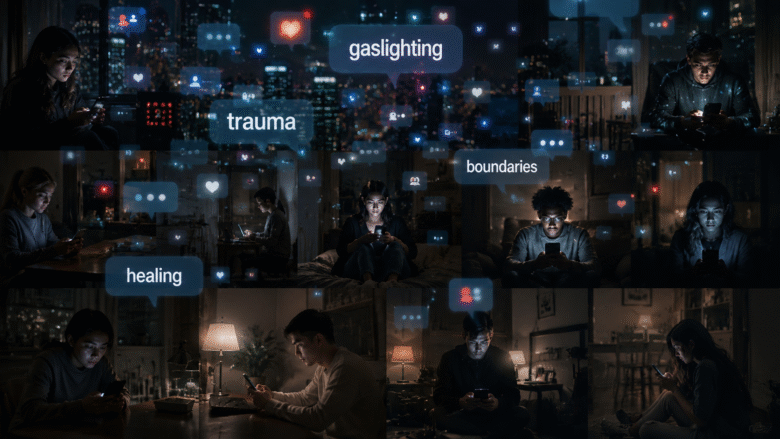
“Gaslighting” was once a rarely used psychological term, but today it appears so often online that people now accuse strangers of it during arguments about movies, cricket, and even food opinions.
A few years ago, people fought online using simpler words. Someone was rude. Someone was selfish. Someone was controlling. Now every disagreement sounds like a therapy session that went slightly off the rails.
Suddenly everyone is “setting boundaries,” “protecting their peace,” “working through trauma,” “holding space,” “healing,” or being labelled “emotionally unavailable.” Someone takes too long to reply and instantly gets analysed for “avoidant attachment issues.”
A breakup becomes “a journey of reclaiming emotional safety.” Someone disagrees with you online and apparently they are “invalidating your lived experience.”
Somewhere between mental health awareness becoming mainstream and social media becoming our primary public stage, therapy language escaped the therapist’s office and entered everyday life. And honestly, some of that is a good thing.
People are now more aware of emotional abuse. They speak more openly about anxiety, depression, childhood neglect, burnout, and toxic relationships. Earlier generations often buried emotional pain under silence or shame. Many families still do. So the rise of therapy language did not appear out of nowhere. It came from a genuine hunger for emotional understanding.
But the internet rarely leaves anything untouched. Once therapy language became socially powerful, it also became fashionable. And once something becomes fashionable online, it slowly stops being used carefully.
Now emotional vocabulary is often used less to understand people and more to win arguments against them.
You can see it everywhere. Couples on social media no longer simply argue. They diagnose each other. Friends do not just drift apart anymore. They “cut off toxic energy.” Every uncomfortable interaction gets framed as psychological damage. People increasingly speak about human relationships like they are managing emotional risk portfolios.
And maybe the strangest part is how corporate culture has quietly absorbed this language too. Companies like TikTok and Instagram are filled with creators teaching people how to “protect their energy” while simultaneously encouraging them to turn every personal experience into content. Meanwhile, companies like BetterHelp and dozens of self-help influencers helped normalize psychological vocabulary for mass audiences. Again, this is not entirely bad. Mental health deserves visibility. But visibility and understanding are not always the same thing.
Online, therapy language often works like moral armour. If you describe yourself using therapeutic terms, you immediately sound more emotionally intelligent. If you describe someone else using therapeutic labels, they immediately sound dangerous.
It slowly changes the way people communicate with each other.
Instead of saying:
“I felt hurt.”
People now say:
“You violated my emotional boundaries.”
Instead of:
“You ignored me.”
It becomes:
“You triggered my abandonment wound.”
The language sounds more sophisticated, but strangely, many conversations feel less human than before.

Because real emotions are usually messy, contradictory, and difficult to categorize neatly. Therapy language sometimes creates the illusion that every emotional situation has a clinically correct answer. It turns ordinary conflict into psychological courtroom drama.
Not every disagreement is trauma.
Not every selfish person is a narcissist.
Not every awkward conversation is emotional abuse.
But social media rewards extreme interpretations because extreme interpretations spread faster.
A calm sentence rarely goes viral. A dramatic psychological diagnosis does.
And there is another uncomfortable truth hidden underneath all this: therapy language often allows people to avoid accountability while sounding deeply self-aware.
The internet is now full of people who can perfectly explain their emotional patterns but still treat others terribly. They know the vocabulary of healing without practicing the behavior of it.
Someone says:
“I’m protecting my peace.”
Sometimes that means healthy boundaries.
Sometimes it simply means avoiding difficult conversations.
Someone says:
“I’m prioritizing myself.”
Sometimes that means self-respect.
Sometimes it means selfishness with better branding.
The language itself is not the problem. Human beings have always needed better emotional vocabulary. The problem begins when therapy terms stop helping people understand themselves and start helping them perform themselves.
Social media encourages performance constantly. Platforms reward people who appear emotionally evolved, self-aware, and psychologically literate. So users slowly learn to narrate their lives like miniature therapists speaking in motivational captions.
You can even hear it in ordinary friendships now. People increasingly speak as though every interaction must be optimized for emotional safety. But close relationships were never built entirely on emotional comfort. Sometimes friendship means misunderstanding each other temporarily. Sometimes love involves frustration, compromise, patience, and imperfect communication.
The internet increasingly treats discomfort itself as unhealthy.
That may be why so many modern relationships feel emotionally fragile. People have learned the language of boundaries faster than the language of resilience. They know how to leave relationships. Many people have learned how to walk away from relationships, but not necessarily how to mend them.
Ironically, therapy itself usually requires patience, discomfort, honesty, and long-term reflection. But online therapy culture often reduces healing into aesthetic slogans and short videos under thirty seconds.
And perhaps that is what feels exhausting about modern online conversations. Everyone sounds emotionally fluent, yet many people feel lonelier, angrier, and more disconnected than ever.

Because vocabulary alone cannot create emotional maturity.
A person can know every psychological term on the internet and still fail at kindness.
Still fail at listening.
Still fail at love.
Maybe the real challenge is learning how to talk about emotions without turning every human interaction into a diagnosis.
Because sometimes someone is not “gaslighting” you.
Sometimes they just disagree with you.
Sometimes someone is not “emotionally unavailable.”
Sometimes they are tired.
And sometimes healing does not sound profound at all.
Sometimes it simply sounds like honesty.
Conclusion
The rise of therapy language online reflects something real: people are desperate to understand themselves better. In many ways, that is progress. Emotional awareness matters. Mental health matters. Language matters too.
But when every conversation starts sounding clinical, relationships can begin feeling strangely artificial. Human beings are not psychology textbooks. We are inconsistent, emotional, flawed, defensive, loving, insecure, compassionate creatures trying to understand each other in real time.
Perhaps the answer is not to abandon therapy language completely. Maybe the goal is to use it carefully enough that it still means something.
Because the internet does not just shape how we speak.
It slowly shapes how we see each other.
Author’s Note
I wanted to write this because I keep noticing how ordinary conversations now sound strangely rehearsed online, as though people are speaking through borrowed language instead of their own emotions. As a teacher, I spend my days watching students learn new words. But words are powerful things. They can clarify feelings, but they can also hide behind them. Writing still matters because sometimes it helps us notice the difference.
G.C., Ecosociosphere contributor.