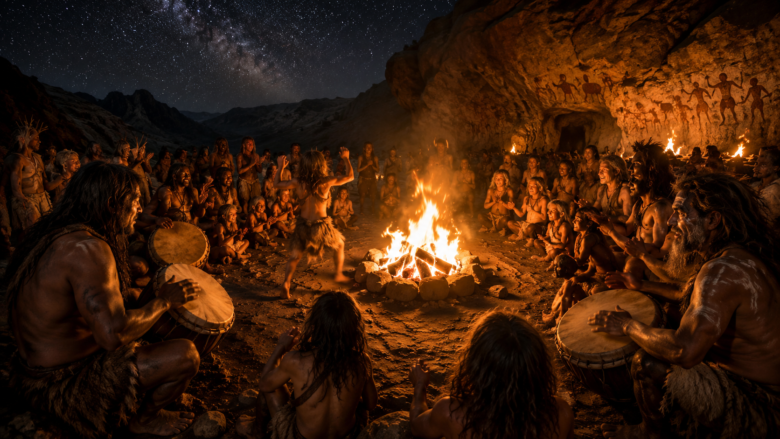
A fun fact: archaeologists have discovered flutes made from bird bones and mammoth ivory that are over 40,000 years old—far older than the earliest known writing systems.
Long before human beings carved laws into stone or scribbled symbols onto paper, they were already making music. Before alphabets, there were drums. Before libraries, there were voices rising together around fires. The strange thing is that this feels almost backwards. Writing seems more practical. More “advanced.” Yet music came first. And maybe that tells us something uncomfortable about what human beings actually are.
We like to think civilization was built on logic, language, and information. But the evidence suggests civilization may have begun with rhythm.
Anthropologists have spent decades trying to understand why nearly every human culture developed music independently. Tribes separated by oceans still invented drums. Isolated communities still sang lullabies. Ancient people with no contact whatsoever still danced in circles under moonlight. Music appears so universally that scientists increasingly believe it is not a cultural luxury. It is biological.
Human beings may have needed rhythm before they needed writing because rhythm solved older and more urgent problems.
Writing stores information. Music stores emotion.
And emotion is what kept early human groups alive.
Imagine life before cities. Before electricity. Before roads. Human beings survived in small groups surrounded by predators, storms, darkness, and uncertainty. Cooperation was not optional. A tribe that failed to move together died together. In that kind of world, synchronized sound became incredibly powerful.
Neuroscientists today know that rhythm physically changes the brain. When people clap together, sing together, or dance together, their nervous systems begin to synchronize. Heart rates align. Breathing patterns adjust. The brain releases chemicals linked to trust and bonding. Modern brain scans show that collective music activates areas associated with pleasure, memory, and social connection.
In simple terms: music turns groups of individuals into something that feels emotionally unified.
That matters enormously when survival depends on collective action.
A written sentence cannot help twenty frightened hunters move with courage before facing a dangerous animal. But a drumbeat can.
Even today, armies march to rhythm. Protesters chant together. Religious rituals depend on repetition and song. Football fans scream in synchronized patterns. Humans still use rhythm to create temporary tribes.
The ancient brain never left us.
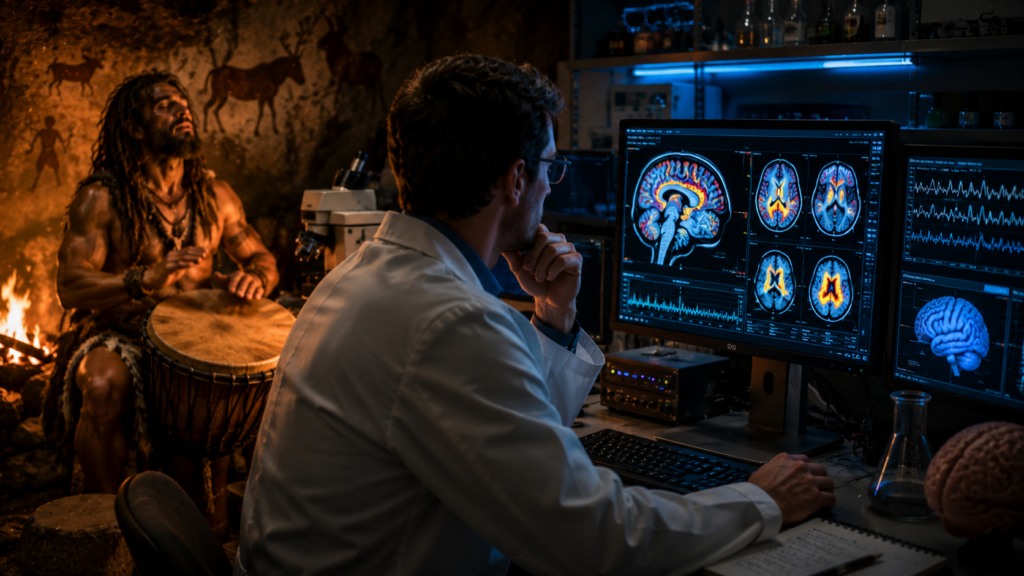
Some researchers even argue that music may have existed before fully developed spoken language. Early vocalizations might have sounded more melodic than grammatical. Tone came before vocabulary. Emotion came before precise meaning. A mother soothing a child with humming probably appeared long before formal speech structures evolved.
And honestly, that still feels true today.
Think about how often music says what ordinary language cannot. People struggle to explain grief, love, loneliness, or hope through direct sentences. Then a song arrives and suddenly thousands of strangers say, “That is exactly how I feel.”
Writing explains.
Music recognizes.
That difference matters.
There is also the question of memory. Before books existed, knowledge had to survive inside human minds. Oral cultures discovered something modern students still accidentally rediscover during exam season: rhythm improves memory. Songs are easier to remember than plain speech. Repetition locks information into the brain.
Ancient communities used chants, poems, and musical storytelling to preserve history across generations. Entire genealogies, myths, survival instructions, and spiritual beliefs survived because they were musical enough to remember.
This is one reason epics like the ancient Indian oral traditions or the works attributed to Homer endured for centuries before widespread writing systems existed. Rhythm acted like a storage device for civilization itself.
Music was humanity’s first hard drive.
But there is another reason music probably appeared before writing, and this one feels more emotional than scientific.
Writing requires stability.
Music does not.
To create writing systems, societies usually need settled agriculture, governments, trade systems, and permanent structures. Writing emerges when humans begin organizing property, laws, taxes, and records. In many ways, writing belongs to civilization.
Music belongs to being human.
A lonely shepherd can sing. A grieving mother can hum. Workers can drum on wood. Children can clap. Music needs no infrastructure. No literacy. No permission.
That universality may explain why music still reaches people more deeply than most forms of information. A song can cross borders faster than philosophy. A rhythm can unite people who do not even share a language. Human beings may argue endlessly about ideas, politics, and religion, but put enough strangers in front of a drum circle and eventually someone starts moving.
The body understands rhythm before the intellect does.
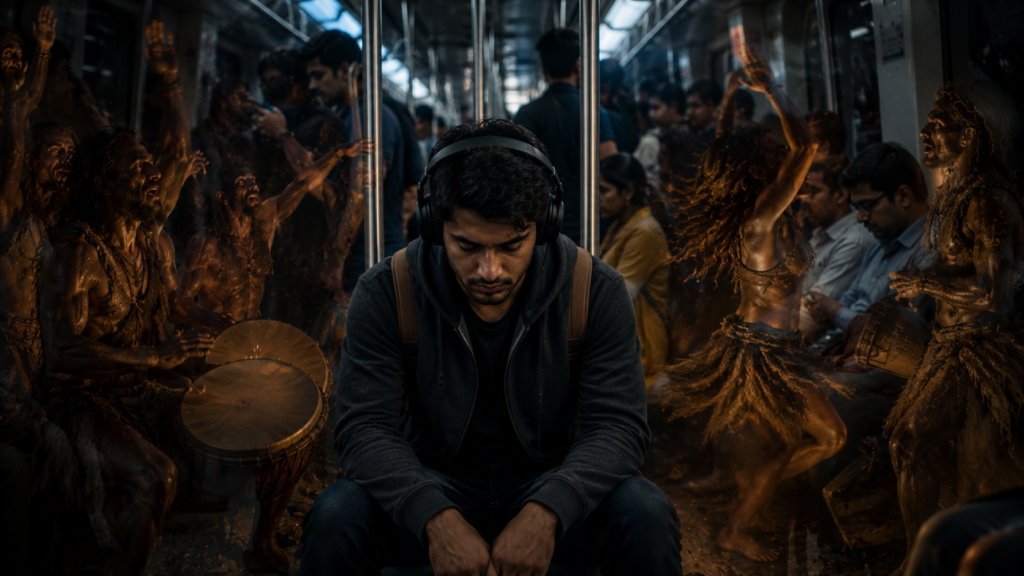
Modern life often forgets this. We now consume music like background wallpaper—something playing softly while we work, study, drive, or endlessly scroll through screens. But historically, music was not background noise. It was social glue. It coordinated labour. It strengthened rituals. It eased fear. It carried memory. It helped people mourn the dead and celebrate survival.
And maybe this is why silence feels so strange to modern humans.
We were shaped by collective sound for tens of thousands of years. The human brain evolved expecting rhythm, voices, repetition, and shared emotional experience. Now millions of people spend entire days isolated behind screens wearing headphones alone. We consume music constantly but experience it communally far less often.
Ironically, we may have more music than any civilization in history while feeling less emotionally synchronized than ever.
Perhaps that is why live concerts still feel almost spiritual. Thousands of strangers suddenly breathing together, singing together, moving together. For a few hours, the ancient tribal brain wakes up again. People leave exhausted but emotionally lighter because something older than language briefly returned.
Maybe music came before writing because human beings did not first need information.
They needed each other.
And rhythm was the bridge.
Conclusion
The story of why human beings invented music before writing is not just about anthropology or neuroscience. At its core, this is really a story about discovering what kind of beings human beings truly are. Long before we became readers, consumers, citizens, or professionals, we were listeners. We were bodies around fires responding to rhythm in the dark.
Writing helped us build civilizations.
Music helped us survive long enough to build them.
Perhaps modern society would feel less emotionally fractured if we remembered that human connection was never originally built through perfectly crafted arguments or endless information streams. It was built through shared sound, collective emotion, and the strange magic of moving together.
Maybe the oldest human technology was not the wheel or the spear.
Maybe it was the drum.
Author’s Note
I kept thinking about something while writing this piece: almost every important moment in human life still involves music. Birthdays. Weddings. Funerals. National anthems. Religious ceremonies. Protest movements. Even heartbreak. We carry songs into moments where ordinary language becomes too small.
As someone who spends much of life around classrooms, books, and words, I find that strangely humbling. Human beings built entire civilizations around writing, yet some part of us still trusts rhythm more deeply than explanation. Maybe that ancient instinct is worth protecting.
G.C., Ecosociosphere contributor.