There are things you might hesitate to do alone that become strangely easier when someone else is standing beside you. Walking down an unfamiliar street late at night, entering a dark building, confronting someone behaving badly, getting onto a frightening amusement-park ride, or simply speaking up when something feels wrong can all change when we have company.
The street has not changed. The darkness is just as dark, and the roller coaster has not become safer because a friend is sitting beside you. Yet somehow the situation feels different, and we often describe that difference simply as courage: someone was afraid, found their nerve, and acted anyway.
But sometimes the courage does not come entirely from within the person. Sometimes it arrives with company.
The presence of another person can change the size of the danger without changing the danger itself.
Humans are deeply social animals, and our brains do not evaluate threats in isolation from the people around us. Psychologists sometimes describe part of this effect as social buffering: the presence of supportive others can reduce psychological and physiological responses to stressful or threatening situations. Research on fear and stress has found that social support can affect the way people respond to threats, suggesting that our sense of danger is influenced not only by what confronts us but also by who is there when we confront it.
This makes obvious sense when the other person can actually help. Two people may be better able to defend themselves than one; a group can share information, notice dangers an individual misses, call for assistance, or know what to do if something goes wrong. Yet the effect can appear even when another person has little practical ability to remove the threat. Studies of social buffering suggest that supportive social presence can sometimes reduce responses to danger without changing the danger itself.
The brain, then, may be making more than one calculation. It needs some estimate of how threatening the situation is, but it also has information about whether that threat must be faced alone.
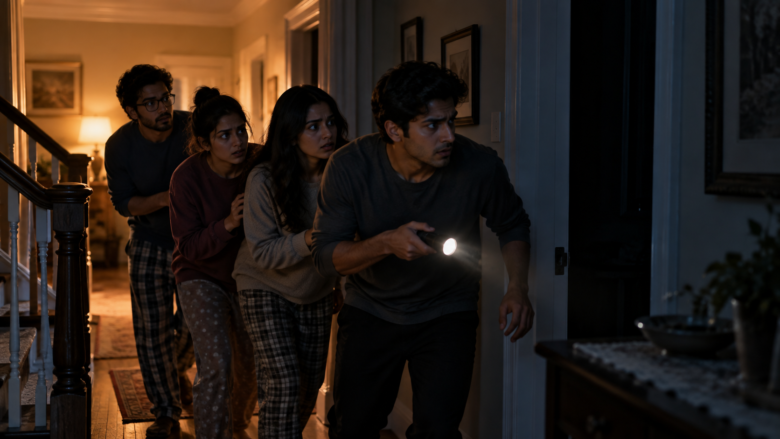
Imagine hearing a sudden noise downstairs in the middle of the night. Alone, you might remain in bed listening carefully, trying to decide whether the sound came from a window, a cupboard, an animal, or something more worrying. Put three friends in the room, however, and someone may eventually say, “Let’s go see what that was.” One person gets up, another follows, somebody makes a joke, and within seconds four people may be walking toward something that none of them particularly wanted to investigate alone.
Fear has not necessarily disappeared. Instead, it now exists inside a social situation in which everyone can see what everyone else is doing, and that information becomes part of the assessment of danger. When we are uncertain, other people’s behaviour provides clues. If everyone around us appears calm, the situation can begin to feel less threatening; once somebody takes the first step, taking the second one becomes easier for everyone else.
There is an obvious problem with this. A group of frightened people can all look at one another for information, and each person can mistake everyone else’s apparent calm for confidence. Nobody necessarily knows more than anyone else.
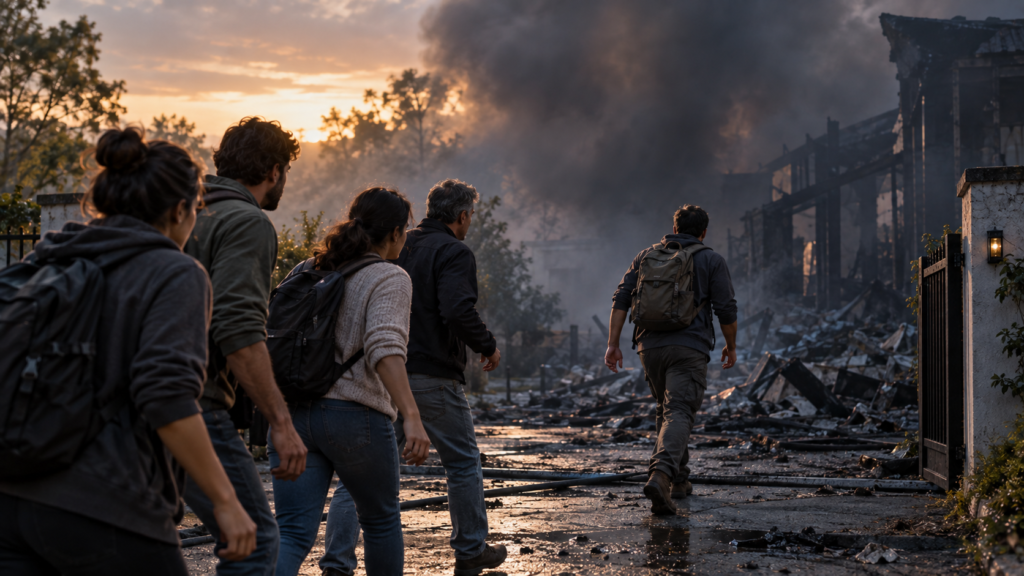
A group can make danger feel smaller simply because nobody else is behaving as though it is large.
Risk changes in groups for another reason too: responsibility begins to change.
Suppose someone proposes a ridiculous challenge. Climb over that fence, jump into that water, send that message, walk onto that stage. If you make the decision entirely by yourself, the choice belongs unmistakably to you, and so does much of the regret if things go badly. In a group, the psychological boundaries are less tidy. The suggestion may have come from someone else, several people may have agreed, and everyone may participate in what happens next.
Researchers studying collective decisions have found evidence that this sharing of decisions can also alter the experience of responsibility. Experimental work suggests that the presence of other agents can reduce a person’s subjective sense of agency over an outcome, even when their own contribution remains identifiable. Other studies in which people could choose between making risky decisions alone and joining a group have found that anticipated regret and negative outcomes can make collective decision-making attractive, as though the group provides some psychological shelter from carrying the entire burden of a bad choice.
This does not mean that people consciously join groups because they are looking for someone else to blame. The change can be much subtler. When ten people participate in a decision, the path between one person’s choice and the eventual outcome no longer feels quite as direct. Responsibility has not disappeared, but it is no longer concentrated in one pair of hands.
It is easier to step toward risk when both the fear and the responsibility have company.
This helps explain a famous puzzle in social psychology. Early experiments on group decision-making produced what became known as the risky shift: under some conditions, groups arrived at riskier choices than individuals had preferred beforehand. It was tempting to conclude that groups simply make people reckless, but later research produced a more complicated picture.
Discussion can push people toward a stronger version of the direction they already favour, a phenomenon generally called group polarization. A group initially inclined toward risk may become more willing to take it, while a group already leaning toward caution can become more cautious. Culture, context, the kind of decision being made and the attitudes people bring into the discussion can all affect the direction of the shift.
What the group adds, then, is not simply recklessness. It adds social information. People discover what others think is acceptable, hear arguments they had not considered, learn whether their hesitation is shared, and notice what kinds of behaviour receive approval. A decision that originally existed between a person and a danger gradually becomes a decision between a person, a danger and everyone watching.
Imagine four friends standing beside a high diving platform. One person is nervous, but then somebody jumps and surfaces laughing. A second person follows. By the time the hesitant person remains at the top, the calculation has changed. They are no longer evaluating only the height of the platform and the water below; they have watched other people survive the jump, seen their reactions afterward and discovered that, within this particular group, jumping has become normal.
There may now be another pressure as well. Jumping can signal courage, while refusing may feel embarrassing. Each successful jump provides evidence that the risk is manageable, but it also quietly changes the social meaning of staying behind. Eventually someone may jump who would never have climbed onto the platform alone.
Were they braver? In one sense, yes: they acted despite their fear. But some of that courage was constructed by the people around them, just as the fear itself was being reshaped by what those people were doing.
This is where group bravery becomes more complicated, because the same psychology can support very different kinds of behaviour. The reassurance of companions can help people enter dangerous situations to rescue someone, confront an aggressor, protest despite intimidation or endure hardship together. Yet social approval and shared responsibility can also make bullying, aggression and pointless risk easier when those behaviours are encouraged by the group.
The distinction is not contained in the mechanism itself. Feeling less alone in the presence of danger can help a person do something admirable or something foolish. Sharing responsibility can allow several people to accomplish something none would attempt individually, while also making each participant feel less personally connected to the consequences.
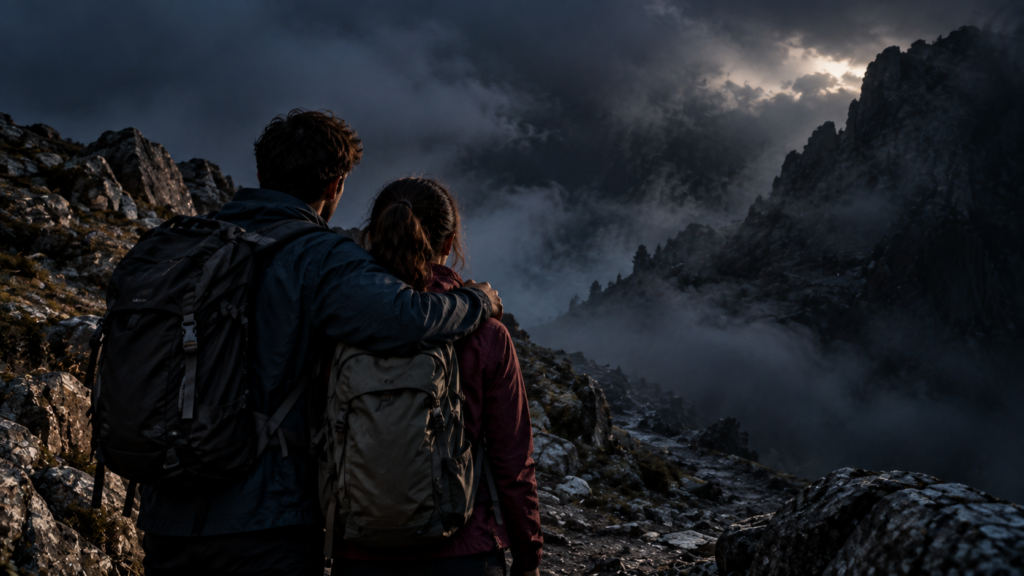
The familiar bystander effect reveals another side of the same problem. It is often presented as evidence that groups make people passive: when many witnesses are present, each individual may feel less personally responsible for intervening. Across decades of research, an overall bystander effect has indeed been observed, but large reviews have found a more complicated pattern in dangerous emergencies. Under some circumstances, the presence of other people can provide physical support and make intervention more feasible rather than simply diluting responsibility.
So other people can pull us in opposite directions. If everyone stands still, standing still becomes easier; if somebody moves forward, movement can become easier too. A crowd can distribute responsibility so widely that nobody acts, or it can distribute fear and practical risk widely enough that somebody finally does.
Courage can be socially contagious, but so can hesitation.
This may be why bravery has such a complicated relationship with crowds. We often imagine courage as one of the most individual of human qualities, something stored somewhere inside a person that appears when circumstances demand it. There are certainly meaningful differences between individuals, but courage also has an environment.
A frightened child may enter a dark room while holding a parent’s hand. An anxious adult may speak before an audience because a familiar face is sitting in the front row. Someone who would never confront an aggressor alone may intervene when several others move with them. In each case, the individual still has to act, but they are no longer carrying the psychological weight of the situation in quite the same way.
For a social species, perhaps that should not be surprising. For much of human existence, many serious dangers were not entirely private problems. Finding food, defending against threats, raising children, travelling through unfamiliar territory and confronting hostile groups were often collective activities. Other people were not simply companions who happened to be nearby when danger appeared; they were among the resources humans had for surviving it.
Something of that social calculation remains with us. Risk is rarely assessed from physical danger alone. Support matters. So does approval. Responsibility matters, as does belonging, and so does the simple observation that everyone around us appears willing to continue.
That is why a person can stand at the edge of something they would never attempt alone, feel the same height beneath them and much of the same fear inside them, then look at the people standing nearby and take a step forward.
The danger may be exactly where it was. They are simply no longer facing it by themselves.
Author’s Note
The idea for this article began with a familiar contradiction. People often do things with friends that they would hesitate to do alone, yet groups can also make people freeze, conform or avoid responsibility. That made the simple explanation that “groups make us brave” feel incomplete.
What interested me more was how many different things change when another person enters a frightening situation. The danger itself may remain untouched, while our sense of support, responsibility, social approval and what appears possible can all shift around it. Courage, viewed this way, is still personal, but it is not always produced alone.
G.C., creator and writer of Ecosociosphere.
References
- Kikusui, T., Winslow, J. T., & Mori, Y. Research on social buffering and the reduction of stress responses through social presence.
- Hornstein, E. A., Fanselow, M. S., & Eisenberger, N. I. Research examining social support and fear acquisition.
- Shteynberg, G., Hirsh, J. B., Galinsky, A. D., & Knight, A. P. Research on group size and perceptions of danger.
- Friedkin, N. E., & Johnsen, E. C. Work on choice shifts and group polarization.
- Fischer, P., et al. Meta-analysis of the bystander effect in dangerous and non-dangerous emergencies.