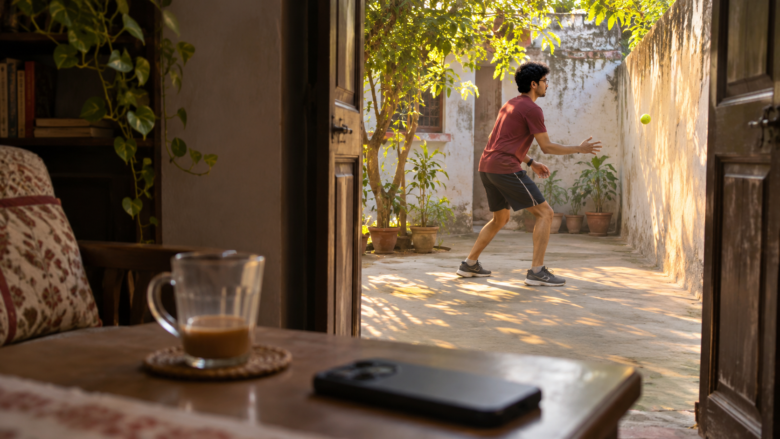
There is something oddly satisfying about standing in front of a wall with a ball in your hand. You throw it, watch it bounce back, catch it, and throw it again. Sometimes you change the angle or increase the speed, but mostly you just repeat the same movement. The ball makes a familiar sound against the wall, your hands find their rhythm, and a few minutes pass without much happening. Your phone might be lying nearby, full of messages, videos and things demanding attention, but you feel no particular urge to pick it up.
For a little while, an ordinary ball and an empty wall seem to provide everything you need.
What makes this interesting is the generation doing it. Millennials and Zillennials have lived through an extraordinary transformation in how entertainment reaches us. Many remember childhoods when a ball, a wall and a little free time were enough to keep them occupied. Now they carry devices capable of producing an almost endless supply of entertainment. They can watch hundreds of videos, follow conversations across continents and find something new whenever boredom approaches. Yet give someone from this generation a tennis ball and a suitable wall, and they might spend twenty minutes throwing and catching it without once wondering what else they could be doing.
There is no scoreboard, no opponent and usually no particular objective. You aren’t practising for a competition or trying to improve a measurable skill. The activity seems almost meaningless, which may be part of its appeal. The next throw follows naturally from the previous catch, and the wall returns the ball with comforting indifference. It doesn’t congratulate you for a successful attempt or complain when you miss.
The activity asks for your attention without asking you to achieve anything important.
Psychologists have a useful concept for understanding why such simple activities can become absorbing. It is called flow, a state of deep involvement in which attention becomes closely connected to what someone is doing. Research associated with psychologist Mihaly Csikszentmihalyi suggests that flow is encouraged by clear goals, immediate feedback and a suitable relationship between challenge and ability. Throwing a ball against a wall offers these conditions in miniature. You know exactly what to do next, the result arrives almost immediately, and you can make the task slightly harder or easier without stopping to think about it.
Of course, catching a ball doesn’t automatically produce a genuine flow state, and not every pleasant repetitive activity needs that explanation. But something about the arrangement fits. The ball leaves your hand, strikes the wall and returns along a path your eyes must follow. Your brain anticipates its movement, while your arms adjust to where it is likely to arrive. A throw that comes back too high requires a different response from one that returns low and fast. Even when the movements look effortless, the nervous system is continually coordinating vision, timing and muscle activity.
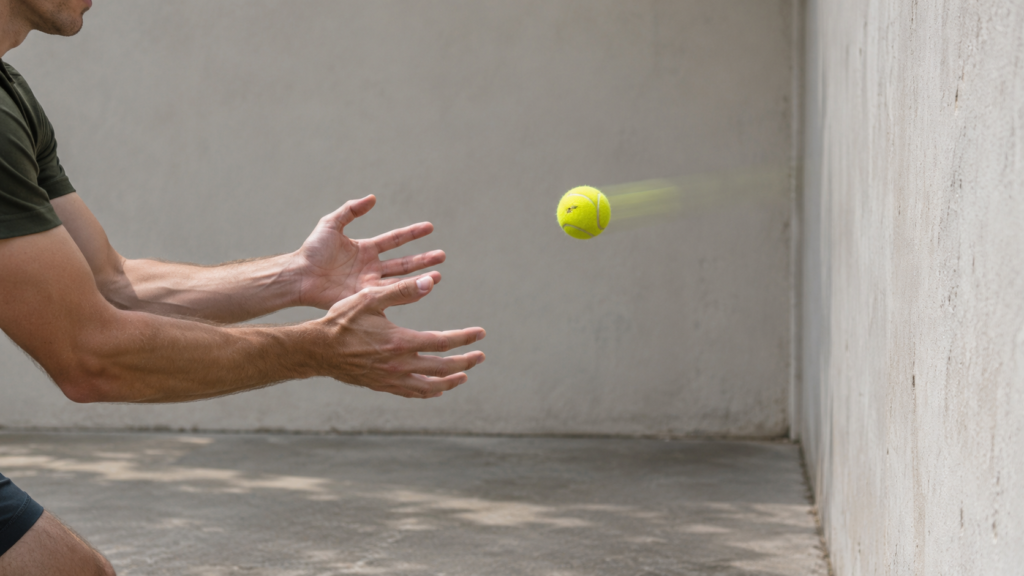
The mind is occupied, but not necessarily burdened.
That distinction may help explain the peculiar quietness people experience during the activity. We often imagine mental peace as the complete absence of thought, but the brain is never literally doing nothing. Watching a moving object, anticipating its trajectory and preparing to catch it all require processing. The difference may lie in where our attention is directed and how we engage with the activity. Instead of reviewing an awkward conversation or worrying about tomorrow’s responsibilities, you are responding to something happening directly in front of you. There is little room or immediate need for a complicated internal discussion. The ball is coming back, and your hands need to be ready.
The repetition also seems important. The familiar sound of the ball striking the wall creates a loose rhythm, followed by the softer sound of it landing in your palms. Throw, bounce, catch. Throw, bounce, catch. The timing isn’t perfectly regular, but it becomes predictable enough for the movement to feel comfortable. Research on rhythmic action and attention suggests that maintaining consistent movements involves coordination between perception and motor control. Yet studies have not established that throwing a ball against a wall produces a specific calming neurological effect. The sense of peace is better understood as a plausible experience arising from focused, familiar movement than as a scientifically proven form of therapy.
There is also a resemblance to meditation, although the two should not be treated as identical. Many forms of meditation involve deliberately attending to breathing, bodily sensations or the present moment while noticing when attention wanders. Ball throwing can produce a similar feeling of being occupied with the immediate present, but the attention is directed towards an external moving object. You do not need to sit still, close your eyes or consciously monitor your thoughts. In fact, trying too hard to make the activity meditative might spoil what makes it enjoyable.
The quiet arrives almost accidentally, while you are busy doing something else.
And perhaps that is what distinguishes the experience from scrolling. A phone can hold our attention by continually presenting new material. One video ends and another begins, each offering something different to notice. A ball and a wall provide almost the opposite arrangement. The environment barely changes, and any variation comes largely from your own movement. One activity can keep delivering new experiences, while the other allows you to remain with essentially the same experience for as long as you like. Neither is inherently good or bad, but they create very different relationships with attention.
There is a tempting generational story here, one in which people supposedly damaged by technology rediscover the innocence of childhood through a forgotten game. The reality is probably less dramatic. Not every millennial or zillennial is addicted to a phone, and enjoying a repetitive activity does not prove that someone is resisting digital dependence. Nor is this behaviour exclusive to any generation. Children, older adults and people who grew up without smartphones can find the same satisfaction in repeated physical play. What makes it particularly noticeable today is the contrast between the elaborate entertainment available to us and the remarkably modest activity we sometimes choose instead.
It is also worth considering that we may not always want entertainment in the usual sense. Sometimes we want something that occupies our hands without making further demands on our minds. We want a little movement, a predictable response and the freedom to stop whenever we please. A ball offers exactly that. It can be thrown harder, bounced at an angle, caught with one hand or allowed to hit the ground before being collected. There is enough variety to maintain interest, but none of it matters beyond the next few seconds.
The pleasure lies in continuing the activity, not in reaching some final achievement.
Eventually, you miss a catch. The ball rolls across the ground, perhaps settling beneath a chair or disappearing into a corner. You retrieve it and continue, or decide that you have had enough. There is no completed level, no reward waiting and no record of how long you played. The wall remains unchanged, and the ball is exactly the same object you picked up earlier. Yet the minutes between the first throw and the last may have felt unusually peaceful. Your responsibilities haven’t disappeared, and your phone is still waiting where you left it. For a brief stretch of time, however, neither seemed especially urgent. You were simply standing there, throwing a ball against a wall, catching it when it returned, and finding that nothing more was necessary.
Author’s Note
There is something I find particularly comforting about activities that don’t have to lead anywhere. Simply tossing a ball against a wall and catching it again offers exactly that kind of experience. You can do it for five minutes or half an hour, without planning anything or expecting a result. What interested me most was that even with so much entertainment available at our fingertips, such a simple activity can still hold our attention. Perhaps the surprising part isn’t that we sometimes enjoy doing almost nothing, but that doing almost nothing can feel so complete.
G.C., creator and writer of Ecosociosphere.
References & Further Reading
The research below supports the discussion of flow, attention, movement and digital engagement. The specific calming experience of repeatedly throwing a ball against a wall has not been directly established as a distinct psychological phenomenon.
- Alameda et al. (2022). A Scoping Review of Flow Research
- Harris et al. (2026). The Predictive Mind in Motion: Exploring Visuomotor Expertise Through Interception
- Seli, Cheyne & Smilek (2013). Wandering Minds and Wavering Rhythms
- Ahokas et al. (2025). The Training of Rhythm Skills and Executive Function: A Systematic Review
- León Méndez et al. (2024). Effects of Internet and Smartphone Addiction on Cognitive Control in Adolescents and Young Adults