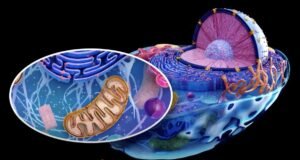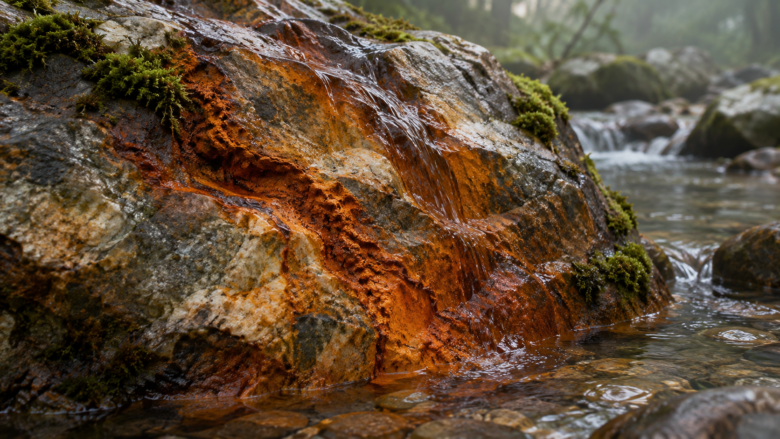
A rusty patch on an old rock rarely attracts much attention. Perhaps rainwater has been running over it for years, leaving orange and brown stains where the minerals have reacted with their surroundings. To us, these changes seem entirely chemical, the slow weathering of something that has never been alive. But in certain environments, microorganisms can participate in these reactions, taking advantage of the substances released from minerals to obtain energy. Some can even use the minerals themselves in processes resembling respiration.
What looks like an ordinary stone to us can be part of the energy supply of another living organism.
We are accustomed to thinking of food as something produced by living things. Plants capture sunlight, animals eat plants or other animals, and microorganisms generally seem to survive by consuming whatever organic material is available. This familiar arrangement explains much of life around us, but it leaves out an enormous variety of microbial metabolisms. Some bacteria can obtain energy from inorganic substances such as iron, sulfur compounds or hydrogen. They do not need to consume sugars or other organic compounds as their immediate source of metabolic energy, although they still need carbon and other nutrients to build their cells.
Scientists call this ability chemolithotrophy, a name that becomes more understandable when broken apart. The first part refers to chemical energy, while the second points to inorganic substances that provide electrons. An organism might oxidise dissolved iron, hydrogen sulfide or another suitable compound, capturing some of the energy released through the reaction. Some of these substances come directly from minerals, while others are gases or dissolved chemicals. So when we say that bacteria can eat rocks, we are using a rather loose description of something more precise.
They can exploit the chemical differences within their surroundings to obtain the energy needed to stay alive.
Iron provides a particularly interesting example because it can participate in microbial metabolism in two different directions. Certain bacteria obtain electrons by converting iron from its reduced form, iron(II), into iron(III). Under suitable conditions, the resulting iron compounds may form reddish deposits in water or on mineral surfaces. In 2019, researchers studying weathered bedrock in Puerto Rico demonstrated that iron-oxidising bacteria could obtain energy from iron contained in the rock’s minerals. The microorganisms also accelerated some of the chemical changes involved in weathering. The rock was therefore doing something more than providing a surface on which bacteria happened to live.
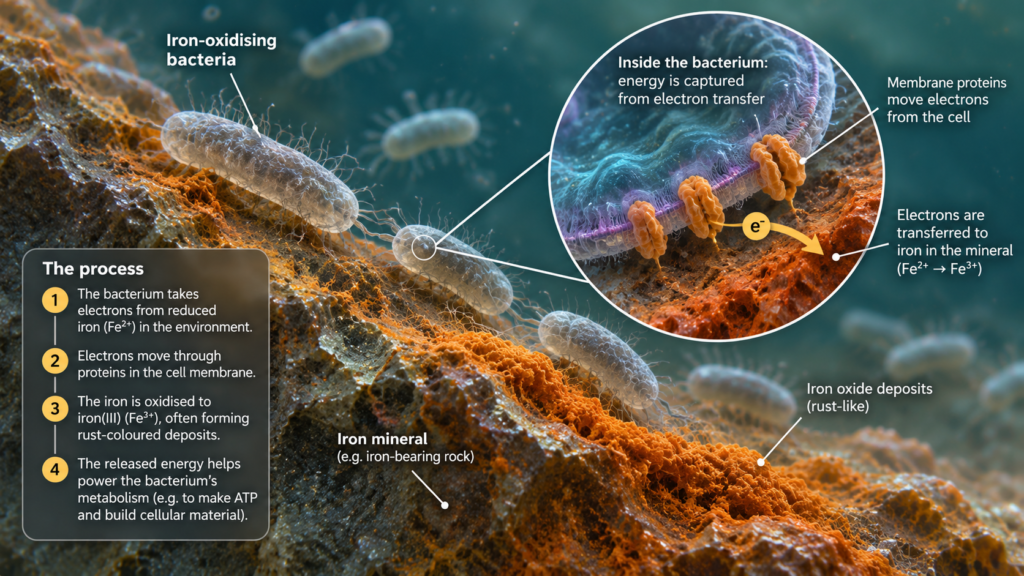
The idea becomes stranger when we consider bacteria that use iron in almost the opposite way. Humans depend on oxygen during cellular respiration because oxygen accepts electrons at the end of a series of energy-producing reactions. Certain microorganisms can carry out respiration using other electron acceptors, including compounds containing iron(III). Species belonging to groups such as Geobacter and Shewanella can transfer electrons to iron or manganese minerals. In these cases, the mineral is receiving electrons rather than supplying them.
One bacterium may draw energy from oxidising iron, while another can use an iron mineral to complete its respiratory process.
There is an obvious physical difficulty with this arrangement. Oxygen molecules can reach the respiratory machinery inside our cells, but a solid mineral cannot simply pass through a bacterial membrane. Some bacteria overcome this problem by transferring electrons beyond their cell surfaces. They possess specialised proteins, including cytochromes, that help move electrons through the cell envelope and towards an external mineral. Depending on the organism, electron transfer may also involve soluble molecules that carry electrons between surfaces or conductive structures associated with the cell. Researchers call these processes extracellular electron transfer.
It is tempting to imagine a tiny bacterium breathing a piece of rock, although nothing resembling inhalation is happening. The organism is using the mineral as part of an electron-transfer process, rather as oxygen participates in our respiration. There is no need for the entire mineral to enter the cell. The relevant chemical reactions can occur at or beyond its surface. Some of these bacteria can even exchange electrons with electrodes under laboratory conditions, which has encouraged research into microbial fuel cells and other bioelectrochemical technologies. The underlying biology, however, evolved long before humans invented electrical circuits.
These abilities can have consequences far beyond the survival of individual cells. Microorganisms that oxidise iron and sulfur compounds can contribute to the breakdown of sulfide minerals. In some mining environments, this activity helps release useful metals from ores through a process known as bioleaching. Similar reactions can also contribute to acidic mine drainage, where water becomes highly acidic and carries dissolved metals into surrounding ecosystems. A bacterium carrying out an ordinary metabolic reaction may therefore become part of a much larger chemical transformation.
The boundary between geological change and biological activity is not always as clear as it appears.
But the most extraordinary implications become visible in places where sunlight cannot reach. In 1977, scientists exploring the deep ocean discovered hydrothermal vents surrounded by unexpectedly rich communities of animals. These environments receive no sunlight capable of supporting photosynthesis, yet tube worms, mussels, shrimp and other organisms can flourish near the chemically rich fluids emerging from the seafloor. The foundation of these communities is microbial life. Certain bacteria and archaea use energy from chemical reactions involving substances such as hydrogen sulfide to manufacture organic material from carbon dioxide. This process is known as chemosynthesis.
In a forest, plants provide much of the organic matter that supports the surrounding food web. At a hydrothermal vent, chemosynthetic microorganisms can perform a comparable ecological role without capturing sunlight. Some live freely in microbial communities, while others form close associations with animals. Giant tube worms, for example, depend on internal bacterial partners that produce nutrients using chemical energy. The animals obtain food through an arrangement that would seem impossible if we assumed that every ecosystem needed green plants at its foundation.
For these communities, the chemical activity of Earth’s interior helps make a living world possible in complete darkness.
Even this requires a little caution. A food web powered by local chemical reactions is not necessarily independent of everything produced through photosynthesis elsewhere. Some microorganisms use dissolved oxygen that ultimately originates from photosynthetic life, while the deep ocean also receives organic material from above. Nevertheless, the central discovery remains intact: sunlight is not the only immediate energy source capable of supporting biological production.
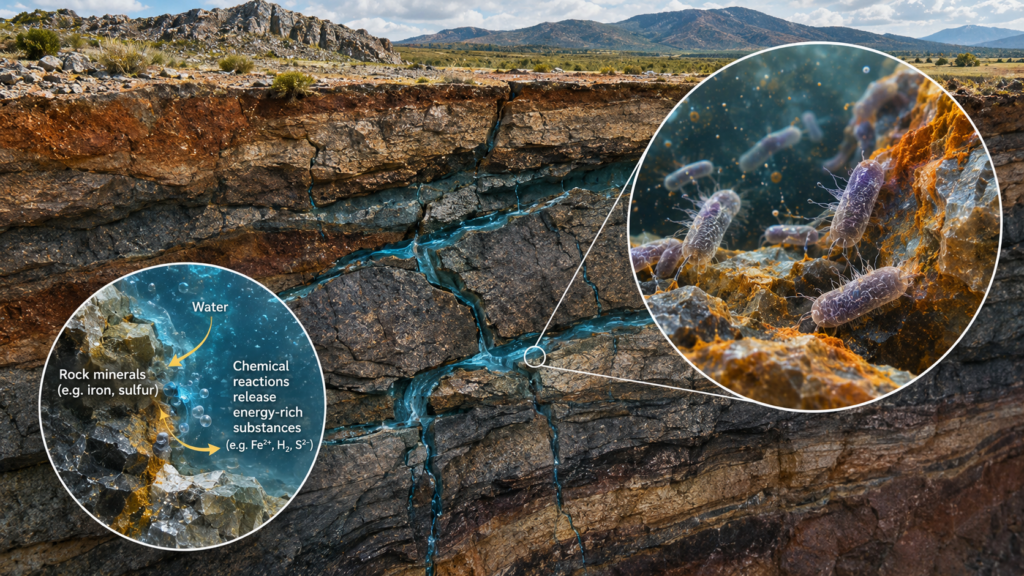
The possibilities extend beneath the ocean floor and into fractures deep within the continental crust. In some underground environments, water reacts with rocks or undergoes chemical changes associated with natural radioactivity, producing hydrogen that microorganisms can use. Such habitats may contain microbial communities whose energy supplies depend heavily on geological processes. These discoveries have also influenced how scientists think about possible life beneath the surfaces of other worlds. If suitable chemical reactions and other necessary conditions exist, sunlight need not be an absolute requirement for metabolism. Whether life actually exists in such places remains unknown.
What makes these microorganisms interesting is the way they change our understanding of an apparently lifeless object. A rock is not alive simply because bacteria can obtain energy from its minerals, and the organisms do not treat every stone as a meal. Their metabolism depends on particular chemical conditions, available electron donors and acceptors, and the ability to capture energy from the reactions involved. Still, something we regard as passive background can become an active participant in a living system.
The next time you notice a rusty stain spreading across a wet stone, there may be nothing biological happening there at all. Ordinary chemistry can produce that appearance without assistance. But elsewhere, under suitable conditions, microorganisms really are exploiting similar chemical changes to survive. Some are taking electrons from mineral-derived substances, while others are sending electrons into minerals beyond their cell walls.
The stone remains a stone, yet its chemistry can help sustain a living cell. And that is a rather different way of looking at the ground beneath our feet.
Author’s Note
I have always tended to think of rocks as the background against which living things exist. They form the ground, hold water and gradually change through weathering, but rarely appear to participate in life’s more immediate activities. What interested me during this research was discovering that certain microorganisms can make use of the chemistry of minerals in ways that resemble feeding and breathing. The distinction between those two processes was particularly revealing, because it suggests a much more varied relationship between life and the physical Earth than we ordinarily imagine.
G.C., creator and writer of Ecosociosphere.
References & Further Reading
- Napieralski et al. (2019). Microbial Chemolithotrophy Mediates Oxidative Weathering of Granitic Bedrock
- Gralnick & Bond (2023). Electron Transfer Beyond the Outer Membrane: Putting Electrons to Rest
- Shi et al. (2016). Extracellular Electron Transfer Mechanisms Between Microorganisms and Minerals
- NOAA Ocean Exploration. What Is the Difference Between Photosynthesis and Chemosynthesis?
- Woods Hole Oceanographic Institution. Life at Hydrothermal Vents and Cold Seeps
- Lin et al. (2005). Radiolytic H₂ in Continental Crust: Nuclear Power for Deep Subsurface Microbial Communities