Imagine sitting inside a spacecraft travelling through empty space. Its engines are powerful, its fuel supply seemingly unlimited, and there is nothing ahead to slow it down. You accelerate steadily, watching distant stars move across the windows. At first, every additional burst of energy increases your speed much as you would expect. But eventually, something peculiar happens. No matter how much energy you supply, your spacecraft can never reach the speed of light. There is no invisible wall waiting to stop it, and no resistance from space itself.
The limit seems to be built into the way the universe allows objects to move.
Light travels through a vacuum at approximately 300,000 kilometres per second, fast enough to circle Earth’s equator more than seven times in a single second. At that speed, sunlight takes about eight minutes and twenty seconds to reach our planet, while light from the nearest star beyond the Sun requires more than four years to arrive. These distances are enormous by human standards, yet light crosses them with extraordinary speed. For centuries, scientists investigated how quickly light travelled and why its measured behaviour seemed so unusual. The deeper mystery, however, was not simply the speed of light. It was why this particular speed appeared to hold a special position in the laws of nature.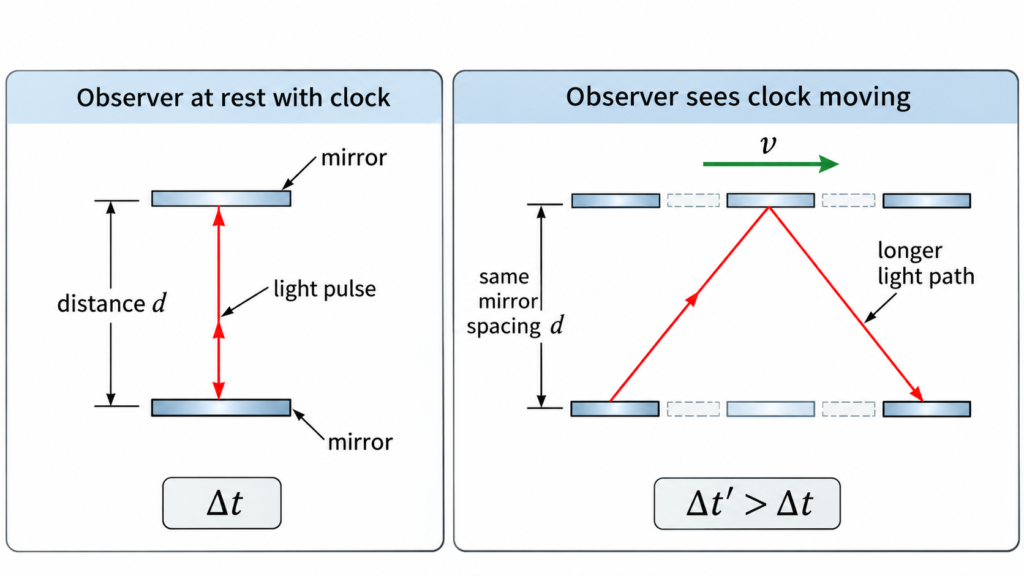
In everyday life, speeds normally add together. If you walk towards the front of a moving train, someone standing beside the tracks sees you moving faster than the train itself. The same reasoning might suggest that a spacecraft travelling towards a beam of light should measure the light approaching at an even greater speed. But experiments and the equations of electromagnetism led physicists towards a very different conclusion. In 1905, Albert Einstein developed his theory of special relativity around two principles, including the requirement that light in a vacuum travels at the same speed for all inertial observers, regardless of their relative motion.
The speed of light does not behave like the speed of an ordinary moving object.
To make this possible, something much more familiar had to change: our understanding of space and time. We ordinarily imagine a second as the same duration everywhere, and a metre as an identical length regardless of who measures it. Relativity reveals that measurements of time intervals and distances can depend on the relative motion of observers. A rapidly moving clock is measured to run more slowly than one at rest relative to the observer, while lengths along the direction of motion can appear contracted. These effects are negligible at everyday speeds, which is why Newton’s laws describe so much of our ordinary experience so successfully. But near the speed of light, they become impossible to ignore.
This brings us to spacetime, the four-dimensional framework in which space and time are connected. An event is not described only by where it occurs, but also by when it happens. Two observers moving relative to each other can disagree about the time separating certain events, and even about which of two sufficiently separated events happened first. Yet the structure of spacetime preserves certain relationships that all observers must agree upon. The invariant speed usually represented by the letter c is part of that structure. Light in a vacuum travels at this speed because photons are massless, but the limit is more fundamental than light itself.
It defines how rapidly a physical influence can propagate locally through spacetime.
The distinction becomes clearer when we return to the accelerating spacecraft. An object with mass can gain speed as energy is supplied to it, but the relationship between energy and velocity changes dramatically near c. At lower speeds, familiar approximations work reasonably well. At relativistic speeds, however, the energy required for further acceleration grows increasingly large. As the object’s speed approaches the speed of light, the energy required to reach that speed increases without bound. No finite amount of energy can accelerate an object with nonzero rest mass all the way to c. The spacecraft can approach the limit more and more closely, but it cannot cross it.
This is not merely a prediction about imaginary spacecraft. Particle accelerators provide striking experimental demonstrations. At facilities such as CERN, electrically charged particles are accelerated to speeds extremely close to that of light. Supplying additional energy continues to increase their energy and momentum, but produces progressively smaller increases in speed.
A proton travelling extremely close to c can carry vastly more energy than a slower proton without becoming appreciably faster.
The result is difficult to reconcile with everyday intuition, because we are accustomed to thinking of acceleration simply as gaining speed. Near the cosmic limit, energy and motion have a more complicated relationship.
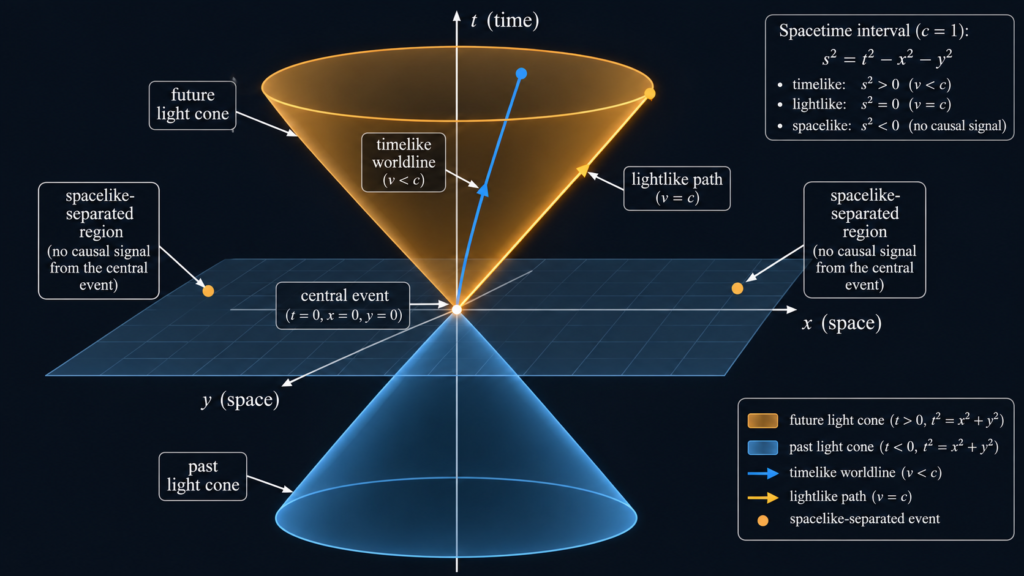
There is another reason this limit matters, and it may be the strangest of all. Physics depends on causality, the relationship between causes and their possible effects. If you press a button that activates a distant machine, the influence connecting those events must travel from one location to the other. Relativity describes these possibilities using structures called light cones, which distinguish events that can be causally connected from those too distant in space and time for a light-speed signal to travel between them. If controllable information could travel faster than light, certain observers could describe signals as arriving before they were sent. With suitable arrangements, faster-than-light communication could create contradictions involving the order of cause and effect.
The speed limit helps preserve the causal relationships on which our understanding of physical events depends.
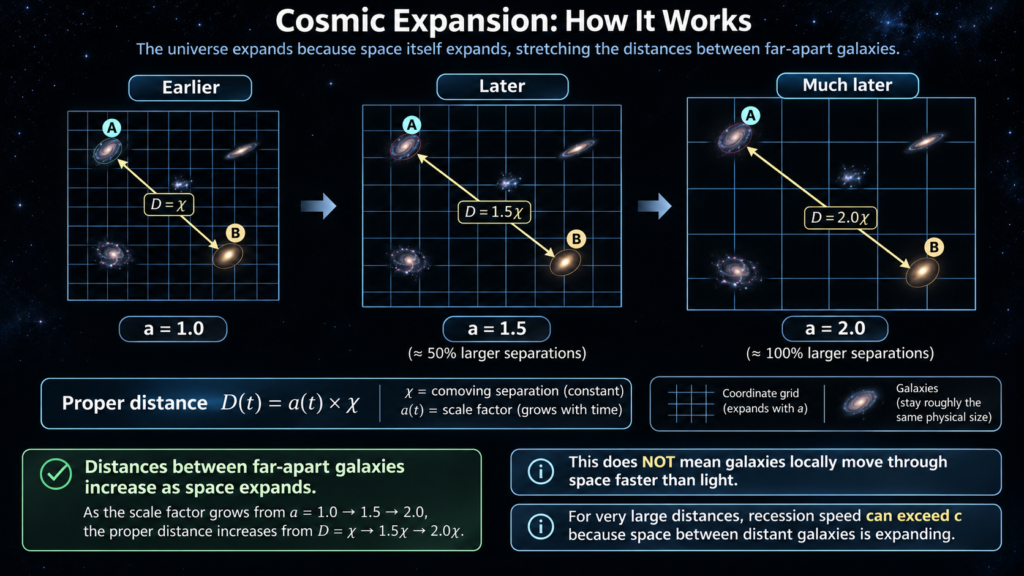
But the universe contains something that seems to challenge this restriction. Astronomers observe galaxies receding from one another as space expands, and sufficiently distant galaxies can have recession rates greater than the speed of light. Does this mean Einstein was wrong? Not necessarily. These galaxies are not travelling through their immediate surroundings faster than light in the ordinary sense. Rather, the distance between widely separated regions can increase because the geometry of expanding space changes. General relativity describes this behaviour without requiring objects or local signals to break the usual speed limit. The distinction is subtle, but essential: the expansion of space is not identical to motion through space.
Even light itself introduces qualifications. It travels more slowly through materials such as glass or water than through a vacuum, and particles can sometimes move faster than light travels through those materials. This produces phenomena such as Cherenkov radiation, a characteristic glow observed in certain nuclear reactors. But the particles are not exceeding the fundamental speed c. They are merely travelling faster than light propagates through that particular medium. The universal limit belongs to the local structure of spacetime, not to every possible speed associated with light under every condition.
Perhaps the most remarkable consequence is what this means for our relationship with the universe.
When astronomers observe a distant galaxy, they see light that may have travelled for millions or billions of years before reaching Earth. They are not seeing the galaxy exactly as it exists at this moment. They are receiving information from its past, carried across space at a finite speed. Even the Sun we watch setting is seen as it was several minutes earlier. The universe does not deliver information instantaneously, no matter how powerful our telescopes become.
Return once more to the spacecraft accelerating into the darkness. Its engines continue working, and the stars ahead remain unimaginably distant. Nothing visible announces that an absolute limit has been reached, because the spacecraft never quite reaches it. The barrier exists not as a physical object, but as a consequence of the relationship between energy, motion, space and time. We tend to think of speed as something that technology can continually increase, given enough ingenuity and power. Yet the universe appears to place a fundamental restriction on how quickly one event can influence another.
Even in a cosmos containing billions of galaxies, there are limits to how rapidly anything can reach beyond itself.
Author’s Note
What interests me most about the speed of light is that it is not simply a record waiting to be broken. Its significance comes from the structure of spacetime itself, where motion, distance and time are more closely connected than everyday experience suggests. I find it particularly strange that the same limit governing a beam of light also determines how far the consequences of an event can reach. Perhaps the extraordinary thing is not that the universe has a speed limit, but that space and time behave in ways that make such a limit possible.
G.C., creator and writer of Ecosociosphere.
References & Further Reading
- OpenStax Physics. Postulates of Special Relativity — Explains the constancy of light speed and why classical velocity addition must be modified.
- NASA Science. 10 Things Einstein Got Right — Describes key predictions of relativity and experimental evidence supporting them.
- CERN. Particle Accelerators — Explains how charged particles are accelerated to speeds approaching that of light.
- U.S. Department of Energy. DOE Explains: Spacetime — Discusses spacetime, relativity and the relationship between light speed and causality.
- Stanford University — Gravity Probe B. Einstein’s Spacetime — Historical and conceptual discussion of how relativity changed the understanding of space and time.
- NASA Goddard Space Flight Center. The Speed of Light — Explains why massive objects cannot attain the speed of light in a vacuum.
- NASA Imagine the Universe. Cosmology Questions and Answers — Discusses cosmic expansion and why recession rates greater than light speed need not violate relativity.
- CERN — Collider Experiments. Collider Experiments: The LHC and Beyond — Includes the distinction between the speed of light in a medium and the invariant vacuum speed.