
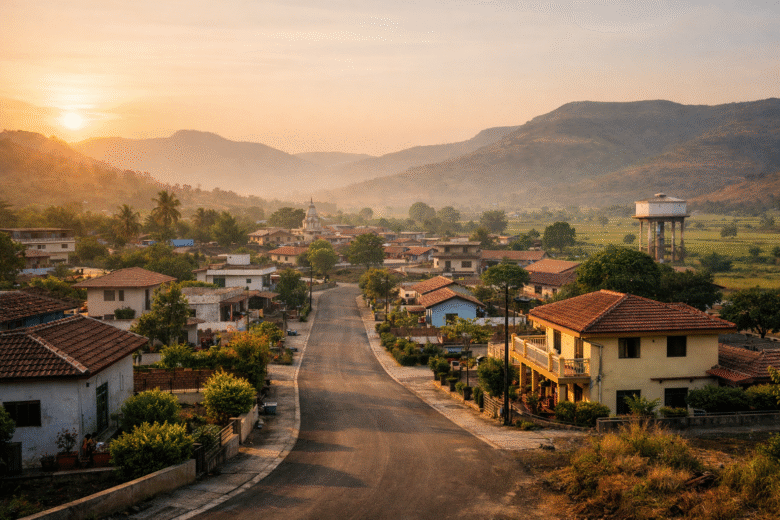
There’s a village in Maharashtra where the roads are cleaner than many cities, where water doesn’t come with anxiety, and where development didn’t arrive with noise—but with discipline.
It’s called Adachiwadi.
Located quietly in the Purandar taluka of Pune district, Adachiwadi is not famous for a tourist attraction or a historical monument. It’s famous for something far more unsettling—it works. And in a country where we often accept “adjustment” as a way of life, that alone makes it revolutionary.
When Cleanliness Isn’t a Campaign, But a Culture
Walk through Adachiwadi, and something feels… different.
No overflowing drains. No plastic tangled in bushes. No careless dumping. The kind of cleanliness that cities try to manufacture through campaigns already exists here as habit.
This isn’t because of a one-time initiative or a government push. It’s because the people decided that their surroundings were a reflection of themselves. Waste management isn’t an afterthought—it’s routine. Discipline isn’t enforced—it’s expected.
And perhaps that’s the first lesson Adachiwadi offers: real change doesn’t come from slogans. It comes from everyday behaviour.
A Village That Built Itself—Quietly, Steadily
Adachiwadi didn’t wake up one day as a “smart village.”
There was a time when it struggled—like most rural settlements—with water scarcity, weak infrastructure, and limited access to opportunities. The difference is what happened next.
Instead of waiting, the village moved.
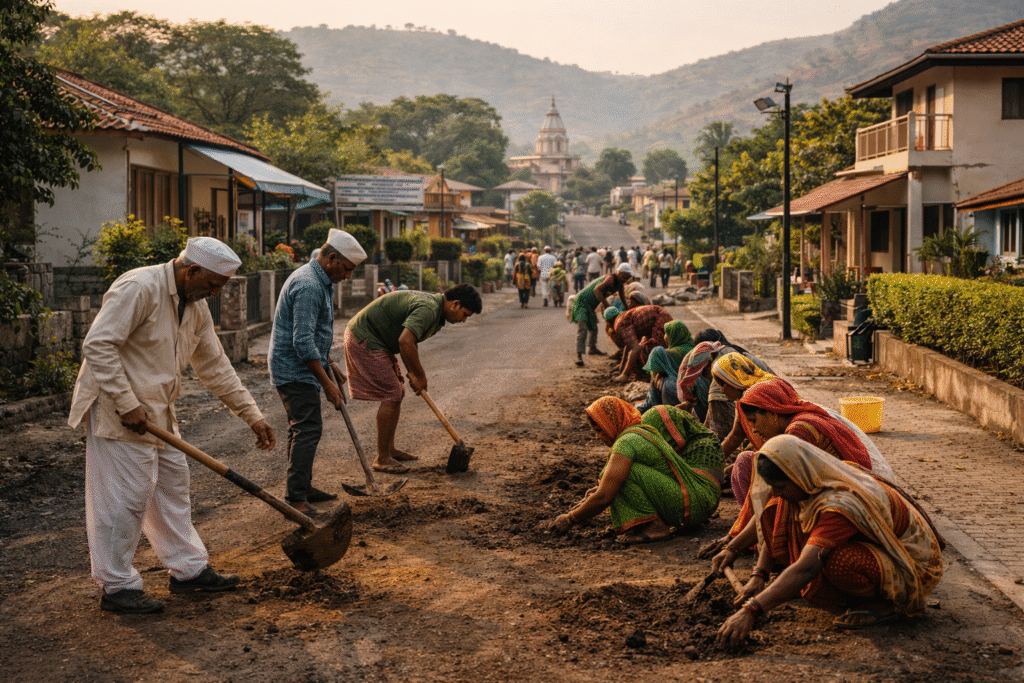
Through community participation—shramdaan, collective effort, and smart use of government schemes—the people rebuilt their own future. Roads were laid. Drainage systems were created. Water pipelines were planned, not patched.
What emerged wasn’t just development—it was ownership.
Where Rural Meets Remarkably Modern
Here’s where Adachiwadi begins to feel almost unbelievable.
A water ATM provides affordable clean drinking water. There are CCTV cameras monitoring streets—not out of fear, but for safety and accountability. Students study in digital classrooms, and there are dedicated study rooms where ambition gets space.
There’s even a gym—not as a luxury, but as a statement. Health matters here.
The village has cemented roads, proper drainage, street lighting, and access to digital services. These are things cities take for granted—and villages are expected to live without.
Adachiwadi quietly rejects that expectation.
Water: The Turning Point Story
If there is one thread running through Adachiwadi’s transformation, it is water.
Once a source of stress, water is now a managed resource. Through conservation projects, planning, and infrastructure, the village ensured that scarcity did not dictate its future.
Because when water becomes stable, everything else follows—health, agriculture, time, and dignity.
The Power of “We” in a World of “I”
What makes Adachiwadi different isn’t just infrastructure—it’s mindset.
In many places, development is seen as something that “someone else” should do. The government. The system. The future.
In Adachiwadi, development became a collective responsibility.
People participated. They contributed labour. They held each other accountable. They treated public spaces as shared assets, not nobody’s property.
And suddenly, progress wasn’t slow anymore.
A Quiet Challenge to Urban India
There’s something slightly uncomfortable about Adachiwadi.
Because it quietly asks a question cities don’t like answering:
If a village with 1,500 people can manage waste, water, discipline, and infrastructure—what exactly are we struggling with?
Maybe the problem was never resources. Maybe it was intention.
Conclusion: Not Just a Village, But a Direction
Adachiwadi is not perfect. No place is.
But it is proof.
Proof that development is not a miracle—it’s a method. That rural India doesn’t need saving; it needs support and trust. That progress doesn’t always come from outside—it can grow from within.
And most importantly, it shows that change doesn’t have to be loud to be powerful.
Sometimes, it just has to be consistent.
Author’s Note
I spend my day in classrooms, talking about what India can become. And then you come across a place like Adachiwadi—and you realize, parts of that future already exist.
Not in headlines. Not in big cities. But in quiet villages where people decided that “better” was not optional. Maybe that’s where real change begins—not with ambition, but with refusal. Refusal to stay the same.
G.C., Ecosociosphere contributor.