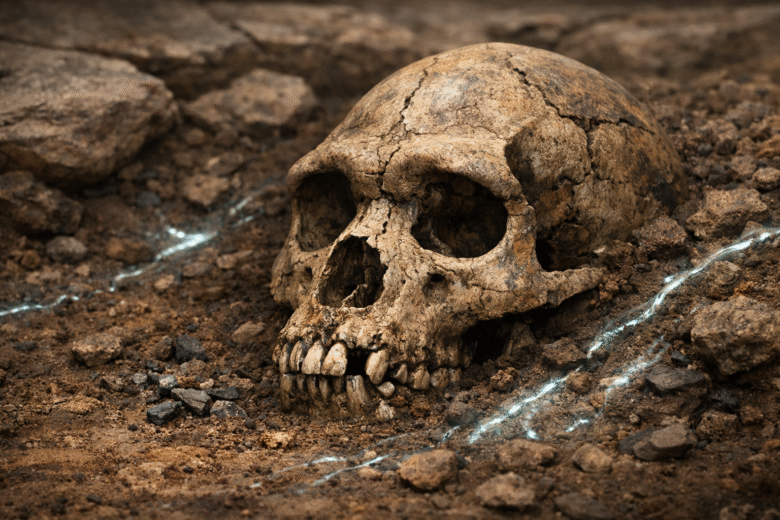
Fun fact: Long before factories, petrol, or batteries existed, early humans were already carrying traces of lead inside their bodies—locked forever in their teeth.
That unsettling truth sits at the heart of Ancient Lead Exposure in Early Humans. Fossil teeth from ancient hominids suggest that lead exposure was not a modern accident but an ancient companion of human life. And the more scientists look closely, the more uncomfortable the question becomes: did toxins quietly shape who we are today?
This is not just a story about the past. It holds today’s world up for quiet scrutiny.
Poison Before Industry
We often tell ourselves a comforting story—that pollution began with smokestacks, cars, and careless modernity. Before that, nature was clean, and humans lived in harmony with their environment. Fossil chemistry tells a less romantic tale.
Lead is a naturally occurring metal. It seeps into soil from volcanic rock, settles in water sources, and accumulates in plants and animals. Early humans did not need mines or factories to encounter it. They drank it. They ate it. They absorbed it.
Recent studies examining fossilised teeth from early hominids show microscopic bands of lead trapped in dental enamel. Teeth, unlike bones, do not remodel themselves. They preserve a chemical diary of childhood—each layer recording what entered the body while the tooth was forming.
What those layers reveal is troubling: lead exposure was not rare. It was routine.
Teeth That Remember What Brains Forget
Fossil teeth function like biological hard drives. Using high-resolution imaging, scientists can track exposure to toxins across specific developmental windows—sometimes down to individual weeks of early life.
In several ancient specimens, lead spikes align with periods of rapid brain growth. That matters, because lead is neurotoxic. Even small amounts can interfere with brain development, learning ability, and behaviour.
This raises a quiet but profound possibility. Early human brains did not evolve in a pristine world. They evolved under chemical stress.
The question is no longer whether ancient humans encountered toxins—but whether surviving those toxins shaped which genes endured.
Adaptation Through Survival, Not Choice
Evolution does not reward comfort. It rewards survival under pressure.
Repeated exposure to lead would have favoured individuals whose bodies handled it better—those who absorbed less, excreted more, or suffered fewer neurological consequences. Over thousands of generations, even small advantages can tilt the genetic balance.
Some researchers now speculate that genes involved in metal detoxification, kidney function, and cellular repair may have been shaped partly by ancient environmental poisons. In other words, toxins may have acted as invisible sculptors of the human genome.
This does not mean lead made us smarter or stronger. It means that only those resilient enough to function despite exposure passed on their genes.
Evolution, as always, was indifferent to suffering.

Nature Was Never Gentle
There is a persistent myth that pre-industrial life was healthier simply because it was “natural.” But nature has always been chemically complex—and often hostile.
Early humans lived near volcanic regions, mineral-rich rivers, and dust-laden plains. Fire, another evolutionary breakthrough, concentrated metals in ash and smoke. Even tool-making exposed hominids to metal-rich sediments.
In this light, lead exposure becomes part of a broader truth: human evolution unfolded in a world full of invisible threats. Parasites, pathogens, famine—and toxins—were all part of the same selective environment.
What feels shocking today is not that ancient humans encountered poison. It is that we are only now learning to see its fingerprints.
Echoes in the Modern Body
Why does this matter now?
Because modern humans still carry the biological consequences of ancient environments. Our bodies did not reset when industry arrived. They adapted slowly, imperfectly, and often at great cost.
Today, lead exposure remains a public health issue in many parts of the world, including India. Old pipes, contaminated soil, informal recycling, and industrial waste continue to expose children to a toxin their ancestors also faced—but at far lower levels.
The tragedy is that modern exposure is no longer accidental. It is systemic.
Ancient humans did not choose contaminated water. Today, entire communities are forced into it.
A History Written in Calcium
There is something haunting about the idea that teeth—objects we associate with smiles, speech, and survival—carry evidence of poison across deep time.
They remind us that history is not only written in stone tools or cave art, but in bodies themselves. Every generation inherits not just genes, but the consequences of environments shaped by those before them.
Ancient lead exposure forces us to confront an uncomfortable continuity. We are not separate from our past mistakes. We are built from them.
The Ethical Weight of Knowledge
Science often prides itself on discovery without judgment. But some discoveries demand reflection.
If toxins influenced human evolution, then environmental harm is not just a modern crisis—it is an ancient force with long shadows. The difference is that today, we understand the damage. And understanding carries responsibility.
We can no longer claim ignorance.
What we expose children to now will not vanish with policy changes or news cycles. It may linger—in bodies, behaviours, and biology—for generations.
Conclusion: Evolution Is Still Watching
This blog is not a story about distant ancestors alone. It is a reminder that evolution is ongoing, and it is paying attention to the environments we create.
The fossil record shows us that survival often comes at a cost. The question facing us now is whether we are willing to keep paying it—or finally change the conditions of the experiment.
Because the future, like the past, will be written in our bones.
Author’s Note
This piece stayed with me longer than most. Perhaps because as a teacher, I spend my days thinking about growth—of minds, of curiosity, of potential. The idea that something as small and invisible as lead could leave marks across millions of years reminds me why writing matters. Not to alarm, but to notice. Not to accuse, but to awaken attention. Some stories ask us not to look away. This felt like one of them.
G.C., Ecosociosphere contributor.