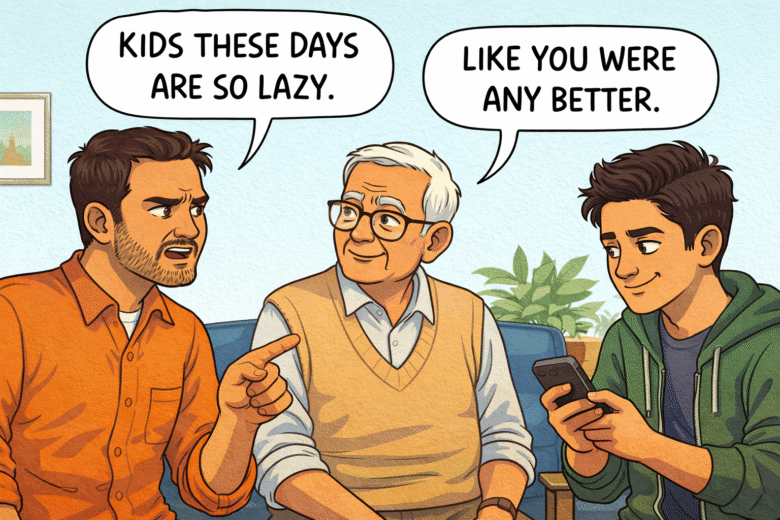
Fun fact: the complaint that “young people are lazy” is more than 2,000 years old—ancient philosophers were already grumbling about the next generation long before smartphones or social media existed. That makes the modern debate around youth culture strangely familiar. Open any social media comment section, scroll through opinion columns, or listen to a family …
Fun fact: Scientists have found that most people form their strongest musical memories between the ages of 12 and 22. If you play a song from your teenage years, something strange happens. Your brain doesn’t just hear music—it opens a door. Suddenly, you are back in a classroom corridor, a bus ride home, a first …
Zillennials: Too Cool (or Too Confused) Between Two Worlds Fun fact: the word “Zillennials” did not exist fifteen years ago — but today, thousands of young adults proudly (or nervously) claim it as their identity. If you have ever rewound a cassette tape with a pencil and also learned to swipe before you could legally …
Fun fact: the “thumbs up” emoji can mean “great job,” “okay,” “end of discussion,” or “I am mildly annoyed” — depending entirely on the age of the person reading it. That’s not a typo. That’s modern communication. Somewhere between rotary phones and reel videos, we created a new dialect — one built out of hashtags, …
Fun fact: during major global crises, meme creation often spikes faster than official news updates — sometimes within minutes of an event trending online. That tells us something about our times. Before politicians speak, before news anchors adjust their ties, someone somewhere has already turned the moment into a meme. And that is exactly what …
Fun fact: Studies show that the average teenager now sends more messages in a single day than many grandparents spoke words outside their home in an entire week half a century ago. “Family Dinner vs Family DM: How Different Generations Communicate Tonight” is not just a catchy headline. It is a snapshot of what is …
Fun fact: the phrase “swag gap” didn’t come from fashion theory or relationship psychology—it came from memes, screenshots, and brutally honest comment sections. The “Swag Gap”: When Style Turns Into a Relationship Debate is not really about clothes. It never was. What started as playful internet humour—partners photographed side by side, one dressed like a runway …
Fun fact: one of the world’s oldest known monuments, Göbekli Tepe in present-day Turkey, was built around 11,000 years ago — long before agriculture, cities, or writing. We’ve been building monuments almost from the moment we gathered in groups. Why? Because building is more than creating. In asking Why Do We Build Monuments? we dig …
Fun fact: the ancient Egyptians believed that every morning the sun god Ra sailed across the sky in a boat—only to descend through the underworld at night, battling chaos until dawn returned. But that dramatic myth hints at a deeper question: Why did ancient civilizations worship the sun? In this article, we’ll peel back the …
Fun fact: even newborns prefer looking at faces to scrambled shapes—suggesting our brains are wired to recognize meaning, relationships, and narrative almost from birth. But why do humans tell stories? Why did our ancestors gather around fires to pass down tales of hunts, gods, love, loss, or tricksters? The title of this piece—“Why Humans Tell …