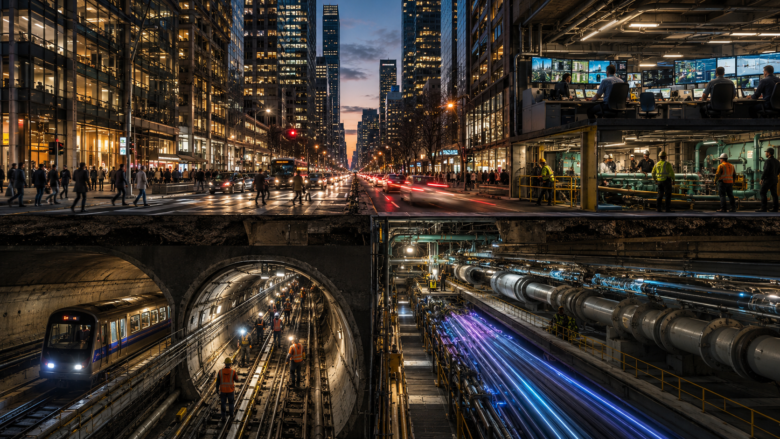
Every day begins with countless assumptions that rarely cross our minds. We expect the lights to turn on, clean water to flow from the tap, traffic signals to keep roads orderly, and groceries to be waiting on supermarket shelves.
Our phones connect instantly to the internet, trains arrive close to schedule, and emergency services remain only a phone call away. These conveniences feel so ordinary that they seem almost automatic. Yet behind each of them lies an enormous network of people and systems working continuously to keep life moving.
Modern civilization is built on things we hardly ever notice.
The most visible parts of society are often not the ones that matter most. Towering skyscrapers, high-speed trains, and advanced smartphones capture our attention, but they depend on less glamorous foundations.
Engineers inspect bridges before cracks become dangerous. Water treatment workers ensure every glass of drinking water is safe. Electric grid operators monitor power supplies around the clock, while sanitation crews quietly remove waste before it becomes a public health problem. Their work rarely attracts headlines because success, in these professions, means that nothing unusual happens.
This invisibility is not a flaw—it is a sign that the system is working.
Human attention naturally focuses on change rather than stability. Psychologists have long known that our brains are far more likely to notice problems than smooth routines. A road without potholes barely enters our thoughts, but one damaged section immediately becomes frustrating.
We rarely celebrate a train arriving on time, yet remember the delays for days. Reliable systems fade into the background because they quietly meet our expectations. Ironically, the more dependable something becomes, the less we appreciate the effort required to keep it that way.
That habit shapes how we think about civilization itself.
We experience electricity as something that simply emerges from a wall socket, yet it is delivered through a vast network of power plants, transmission lines, substations, transformers, and control centres operated by thousands of skilled professionals. Food seems to originate in supermarket aisles, though it has already passed through farms, processing facilities, warehouses, refrigerated trucks, ports, and distribution centres.
Even sending a simple message relies on data centres, fibre-optic cables, satellites, software, and engineers spread across the globe. Every ordinary moment is supported by an extraordinary chain of cooperation that remains almost completely hidden.

We usually discover these systems only when they stop working.
A citywide power outage suddenly reminds everyone how dependent daily life is on electricity. Empty supermarket shelves reveal the complexity of supply chains that usually operate unnoticed.
A disrupted internet connection can interrupt work, education, banking, healthcare, and communication all at once. Failures have a way of exposing the machinery that success quietly conceals. For a brief moment, we see the invisible architecture that supports modern life every day.
History repeatedly shows that civilization is sustained not only by famous leaders or groundbreaking inventions but also by millions of ordinary people performing essential tasks with remarkable consistency.
The technician replacing ageing electrical equipment before it fails, the bridge inspector identifying hidden weaknesses, the railway maintenance crew working through the night, and the emergency dispatcher calmly coordinating responses all contribute to a society that feels stable. Their greatest achievement is often preventing problems that the public never knows existed.
Success is strangely difficult to notice when it prevents disaster.
This creates an unusual paradox. Preventive maintenance rarely receives attention because its results are invisible. A bridge that safely carries traffic for fifty years appears ordinary, even though decades of inspection and repair made that possible. Clean drinking water is taken for granted until contamination occurs.
Public health systems are usually noticed only when a crisis unfolds, even though their everyday work is focused on preventing such crises from occurring in the first place. When nothing goes wrong, people naturally assume that nothing needed to be done.
Technology has made these hidden systems even easier to overlook.
Ordering food, transferring money, or finding directions now requires only a few taps on a screen. The simplicity of these experiences hides astonishing complexity beneath the surface.
Vast data centres consume enormous amounts of electricity, cybersecurity teams defend networks against constant threats, and technicians replace failing hardware before users notice a problem. The digital world feels effortless precisely because an immense physical infrastructure works tirelessly behind it.
These invisible systems also reveal something remarkable about human trust.

Every day, billions of people depend on strangers they will never meet. Patients trust laboratories to produce accurate test results. Drivers trust that roads and bridges have been properly maintained. Families trust that drinking water is safe, and businesses trust that financial systems will process transactions correctly.
Most of this confidence does not come from personal relationships but from professional standards, institutions, and countless individuals who quietly fulfil their responsibilities every day.
This may explain why the breakdown of essential systems feels so deeply unsettling. They remind us that modern civilization is less like a collection of separate machines and more like a living network in which everything depends on everything else.
Roads, electricity, communications, healthcare, transportation, and sanitation do not operate in isolation. Together they create the stable environment that allows society to function, innovate, and grow.
We often admire civilization through its greatest achievements—its tallest buildings, fastest computers, or most ambitious scientific discoveries.
Yet its true strength may lie somewhere far less visible.
It exists in the quiet coordination of millions of people who inspect, repair, maintain, monitor, and improve the systems that most of us never think about. Their efforts seldom earn public recognition because their success is measured by how ordinary and uninterrupted everyday life remains.
Perhaps that is civilization’s greatest triumph. It has become so dependable that we mistake it for something natural rather than something carefully maintained.
Behind every illuminated home, every safe journey, every successful hospital operation, and every uninterrupted conversation lies an invisible web of people and infrastructure working together.
We seldom notice it because it is designed to disappear into everyday life. And perhaps the clearest sign that these hidden systems are doing their job is that, most days, we never have a reason to think about them at all.
Author’s Note
The strongest foundations are often the least visible. This article explores the hidden infrastructure and people whose quiet work allows modern civilization to function every day, reminding us that reliability itself may be one of humanity’s greatest achievements.
G.C., Ecosociosphere contributor.