Fun fact: Europa, one of Jupiter’s moons, reflects so much sunlight that it would shine brighter than Earth’s Moon if it orbited our planet.
Every few years, space throws us an image that looks like it belongs in a horror film rather than a science journal. This time, it was a strange, branching shape on Europa — jagged, radial, unsettling — quickly compared to the Mind Flayer from Stranger Things. The headline practically wrote itself. Something alien. Something watching. Something beneath the ice.
And yet, Europa’s Mind Flayer Moment Explained is not a story about monsters. It is a story about how easily wonder turns into panic when science meets spectacle.
The image itself is real. The fear around it is not.
Why Europa Never Leaves the Conversation
Europa has fascinated scientists long before social media gave it a villain arc. Beneath its frozen surface lies a global ocean, likely deeper than all of Earth’s oceans combined. That single fact keeps Europa permanently pinned on humanity’s mental map of “possible life elsewhere.”
This is why the NASA (National Aeronautics and Space Administration, the United States government agency responsible for space research and exploration) keeps returning to this moon in its plans and missions. Not because Europa looks dramatic — but because it behaves like a world that never quite froze solid.
Cracks appear. Ice shifts. The surface looks bruised, restless, unfinished. Europa does not sit still.
And then came the shape.
The Shape That Triggered the Internet
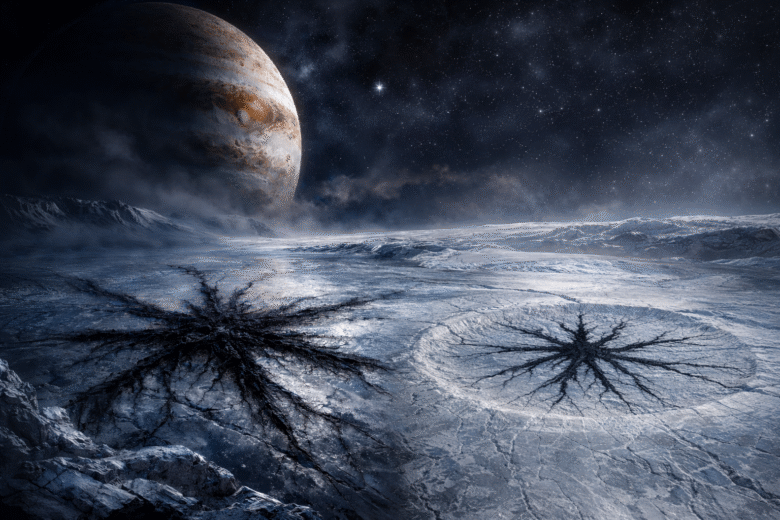
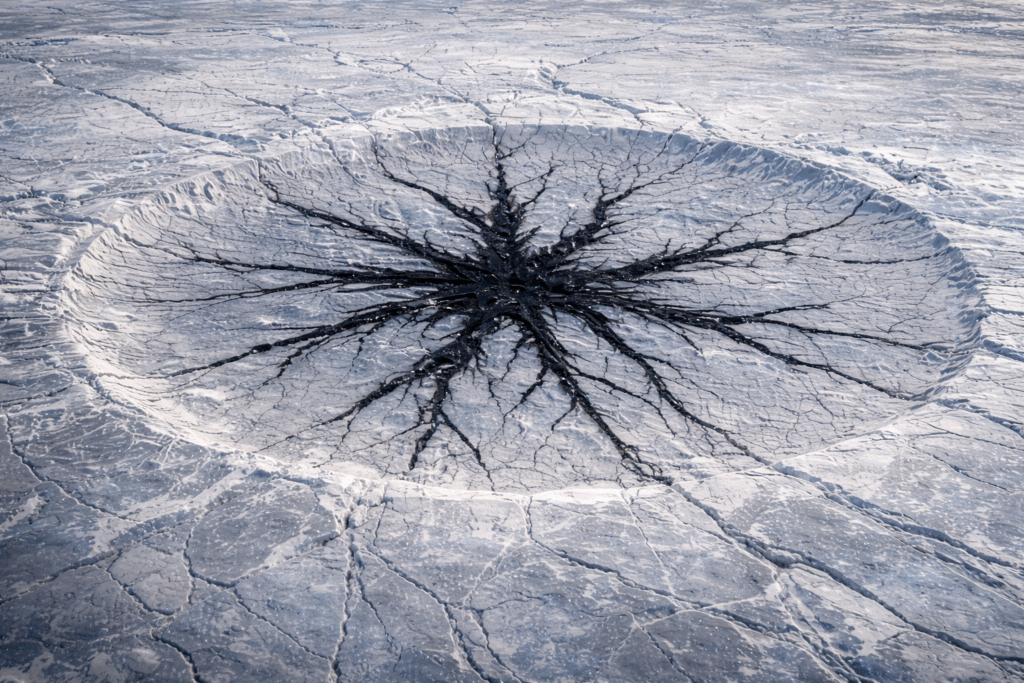
The formation appears inside a crater, spreading outward like a frozen explosion. Dark lines branch in all directions, giving the impression of movement, almost intention. It does not help that humans are exceptionally good at seeing patterns where none were designed.
The comparison to the Mind Flayer from Stranger Things (a popular science-fiction television series produced by Netflix) was irresistible. A generation raised on sci-fi metaphors saw what it was trained to see.
But science does not work on visual resemblance. It works on process.
What Scientists Think Is Actually Happening
According to planetary scientists, the most likely explanation is far less cinematic and far more interesting. Europa’s ice shell is thought to contain pockets of salty liquid water. Under pressure, this brine can push upward through cracks in the ice.
When that liquid reaches colder layers near the surface, it freezes. As it freezes, it expands, fractures the ice further, and spreads outward in branching paths. The result is a star-like or spider-like pattern.
On Earth, similar shapes appear on frozen lakes during extreme cold snaps. No life involved. Just temperature, pressure, salt, and time.
Europa is doing the same thing — only on a planetary scale.
Why Sensational Science Travels Faster Than Careful Science
There is a reason dramatic interpretations dominate space news. Fear is faster than understanding. Mystery spreads better than mechanism.
Tabloid framing turns scientific uncertainty into implication. A “formation” becomes a “signal.” A hypothesis becomes a “hint.” A cautious sentence from a researcher becomes a cosmic tease.
The damage here is subtle but serious. When science is repeatedly framed as spectacle, the public stops trusting calm explanations. Reality feels disappointing compared to the promise of shock.
But the universe does not owe us drama.
Why This Discovery Still Matters
Stripped of its pop-culture costume, this Europa formation tells us something important. It suggests that the moon’s surface and its hidden ocean may be connected more often than we thought.
That connection matters. If material from the ocean can reach the surface, future missions might study Europa’s chemistry without drilling kilometres of ice. In space exploration, accessibility changes everything.
This is not proof of life. But it is evidence of motion. And motion is a prerequisite for habitability.
Europa, quietly, keeps passing small but meaningful tests.
Our Obsession With Aliens Says More About Us
There is something revealing about how quickly we jump from “unusual” to “alive.” We want the universe to look back at us. We want intention. Narrative. Faces in the dark.
But most of the cosmos is indifferent and endlessly patient. It moves slowly, obeying rules we barely understand, unconcerned with our expectations.
Europa’s scar is not frightening. It is honest. It tells us what ice does when water refuses to stay buried.
That truth is harder to sell than a monster.
The Real Wonder Is Still Ahead
Europa does not need fictional villains to justify attention. A moon with a living ocean beneath frozen rock is already extraordinary. Its silence is not emptiness; it is unanswered physics.
If life exists there, it will not announce itself with shapes we recognise. It will be quiet, chemical, microscopic — and easy to miss if we are too busy chasing drama.
Science rewards patience. Headlines rarely do.
Conclusion: Curiosity Without Fear
Europa’s so-called Mind Flayer moment tells us less about aliens and more about ourselves. About how we react to the unfamiliar. About how quickly wonder turns theatrical.
The universe is strange enough without our exaggerations. If we learn to sit with that strangeness — calmly, honestly — we may be better prepared for whatever we eventually find.
Not everything unknown needs to be frightening. Some things just need time.
Author’s Note
I kept thinking about my students while writing this — how easily excitement can slip into misunderstanding, and how careful explanation often feels less exciting but far more powerful. This topic mattered to me because it reminded me that learning is not about being dazzled. It is about staying curious even when the answer is quieter than the question.
G.C., Ecosociosphere contributor.