
Fun fact: In several countries today, four young people compete for every single apprenticeship seat—sometimes more.
That imbalance isn’t a statistic you forget easily. It lingers. And it quietly explains Skill Gaps and the Apprenticeship Dilemma better than any motivational slogan ever could.
We’ve told young people a clear story for decades. Study well. Go to college. Collect qualifications. Everything else will fall into place. But something odd has happened along the way. The studying still happens. The degrees still arrive. What doesn’t arrive—at least not reliably—is work.
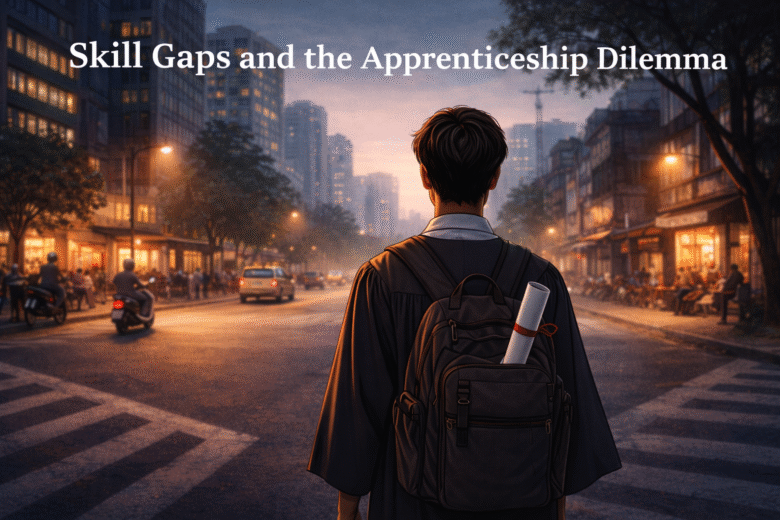
Instead, many graduates step out of college into a strange, foggy space where job portals blink “under review,” employers talk about “skills,” and time stretches longer than expected.
The moment after college, nobody prepares you for
Graduation ceremonies are noisy. Life after them is quiet.
That silence can be unsettling. Young workers find themselves overqualified for some roles, under-experienced for others, and unsure which missing ingredient they are supposed to acquire next. Every rejection sounds vaguely instructional: come back when you have experience.
But experience, inconveniently, does not grow in isolation.
This is where the idea of “skill gaps” enters public conversation. It sounds technical, almost neutral. Yet what it often hides is a much simpler truth: many young people are not failing to learn; they are failing to enter.
Workplaces expect readiness. Colleges deliver preparation. The space between the two has widened, and young workers are expected to leap it alone.
When “upskilling” becomes a convenient excuse
There is an entire industry now built around telling young people to upskill. Learn another tool. Take another course. Add one more certification. The advice is everywhere—well-meaning, relentless, exhausting.
What it rarely asks is where these skills are meant to be used.
Skills do not harden in theory. They mature through repetition, feedback, mistakes, and responsibility. Earlier systems understood this. Training happened inside workplaces. Beginners were allowed to be beginners.
Today, many employers want certainty without investment. They want productivity without patience. Training is treated as a cost rather than a contribution. Calling this a “skill gap” conveniently shifts attention away from that choice.
Apprenticeships: promised loudly, delivered quietly
Apprenticeships are often presented as the answer. And on paper, they are a good one.
They combine earning with learning. They soften the jump from education to employment. They recognise that growth takes time. Yet in reality, apprenticeships have become scarce, unevenly distributed, and surprisingly difficult to access.
Interest has grown. Supply has not.
Small businesses—the ones most likely to train young workers patiently—often struggle with costs and paperwork. Larger organisations frequently redirect apprenticeship schemes toward existing staff rather than first-time entrants. The result is a funnel that narrows precisely where it should widen.
So apprenticeships exist, but not enough of them. They are discussed constantly, yet experienced by relatively few.

Why can college alone not carry the burden anymore
This is not an argument against education. Education still matters deeply. But it cannot be asked to do everything.
Colleges cannot fully simulate workplaces. They cannot predict every shift in industry. And they cannot replace the role of employers in shaping workers. When education systems operate separately from labour markets, students graduate fluent in theory but unfamiliar with context.
The problem isn’t that young workers are unprepared. It’s that preparation is happening without a handover.
The emotional cost nobody budgets for
Prolonged uncertainty changes people.
A few months without work can feel like rest. A year can feel like erosion. Confidence slips quietly. Motivation thins. Skills rust—not from laziness, but from disuse.
Mental health struggles often follow, not precede, this exclusion. Being repeatedly told you’re “almost ready” does something subtle to the way you see yourself. Over time, hesitation replaces ambition.
These costs don’t appear on balance sheets, but they accumulate nonetheless.
Other ways are possible—and already exist
It’s tempting to believe this struggle is unavoidable. That technology, competition, or global economics has made it permanent. But comparisons tell a different story.
Some countries treat apprenticeships as essential infrastructure, not optional add-ons. Employers are expected to participate. Governments share hiring risks. Training is recognised as part of economic health, not charity.
Young people in these systems don’t avoid effort. They’re simply not left to navigate transitions alone.
The difference isn’t motivation. Its design.
Rethinking the question we keep asking
Instead of repeatedly asking why young people lack skills, perhaps we should ask why systems lack pathways.
Why does training begin too early or too late, but rarely at the right moment? Why is the responsibility of transition placed almost entirely on individuals? Why do we celebrate education while quietly neglecting entry-level work?
These are uncomfortable questions. Which is probably why they’re asked so rarely.
Conclusion: fixing the space in between
The real crisis is not education. And it’s not youth ambition.
It’s the space in between.
Skill Gaps and the Apprenticeship Dilemma is ultimately a story about broken transitions—about what happens when learning ends but working doesn’t quite begin. If we want young workers to stop struggling after college, we must rebuild that missing bridge with intention, support, and shared responsibility.
Advice alone won’t do it. Neither will blame.
What’s needed is something simpler—and harder: systems that remember how learning actually becomes work.
Author’s Note
This piece stayed with me because it echoes conversations I hear again and again—often quietly, sometimes reluctantly. Young people rarely say they’re afraid of effort. They say they’re unsure where effort should go next. Writing helps me slow those moments down, listen carefully, and resist easy answers. I still believe words can make us notice what we’ve learned to overlook. And once noticed, things begin to shift.
G.C., Ecosociosphere contributor.
References and Further Reading
- New Report Reveals the Struggle Worldwide to Prepare Young People for Work (23 Sept 2025)
- Apprenticeship and Youth Unemployment (IZA Discussion Paper)
- Can Apprenticeships Help Reduce Youth Unemployment?
- Bridging India’s Skill Gap (Drishti IAS)
- How Embracing Apprenticeships Can Shape India’s Youth Employment (UNDP India)
- From Education to Employability: Why Youth Skills Are the Missing Link (FE News, 1 day ago)
- Youth Unemployment and Vocational Training (World Bank)
- Global Apprenticeship Network (Wikipedia)
- Apprenticeship in Germany (Wikipedia)