
Fun fact: some of the largest structures ever seen in the universe are completely invisible to human eyes—and we only notice them because space “whispers” in radio waves.
Astronomers have now detected the most powerful and most distant “odd radio circle” ever observed, and the discovery feels less like ticking off another cosmic object and more like stumbling into a mystery that refuses to behave. These enormous, ghostly rings—floating around galaxies billions of light-years away—are forcing scientists to admit something uncomfortable: we may be very good at mapping the universe, but we still don’t fully understand how it screams, echoes, and remembers its own violence.
This newly discovered odd radio circle is bigger, brighter, and farther than anything of its kind seen before. And its existence quietly challenges how confident we are about what galaxies do when they erupt, collide, or breathe out colossal amounts of energy.
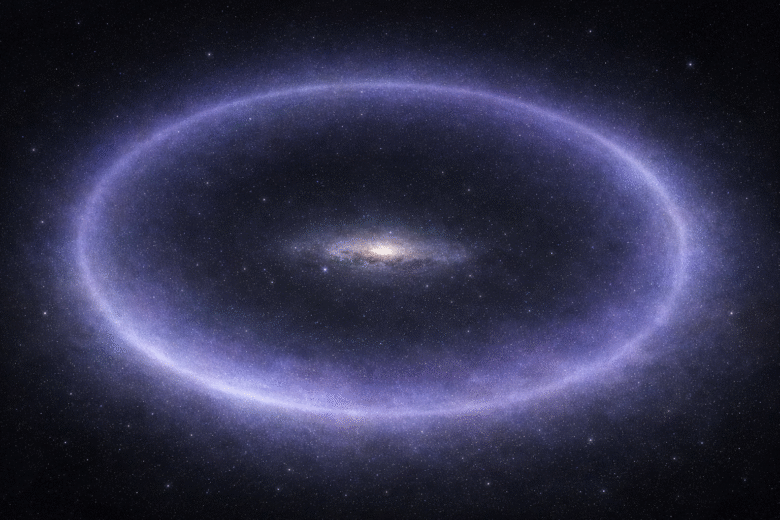
Odd radio circles, often shortened to ORCs (odd radio circles), are cosmic structures that look deceptively simple: enormous rings of radio emission surrounding distant galaxies. No stars. No glowing gas clouds. No dramatic colours in visible light. Just vast, faint circles that only appear when radio telescopes listen carefully to the universe’s static.
They were first noticed only a few years ago, which in astronomy terms means we discovered them yesterday. Since then, only a small number have been confirmed. That alone should tell us something. If these objects were easy to explain, we would already have done so.
The latest odd radio circle pushes the puzzle further. It sits more than seven billion light-years away, meaning the signal reaching us today began its journey when Earth itself was still young and unrecognisable. Even more striking, this object is not just large—it is exceptionally powerful, radiating far more radio energy than earlier examples.
To grasp the scale, imagine a ring of energy nearly a million light-years across. Our entire Milky Way galaxy would fit comfortably inside it. This is not a leftover ripple from a small event. Whatever caused this structure involved galaxy-scale forces acting over immense periods of time.
One of the most unsettling aspects of odd radio circles is what they don’t show. They lack the usual fingerprints astronomers rely on. There is no obvious explosion debris. No clear jets shooting from black holes. No matching glow in X-ray or visible light images. It is as if the universe performed an act of enormous violence and then erased most of the evidence—leaving only a circular echo behind.
Scientists are now debating several possibilities. One idea suggests that these rings form when a galaxy undergoes an intense phase of activity, perhaps driven by its central supermassive black hole. During such phases, galaxies can expel vast “superwinds”—streams of charged particles moving at incredible speeds. Over time, these winds may crash into surrounding space, creating spherical shockwaves that appear as rings when seen from Earth.
Another idea is more dramatic: the rings could be relics of rare, colossal outbursts—events far more energetic than typical galaxy activity, but not quite fitting any known category. The problem is that none of these explanations fully accounts for the shapes, symmetry, and sheer scale involved.
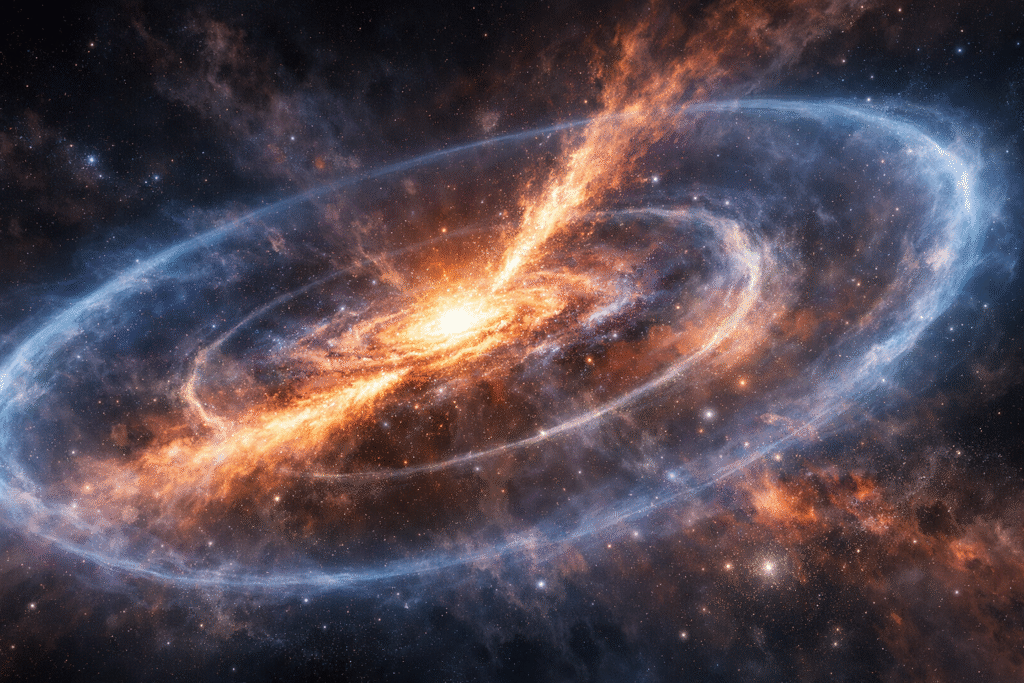
This newest discovery complicates matters further because it appears to involve more than one ring, overlapping or interacting in ways that current models struggle to reproduce. That detail matters. Nature rarely produces perfect circles by accident. When it does, it usually means geometry, physics, and timing aligned with unsettling precision.
There is also a quiet philosophical discomfort in this discovery. Astronomy has spent decades refining its tools, building more sensitive telescopes, and collecting petabytes of data. Yet phenomena like odd radio circles remind us that new instruments do not automatically bring new understanding. Sometimes they simply reveal how incomplete our mental models still are.
The role of citizen scientists in identifying these structures adds another layer to the story. Trained volunteers scanning vast datasets were among the first to flag this strange ring. In an era where algorithms dominate discovery, this is a reminder that human curiosity still matters—especially when patterns are subtle and expectations can blind even the smartest software.
Odd radio circles also force us to rethink how galaxies interact with their environments. We often imagine galaxies as islands, quietly rotating in space. But these rings suggest something more violent and expansive: galaxies that shape space far beyond their visible edges, imprinting their histories onto the cosmic medium itself.
There is a temptation to label odd radio circles as exotic oddities—interesting, but ultimately niche. That would be a mistake. History shows that unexplained phenomena often turn out to be doorways rather than dead ends. Pulsars, quasars, and cosmic microwave background radiation were once baffling curiosities too. Each eventually reshaped our understanding of the universe.
What makes odd radio circles especially compelling is that they don’t announce themselves with spectacle. No dazzling images. No instant public awe. They are quiet, patient structures that demand attention rather than demand admiration. And perhaps that is why they matter.
They suggest that the universe has been conducting conversations in radio waves for billions of years, and we have only just started listening properly.
Conclusion
The most powerful and distant odd radio circle yet discovered is not just a new entry in an astronomical catalogue. It is a reminder that the universe is still capable of surprising us in fundamental ways. These immense rings challenge tidy explanations and resist easy classification. They ask uncomfortable questions about how galaxies release energy, how space absorbs violence, and how much of cosmic history remains invisible.
As radio telescopes grow more sensitive and surveys expand, we will likely find many more of these circles. Each new detection will sharpen the mystery—or deepen it. Either way, odd radio circles are teaching us something essential: understanding the universe is not about filling in gaps, but about learning to live with better questions.
And perhaps that is the most honest kind of science.
Author’s Note
This story stayed with me because odd radio circles feel like humility written across the sky. They remind us that knowledge is not a finished building, but a construction site—messy, uncertain, and alive. Writing about them felt necessary, not to solve the mystery, but to honour the act of noticing it.
G.C., Ecosociosphere contributor.