

Fun fact: Every single day, Earth quietly produces bursts of gamma radiation powerful enough to rival events we usually associate with exploding stars—yet most of us will live our entire lives never knowing they exist.
That hidden drama is the heart of “When Lightning Turns Radioactive: Earth’s Gamma Secret.” The idea sounds like science fiction, but it is very real. High above thunderclouds, in the brief blink of a millisecond, our planet fires off something called a TGF (terrestrial gamma-ray flash)—a pulse of radiation so energetic that space telescopes first mistook it for signals from deep space.
This is not a story about distant galaxies. It is about storms over our own heads, about lightning that does more than light up the sky, and about how little we still understand the atmosphere we breathe through every day.
The day Earth surprised space scientists
For decades, gamma rays were considered the language of violent cosmic events—supernova explosions, collapsing stars, and black holes. Earth, we assumed, was far too tame for such theatrics. That belief cracked in the 1990s when satellites designed to watch the universe accidentally caught Earth misbehaving.
Instruments aboard spacecraft detected sudden gamma-ray bursts… coming from below.
At first, scientists suspected errors. Then patterns emerged. These flashes were short, intense, and closely linked to thunderstorms. Earth, it turned out, was producing its own gamma radiation during lightning storms. The phenomenon was eventually named TGF, or terrestrial gamma-ray flash.
The shock was not just that these flashes existed, but how powerful they were. A TGF can reach energy levels comparable to those found near cosmic explosions, even if only for a tiny fraction of a second. It was a reminder that the line between “space physics” and “weather” is thinner than we like to think.
What exactly is a terrestrial gamma-ray flash?
A TGF is an extremely brief burst of gamma radiation generated in Earth’s atmosphere during powerful thunderstorms. These flashes last anywhere from a few tenths of a millisecond to a few milliseconds—far too fast for human senses.
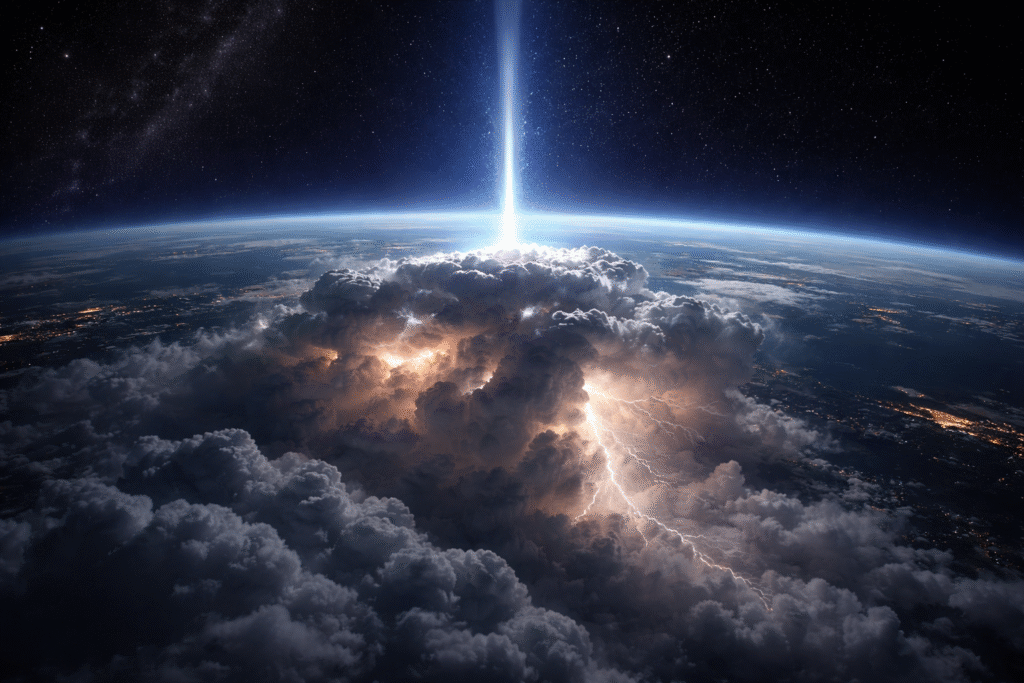
They are often described as “dark lightning.” Unlike normal lightning, they produce no visible flash. Instead, they release high-energy radiation that shoots upward toward space, where satellites detect it.
What makes a TGF unsettling is its intensity. Gamma rays represent the universe’s highest-energy form of light. They are capable of damaging cells, altering atoms, and triggering nuclear-scale interactions. We normally think of them as a hazard in hospitals, nuclear accidents, or outer space—not something born in a rain cloud.
Yet there they are, firing silently above tropical storms, mostly unnoticed.

How thunderstorms become particle accelerators
Inside a thundercloud, chaos reigns. Ice particles collide, electric charges separate, and massive electric fields build up. Under the right conditions, these electric fields become strong enough to do something extraordinary: they accelerate electrons to near the speed of light.
When these runaway electrons slam into air molecules, they slow down abruptly and release energy in the form of gamma rays. This process, known as braking radiation (bremsstrahlung radiation), lies at the core of the TGF.
In simple terms, a thunderstorm briefly turns into a natural particle accelerator.
Some scientists compare it to a miniature version of the machines humans build to study atomic physics, except this one appears spontaneously in the sky and shuts down in milliseconds. It is humbling—and slightly unsettling—to realize that nature can casually replicate processes that take billions of rupees and decades of engineering to recreate on the ground.
Antimatter in the sky? Yes, really
If gamma rays alone were not strange enough, TGFs sometimes produce positrons —the antimatter counterparts of electrons. These particles can escape the atmosphere and travel along Earth’s magnetic field lines before returning elsewhere, like cosmic boomerangs.
This means that during some thunderstorms, Earth briefly manufactures antimatter.
Not enough to threaten the planet, of course. But enough to force a rethink of how energetic and complex our atmosphere really is. Thunderstorms are not just electrical events. They are nuclear-scale laboratories unfolding above villages, cities, farms, and forests.
How common are these flashes?
Here is the part that should make us pause: TGFs are not rare.
Early on, scientists thought they were unusual curiosities. Improved instruments have since revealed that hundreds of TGFs may occur globally every day. Most go undetected simply because satellites must be in the right place at the right time to see them.
They appear most often over tropical regions, where tall, powerful thunderstorms dominate the climate. That includes parts of South Asia, Africa, and South America—regions already vulnerable to climate stress and extreme weather.
As storms grow taller and more energetic in a warming world, scientists are quietly asking an uncomfortable question: could TGFs become more frequent or more intense?
Should we be worried?
The word “gamma” understandably triggers fear. Radiation is serious business. But for people on the ground, TGFs are not considered a direct threat. The atmosphere absorbs most of the radiation before it can reach us.
However, there are ongoing concerns about aircraft flying close to storm systems and about astronauts in low Earth orbit. Even if the risks are small, they are real enough to warrant careful study.
More broadly, TGFs matter because they expose how incomplete our understanding of the atmosphere still is. Weather is not just about rain and temperature. It is entangled with high-energy physics, space weather, and planetary safety in ways we are only beginning to grasp.
Why this matters beyond curiosity
It is tempting to dismiss TGFs as exotic trivia. But that would be a mistake.
They challenge our assumptions about Earth as a “quiet” planet. They blur the boundary between Earth science and astrophysics. They remind us that nature does not compartmentalize knowledge the way textbooks do.
In an age where climate change is amplifying storms, heat, and instability, understanding extreme atmospheric processes is no longer optional. The sky is not just a backdrop to human life. It is an active, volatile system capable of surprises that ripple far beyond a single thunderclap.
TGFs are not just about lightning. They are about humility—about accepting that the world we live in still holds forces we barely comprehend.
Conclusion: listening to the sky
The next time a storm rolls in and lightning splits the sky, remember this: something invisible and astonishing may be happening above the clouds. Earth might be firing gamma rays into space, briefly glowing in a language usually spoken by stars.
TGFs remind us that science is not only about distant planets and abstract equations. Sometimes, the universe whispers its secrets during a thunderstorm over our own homes.
If we want to understand the future of our climate, our atmosphere, and our planet’s safety, we must learn to listen—to the rain, to the lightning, and to the silent flashes of gamma energy hiding in plain sight.
Author’s Note
I wrote this because teaching science often means simplifying the world, but learning science means realizing how wild it truly is. The idea that a thunderstorm can briefly rival cosmic violence stayed with me long after I first encountered it. Writing, for me, is a way of slowing down and paying attention—to remind myself, and others, that curiosity is not a luxury. It is how we stay awake in a world that still has the power to astonish.
G.C., Ecosociosphere contributor.
References and Further Reading
- Terrestrial Gamma-Ray Flash Overview (Wikipedia)
- National Aeronautics and Space Administration Research on Gamma-Ray Flashes
- Fermi Gamma-ray Space Telescope Mission (operated by NASA for high-energy space observations)
- International Space Station Atmospheric Studies (a multinational space laboratory orbiting Earth)