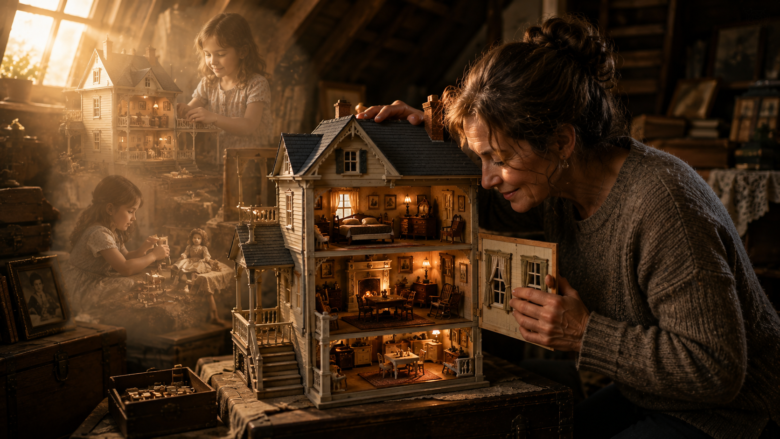
There is something strangely irresistible about things that are much smaller than they should be. Adults who rarely stop to admire a full-sized house can spend hours examining an intricately furnished dollhouse. Thousands gather to watch model trains wind through miniature mountains and tiny villages.
Videos of perfectly crafted miniature kitchens preparing meals no bigger than a coin attract millions of viewers. Even tiny replicas of ordinary objects—a pocket-sized bicycle, a miniature book, or a perfectly scaled café—often seem more captivating than the real thing.
This fascination is so widespread that it feels almost instinctive. Yet the question remains: why does shrinking something make it so appealing?
A miniature object changes more than its size—it changes the way our brain experiences it.
Part of the answer lies in how humans naturally explore the world. From infancy, we learn by reaching, holding, turning, and inspecting objects with our hands. Small objects invite exactly this kind of attention. Unlike a real building or a full-sized train, a miniature allows us to see the entire object at once.
Every window, staircase, rooftop, and tiny detail fits comfortably within our field of view. Instead of feeling overwhelmed by scale, our brain experiences something surprisingly satisfying—the feeling of understanding an entire world in a single glance.
Psychologists sometimes describe this as the pleasure of cognitive completeness. The real world is enormous and impossible to grasp all at once. Cities stretch beyond the horizon, railway networks disappear into the distance, and buildings hide countless unseen rooms.
Miniatures reduce that complexity without losing its recognizable form. Suddenly, a complicated world feels manageable.

When the world becomes smaller, it also becomes easier to understand.
Our fascination with miniature worlds is also remarkably ancient. Archaeologists have uncovered tiny clay houses, miniature animals, and carved human figures dating back thousands of years.
Ancient Egyptians placed miniature servants inside tombs. Japanese traditions transformed bonsai trees and miniature gardens into respected art forms. European dollhouses began as displays of craftsmanship before becoming educational toys.
Although these traditions developed independently, they reveal the same tendency. Humans have repeatedly recreated their world on a smaller scale, suggesting that this attraction runs much deeper than fashion or entertainment.
Miniatures also mirror the way our minds naturally think. Every day, we simplify reality into models that are easier to understand. We use maps instead of landscapes, diagrams instead of machines, and globes instead of planets.
A miniature is simply another kind of model. By reducing complexity without removing meaning, it allows us to focus on relationships instead of becoming overwhelmed by details.
Researchers studying perception have found that scaled-down environments encourage curiosity rather than caution. Walking through a real city demands attention to navigation, safety, and decisions.
Looking at a miniature city frees the brain from those demands. Instead of wondering where to go, we begin wondering how every tiny detail was created. Observation replaces survival, and curiosity becomes the dominant experience.
Another layer of this attraction may come from our instinct to care for small things. Psychologists have long known that humans respond strongly to what is known as the “baby schema”—features such as small size, rounded shapes, and delicate proportions that naturally trigger feelings of affection and protection.
While a dollhouse or model train is not alive, its reduced scale can evoke a similar emotional response. Small objects often feel precious, fragile, and worthy of careful attention.
Miniatures also awaken powerful memories. Many people first encountered tiny worlds through toys, dollhouses, construction blocks, or model vehicles that became part of elaborate childhood adventures. Long before we understood architecture or engineering, we were already creating entire worlds on the floor of our homes.
Years later, encountering a beautifully crafted miniature often reconnects us with those experiences. Neuroscientists believe nostalgia activates networks associated with memory, emotion, and reward.
A miniature village or railway station may resemble nothing we have personally experienced, yet it still feels familiar because it reminds us of a time when imagination transformed ordinary objects into entire worlds.
Sometimes we are not admiring the tiny object itself—we are remembering the much larger world we once imagined around it.

Building miniature worlds offers another kind of satisfaction. Whether someone constructs a model railway, paints tiny figurines, or assembles an architectural replica, they are creating a complete system where every element has its place. In everyday life, very little feels entirely under our control.
A miniature world offers the opposite experience. Within its carefully defined boundaries, everything makes sense because someone intentionally made it so. That quiet sense of mastery helps explain why hobbies involving miniatures are often described as deeply relaxing.
This ability to simplify complexity is also why professionals rely on miniatures. Architects study scale models before constructing buildings.
Filmmakers have long used miniature sets to create convincing scenes, while engineers and designers continue to build physical models because shrinking a system often makes its structure easier to understand.
Social media has simply given this ancient fascination a new stage. Videos featuring tiny cafés, miniature libraries, scaled-down cooking, and handcrafted villages attract millions of viewers across every age group. The technology may be modern, but the psychology is timeless.
Our attraction to miniatures ultimately reveals something important about human perception.
We do not love them simply because they are small. We love them because they make complexity approachable, awaken imagination, and briefly give us the comforting feeling that an entire world can fit within our understanding.
As the modern world grows larger and more complex, miniature worlds give us something increasingly rare—a feeling that everything can be seen, understood, and appreciated at once. They remind us that understanding does not always come from making things bigger.
Sometimes the surest way to appreciate the complexity of the world is to hold a smaller version of it in the palm of our hand.
Author’s Note
From ancient miniature figurines to today’s viral tiny-food videos, our fascination with small worlds has remained remarkably consistent. This article explores why reducing the scale of reality often makes it feel more meaningful, understandable, and emotionally engaging.
G.C., Ecosociosphere contributor.