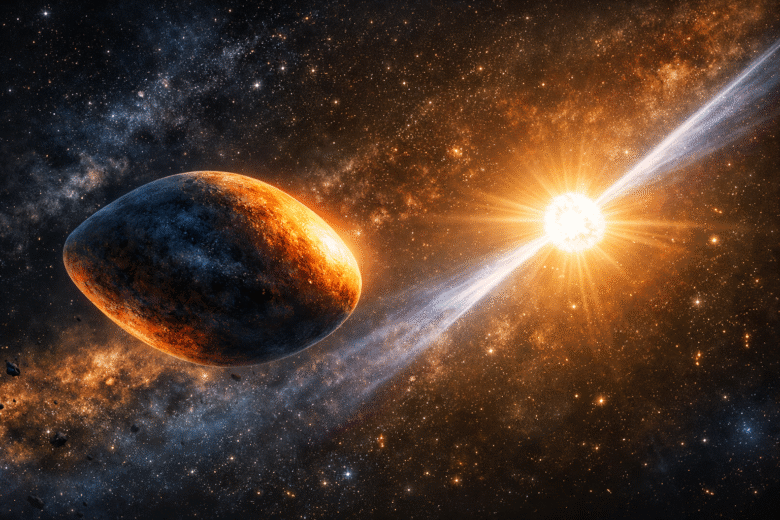
Fun fact: Not all planets are round—some are stretched so violently by gravity that they resemble lemons drifting through space.
That strange truth sits at the heart of A Lemon-Shaped Planet Is Rethinking What Worlds Can Be, a story that feels less like astronomy and more like a quiet insult to our assumptions. Somewhere far beyond our solar system, astronomers have found a planet so distorted, so chemically unusual, that it refuses to behave the way planets are “supposed to.” And it took the most powerful space telescope humans have ever built to notice just how odd it really is.
This is not just a story about a distant exoplanet. It is a story about how fragile our cosmic confidence is—and how quickly it crumbles when the universe decides to improvise.
When Gravity Stops Playing Fair
For generations, we have been taught a simple idea: planets are round. Gravity pulls matter inward evenly, smoothing worlds into spheres like cosmic marbles. It is neat. It is comforting. And it is mostly true.
Mostly.
The newly observed exoplanet—studied using the James Webb Space Telescope (JWST) (a next-generation space observatory designed to study the universe in infrared light)—breaks that rule. Instead of being round, it is stretched into an elongated, lemon-like shape. This deformation is not cosmetic. It is the direct result of brutal gravitational forces at work.
The planet orbits dangerously close to a pulsar—a rapidly spinning neutron star that packs more mass than the Sun into a body barely the size of a city. The pulsar’s gravity grips the planet so tightly that one side is constantly pulled outward, warping the entire world. The result is tidal distortion taken to an extreme, a reminder that space is not gentle just because it looks quiet.
This is not the gravity that gives us orbits and sunsets. This is gravity that reshapes worlds.
An Atmosphere That Shouldn’t Exist (But Does)
If the planet’s shape is unsettling, its atmosphere is downright rebellious.
Astronomers expected to find familiar gases—oxygen, nitrogen, water vapour, maybe methane. Instead, they found something far stranger: an atmosphere dominated by helium and carbon-based molecules, with noticeable absences where “normal” gases should be.
This matters more than it sounds.
Atmospheres tell stories. They reveal how planets form, how they evolve, and sometimes whether they can host life. Our existing models of planetary atmospheres are built on patterns—rules derived from thousands of observations. This planet ignores many of them.
Carbon-rich chemistry suggests extreme pressures and temperatures. In fact, scientists suspect that deep within the planet, carbon may be compressed into crystalline forms. Yes—this could be a world where diamonds form not as ornaments, but as geology.
It forces an uncomfortable question: how many planets have we misunderstood simply because they do not fit the template we designed?
Planets Around Pulsars: Survivors or Remnants?
Pulsars are violent objects. They are born from stellar explosions powerful enough to tear stars apart. Any planet found near one raises eyebrows immediately.
So how does a planet survive such an event?
One possibility is that this planet is not a survivor, but a leftover—perhaps the dense core of a star stripped bare by cosmic catastrophe. Another possibility is that it formed later, from debris pulled together by gravity in a system that had no right to stabilise.
Neither explanation sits comfortably within standard theories of planet formation.
That discomfort is valuable. Science advances not when observations agree with expectations, but when they force us to rewrite them.

Why This Discovery Matters to Earthbound Humans
It is tempting to treat this as a curiosity—an exotic footnote in space science. But that would miss the point.
This discovery highlights something deeper: the universe is far less tidy than our textbooks suggest. Worlds can be stretched, chemically skewed, and shaped by forces we rarely witness up close. Life, geology, and atmospheres are not universal recipes. They are local improvisations.
There is also a humbling message here for Earth.
We often speak about habitability as if it is binary—either a planet is Earth-like, or it is useless. But this lemon-shaped planet reminds us that diversity is the rule, not the exception. Earth is not the standard. It is an accident that worked.
And accidents, as history shows, can be powerful teachers.
The Real Achievement: Seeing the Unseeable
None of this would have been possible without the James Webb Space Telescope, a project led by the National Aeronautics and Space Administration (NASA) (a United States government agency responsible for space exploration and aerospace research).
What makes this discovery remarkable is not just what was found, but how it was found. Detecting the composition of an atmosphere on a distorted planet orbiting a pulsar would have been unimaginable a decade ago.
We are entering an era where we no longer just find planets—we interrogate them.
And some of them answer back with unsettling honesty.
Conclusion: The Universe Does Not Owe Us Familiarity
The lemon-shaped exoplanet is not dangerous to us. It will never threaten Earth. But it does something more unsettling: it challenges our sense of cosmic normalcy.
It tells us that planets do not need to be round, atmospheres do not need to follow rules, and formation stories do not need tidy beginnings. The universe is not designed to make sense to us. We are the ones struggling to keep up.
Perhaps that is the real lesson. Not that space is strange—but that our expectations are small.
The universe is wider than our comfort zone, and that is exactly why we should keep looking.
Author’s Note
This lemon-shaped planet lingers in the mind because it refuses symmetry, familiarity, and comfort. It exists under forces so extreme that even shape and chemistry surrender, reminding us that the universe is not obliged to make sense on our terms. Writing about it felt important because it exposes how small our definitions of “normal” truly are. In confronting such strange worlds, we are really confronting the limits of our own imagination.
G.C., Ecosociosphere contributor.
References and Further Reading
- NASA’s James Webb Telescope Discovery Report
- University of Chicago News: Lemon-Shaped Exoplanet Study
- Smithsonian Magazine – Unusual Exoplanet Atmospheres
- Nature Astronomy: Extreme Atmospheric Chemistry on a Pulsar-Orbiting Exoplanet
- European Space Agency: How the James Webb Space Telescope Studies Exoplanet Atmospheres