
Fun fact: during major global crises, meme creation often spikes faster than official news updates — sometimes within minutes of an event trending online.
That tells us something about our times. Before politicians speak, before news anchors adjust their ties, someone somewhere has already turned the moment into a meme. And that is exactly what The Memeification of Serious Issues is about — how young people convert heavy social realities into bite-sized jokes, and why that strange, uncomfortable laughter might be more important than we think.
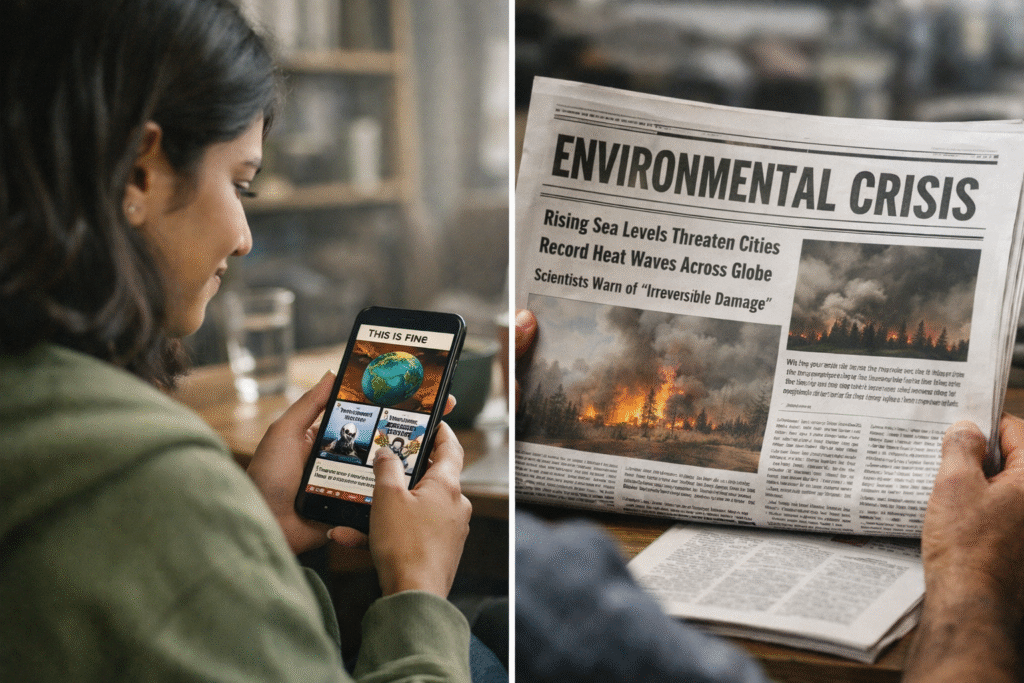
At first glance, it can look disrespectful. War becomes a joke format. Inflation becomes a punchline. Climate anxiety becomes a self-deprecating caption under a blurry sunset. Adults shake their heads and mutter, “This generation doesn’t take anything seriously.”
But what if they are taking it so seriously that comedy is the only way they can carry it?
When Humor Becomes Survival
Generation Z — broadly those born between the late 1990s and early 2010s — grew up inside a 24-hour news cycle. Terror attacks, financial crashes, pandemics, school shootings, climate disasters — all of it streamed live to their palms through smartphones. There is no “later” for them. Everything is now.
So when serious issues trend, memes trend faster.
Take climate change. Instead of only sharing graphs and policy discussions, young people circulate memes that say things like, “At least the apocalypse will cancel my student loans.” It’s absurd. It’s dark. It’s funny in a way that makes you slightly uncomfortable.
But underneath the humor is something raw: fear.
Memes become a pressure valve. They transform dread into something shareable. When you forward a meme about rising food prices, you are not ignoring inflation — you are admitting you feel it too. Laughter becomes a way of saying, “We’re in this mess together.”
The Language of the Internet Generation
Memes are not random jokes. They are a language.
A meme can compress an entire political debate into a single image and two lines of text. It can mock a corporate apology without naming the company. It can expose hypocrisy in seconds.
When a large technology platform like Meta — a multinational technology company that owns Facebook and Instagram — changes its algorithm, memes appear almost immediately, poking fun at “invisible reach” and “shadow bans.” When a global e-commerce giant like Amazon — a company that sells products online and operates large warehouses — faces criticism about working conditions, memes circulate about overworked delivery drivers and impossible deadlines.
The joke is not accidental. It is commentary.
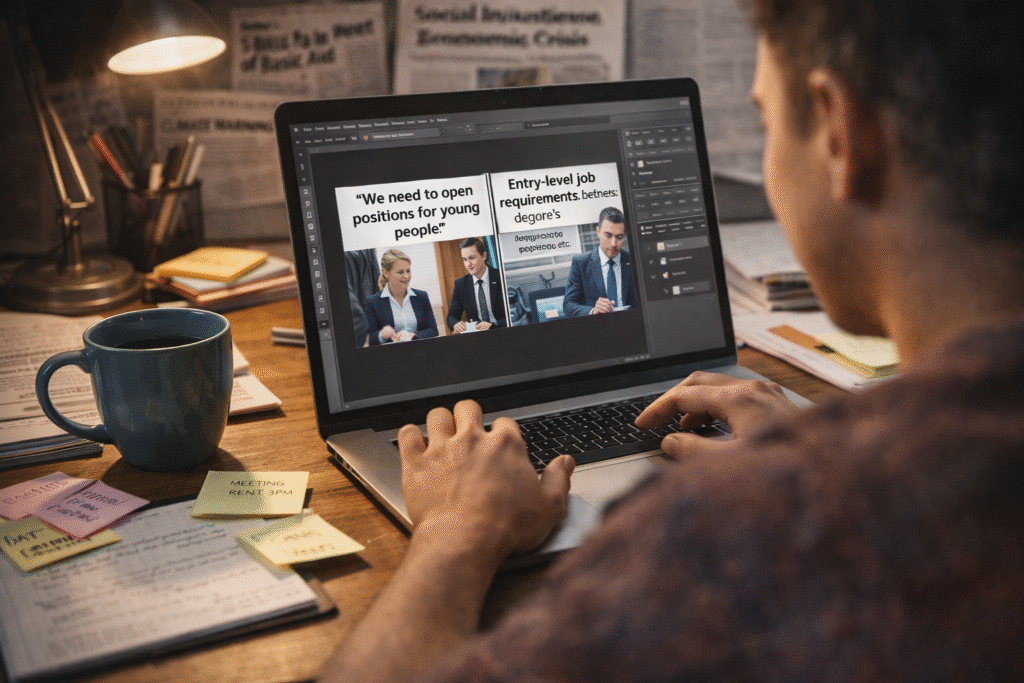
In countries like India, where youth unemployment and rising costs of living dominate dinner-table conversations, memes about job interviews and unrealistic experience requirements spread like wildfire. “Entry-level job: minimum five years’ experience.” It is funny because it is painfully true.
Memes do what opinion columns sometimes cannot: they travel fast, and they travel far.
Are We Trivializing Suffering?
Here is the uncomfortable question: does turning serious issues into memes make them less serious?
It can.
There is a risk that constant joking numbs us. When every crisis becomes a punchline, outrage can dissolve into apathy. The danger of the memeification of serious issues is that we might scroll, laugh, and move on.
But that is only half the story.
Historically, satire has always played a role in political and social critique. Newspapers once carried cartoons mocking kings and ministers. Comedians have long challenged power through humor. Memes are simply the digital-age version of that tradition.
The difference is speed and scale.
Today, a teenager in Jaipur can create a meme about fuel prices, and within hours, it can reach someone in Jakarta. The power structure is shaken not by formal speeches but by viral jokes.
Comedy becomes a democratizing force.
From Viral to Vital
One of the most interesting aspects of the memeification of serious issues is how it often leads to deeper engagement.
A meme about mental health might begin as a joke — “Me pretending to be fine in public” — but in the comments, people start sharing real struggles. What began as humor becomes community.
A meme about gender pay gaps may open the door to discussions about workplace policies. A meme about climate anxiety may lead someone to research sustainability movements.
Memes act like hooks. They pull people in who might otherwise avoid heavy topics.
Young people are not unaware of the seriousness. In fact, they are hyper-aware. They just prefer a different entry point.
The Emotional Mathematics of Memes
There is something deeply human about laughing at what scares us.
When the COVID-19 pandemic hit, memes about sourdough bread, online classes, and awkward video calls flooded timelines. The virus was real. The fear was real. The isolation was real. But humor helped people breathe.
In psychology, humor is often described as a coping mechanism. It allows us to confront something overwhelming without collapsing under its weight.
For Generation Z, memes are collective coping.
Instead of suffering silently, they convert anxiety into creativity. They remix headlines. They exaggerate political speeches. They turn personal struggles into universal jokes.
That act of creation is not laziness. It is resilience.
Why Older Generations Misread It
Many older observers interpret memes as flippant or shallow. But perhaps that says more about generational differences in communication styles.
Previous generations wrote letters to the editor. They attended town halls. They debated in drawing rooms.
Today’s youth debate in comment sections and caption threads.
A meme about rising tuition fees may not look like activism. But when it gathers millions of shares, it shapes public discourse. It signals collective frustration.
We cannot dismiss that simply because it is wrapped in humor.
The Thin Line Between Awareness and Exhaustion
Still, there is a line.
If every issue becomes meme material, seriousness can blur. Tragedy deserves sensitivity. Not every moment needs a punchline.
The challenge for the memeification of serious issues is balance. Humor should illuminate, not belittle. It should question power, not punch down at victims.
Young creators are increasingly aware of this responsibility. Many meme pages now include disclaimers, fundraising links, or informational slides alongside jokes.
Comedy and conscience are learning to coexist.
The Future of Social Commentary
We are entering an era where memes are not side content — they are central to how ideas spread.
Politicians hire social media teams to “be relatable.” Brands attempt to speak meme language. Corporations like Netflix — a global streaming service that provides movies and television shows online — use meme formats to promote content because they know attention lives there.
But authenticity matters. Young audiences can detect forced humor instantly.
The memeification of serious issues works because it feels organic. It comes from lived experience, not marketing strategy.
And perhaps that is the quiet revolution: commentary no longer belongs only to columnists and commentators. It belongs to anyone with a smartphone and a sharp sense of irony.
Conclusion: Laughing, But Not Looking Away
So is the memeification of serious issues dangerous? Sometimes.
Is it powerful? Absolutely.
Humor does not always mean indifference. Often, it means involvement. It means someone cared enough to react.
In a world overloaded with crisis, memes may be the emotional shorthand that keeps young people engaged rather than overwhelmed. They are not replacing serious conversation — they are reframing it.
The next time you see a meme about inflation, climate change, or mental health, pause before dismissing it as “kids being silly.” It might be social commentary disguised as comedy.
And maybe — just maybe — laughter is not the opposite of seriousness. It is the bridge that allows us to face it.
Author’s Note
I wrote this because I keep seeing students laugh at things that would have terrified my generation. At first, I worried. Then I listened. Beneath the jokes, I heard fatigue, anger, hope. Humour was not an escape — it was translation. Writing about this felt necessary. Not to defend memes, but to understand them. Because if we want to reach young minds, we must learn the language they are already speaking.
G.C., Ecosociosphere contributor.